macrophages tagged posts

New insight into the immune signals driving inflammation in multiple sclerosis

New insight into the immune signals driving inflammation in multiple sclerosis
Representative confocal microscopy image of a cross-section of the whole spinal column of an EAE animal co-transferred with control (red) and Tgfbr1-KO (green) cells. Credit: de la Rosa, Kendirli et al

Multiple sclerosis (MS) is a chronic neurological disease characterized by nerve damage and consequent impairments in vision, movement, balance and mental function. In MS, the immune system mistakenly starts attacking myelin, the protective sheath that surrounds axons (i.e., nerve fibers) in the brain, spinal cord and optic nerves.

Macrophages, immune cells responsible for detecting damaged cells, germs or other debris in the central nervous system (CNS) and eliminating them, have been found to play a key role in MS...

Read More
First breathing ‘lung-on-chip’ developed using genetically identical cells

lung
Credit: Pixabay/CC0 Public Domain

Researchers at the Francis Crick Institute and AlveoliX have developed the first human lung-on-chip model using stem cells taken from only one person. These chips simulate breathing motions and lung disease in an individual, holding promise for testing treatments for infections like tuberculosis (TB) and delivering personalized medicine.

The research is published in the journal Science Advances.

Air sacs in the lungs called alveoli are the essential site of gas exchange and also an important barrier against inhaled viruses and bacteria that cause respiratory diseases like flu or TB.

Researchers have been working to recreate the battle between human cells and bacteria in the lab by building a lung-on-a-chip: small units of human lung on a plast...

Read More

Rebalancing the Gut: How AI Solved a 25-Year Crohn’s Disease Mystery

Graphic of macrophages
Electron micrographs show how macrophages expressing girdin neutralize pathogens by fusing phagosomes (P) with the cell’s lysosomes (L) to form phagolysosomes (PL), compartments where pathogens and cellular debris are broken down (left). This process is crucial for maintaining cellular homeostasis. In the absence of girdin, this fusion fails, allowing pathogens to evade degradation and escape neutralization (right). (UC San Diego Health Sciences)

AI uncovers how a severed bond between two gut proteins sparks Crohn’s disease, and how restoring it could heal inflammation. UC San Diego researchers combined artificial intelligence with molecular biology to unravel how immune cells in the gut decide between inflammation and healing, a process gone awry in Crohn’s disease...

Read More

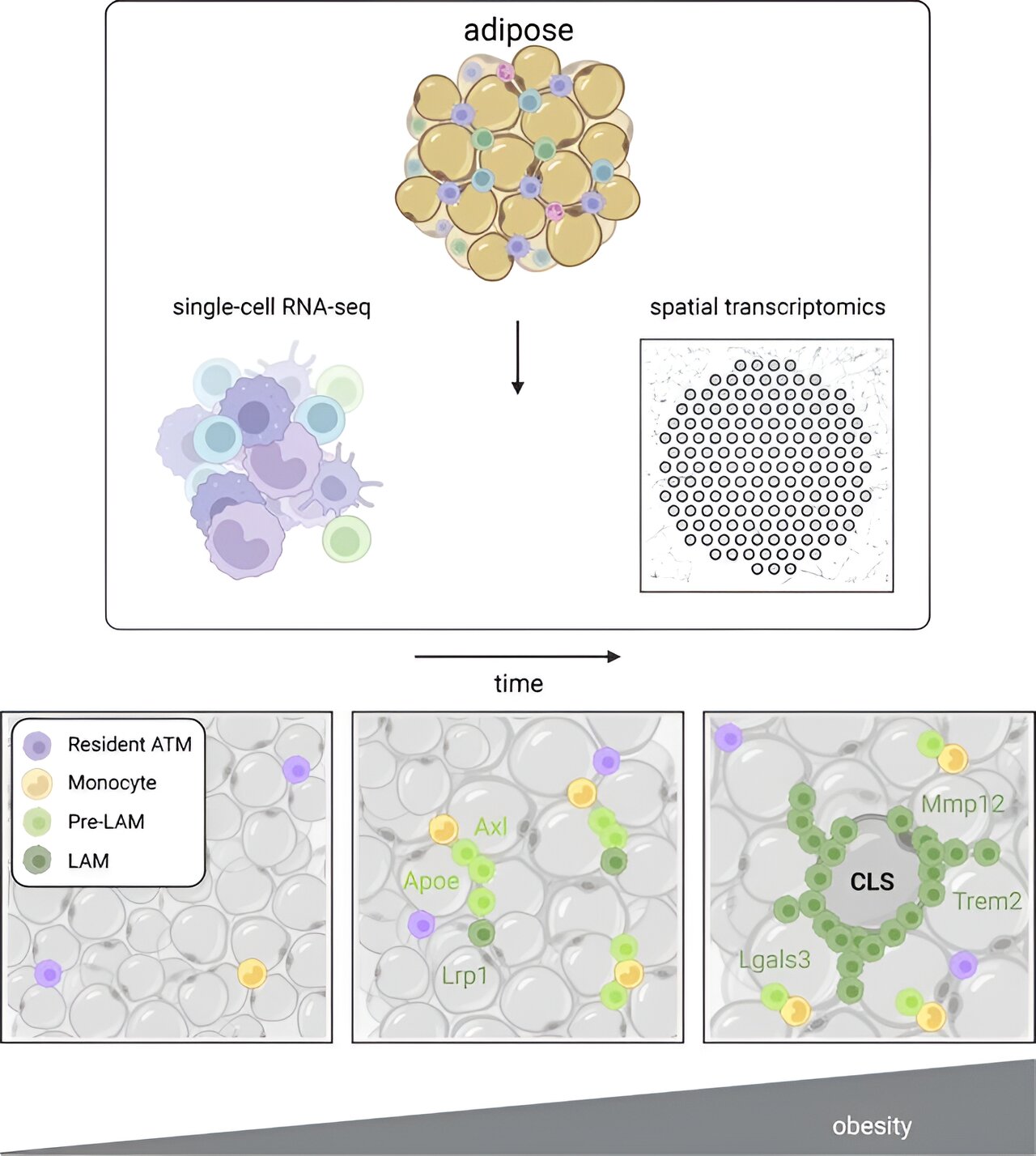
Obesity leads to a Complex Inflammatory Response inside Fat Tissue, study finds

Obesity leads to a complex inflammatory response inside fat tissue
Credit: JCI Insight (2023). DOI: 10.1172/jci.insight.171701

Fat tissue, for as much as it’s been vilified, is an incredibly complex and essential bodily organ involved in energy storage and hormone production, among other functions. Yet, modern lifestyles have led to a worldwide epidemic of obesity, and a corresponding increase in related conditions like type 2 diabetes and cardiovascular disease.

Researchers are attempting to uncover the basics of how fat tissue is structured and, specifically, inflammation associated with obesity, in the hopes of unlocking the connection between the accumulation of fat and poor health outcomes.

A new study from Lindsey Muir, Ph.D., Ph.D...

Read More