
macrophages tagged posts

Saturated Fat ‘Short-Circuits’ Immune Cells to Trigger Inflammation

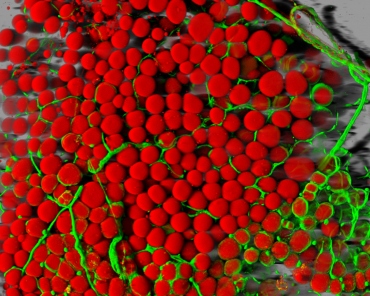
A mouse's fat cells are shown surrounded by a network of blood vessels.

A mouse’s fat cells (red) are shown surrounded by a network of blood vessels (green). Source: Daniela Malide, National Heart, Lung, and Blood Institute, National Institutes of Health

UC SF scientists have found a surprising new avenue for potential therapies to reduce risk of type 2 diabetes and other metabolic disorders associated with chronic tissue inflammation in obesity. Inflammation in obesity may be caused, at least in part, by a completely different mechanism from the one that controls normal immune responses. The research shows saturated fats “short-circuit” both mouse and human immune cells, producing an inappropriate inflammatory response as a consequence...

Read More

Impact of High-Fat Diet on Red Blood Cells may cause Cardiovascular Disease

MCP-1 released by smooth muscle and endothelial cells promotes the recruitment of monocytes and macrophages to the subendothelial cell layer. Deposition of lipids within these monocytes and macrophages then leads to development of atherosclerotic lesions.

MCP-1 released by smooth muscle and endothelial cells promotes the recruitment of monocytes and macrophages to the subendothelial cell layer. Deposition of lipids within these monocytes and macrophages then leads to development of atherosclerotic lesions.

This is one of the 1st studies to demonstrate the effect of red blood cells on the disease and could also affect the way patients with other health conditions, like cancer, who are prone to developing cardiovascular issues, are diagnosed and treated. “White blood cells play a key role in fueling adipose tissue (fat) inflammation and insulin resistance in obesity and also promote the clogging of arteries, or atherosclerosis, setting the stage for heart attack and stroke...

Read More

Smart Immune Cells teach Neurons damaged by Parkinson’s to Heal themselves

Smart Immune Cells teach Neurons damaged by Parkinson's to Heal themselves

Smart Immune Cells teach Neurons damaged by Parkinson’s to Heal themselves

As a potential treatment for Parkinson’s disease, scientists have created smarter immune cells that produce and deliver a healing protein to the brain while also teaching neurons to begin making the protein for themselves.

The researchers, led by A/Prof Elena Batrakova at UNC Eshelman School of Pharmacy’s Center for Nanotechnology in Drug Delivery, genetically modified macrophages to produce glial cell-derived neurotrophic factor, or GDNF, and deliver it to the brain. Glial cells provide support and protection for nerve cells throughout the brain and body, and GDNF can heal and stimulate the growth of damaged neurons.

“Currently, there are no treatments that can halt or reverse the course of Parkinson’s disease...

Read More

“We know from previous research that macrophages are versatile, and signals at the injury site can stimulate repair or destruction–or confusingly, both,” said John Gensel Ph.D., Assistant Professor of Physiology in the Spinal Cord and Brain Injury Research Center at the University of Kentucky. “But the mechanisms through which these signals stimulate the good and/or bad functions in macrophages are not known. So the next big question to answer in the efforts to understand and treat SCI was, ‘Why?'”

Gensel and Popovich looked at more than 50 animals with spinal cord injury to try to identify which macrophage receptors promoted neuronal repair and which directed the destructive process...

Read More
