
magnetic reconnection tagged posts

Seeing Double: NASA Missions measure Solar Flare from 2 Spots in Space

During a December 2013 solar flare, three NASA missions observed a current sheet form -- a strong clue for explaining what initiates the flares. This animation shows four views of the flare from NASA's Solar Dynamics Observatory, NASA's Solar and Terrestrial Relations Observatory, and JAXA/NASA's Hinode, allowing scientists to make unprecedented measurements of its characteristics. The current sheet is a long, thin structure, especially visible in the views on the left. Those two animations depict light emitted by material with higher temperatures, so they better show the extremely hot current sheet. Credit: NASA/JAXA/SDO/STEREO/Hinode (courtesy Zhu, et al.)

During a December 2013 solar flare, three NASA missions observed a current sheet form — a strong clue for explaining what initiates the flares. This animation shows four views of the flare from NASA’s Solar Dynamics Observatory, NASA’s Solar and Terrestrial Relations Observatory, and JAXA/NASA’s Hinode, allowing scientists to make unprecedented measurements of its characteristics. The current sheet is a long, thin structure, especially visible in the views on the left. Those two animations depict light emitted by material with higher temperatures, so they better show the extremely hot current sheet. Credit: NASA/JAXA/SDO/STEREO/Hinode (courtesy Zhu, et al.)

Solar flares are intense bursts of light from the sun...

Read More
MMS Mission delivers promising Initial Results

NASA's MMS delivers promising initial results

The four identical spacecraft of NASA’s Magnetospheric Multiscale, or MMS, mission (one of which is illustrated here) fly through the boundaries of Earth’s magnetic field to study an explosive process of magnetic reconnection. Thought to be the driver behind everything from solar flares to aurora, magnetic reconnection creates a sudden reconfiguration of magnetic fields, releasing huge amounts of energy in the process. Credit: NASA’s Goddard Space Flight Center

Just under four months into the science phase of the mission, NASA’s Magnetospheric Multiscale, or MMS, is delivering promising early results on magnetic reconnection—a magnetic explosion that’s related to everything from the northern lights to solar flares...

Read More

1st direct evidence for Explosive releases of Energy in Saturn’s Magnetic Bubble using data from Cassini

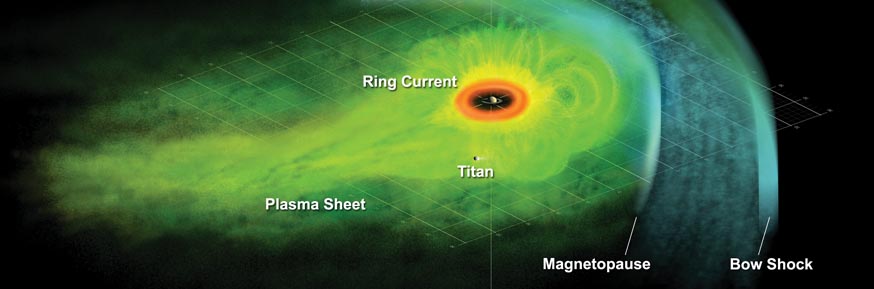
An artist’s concept of Saturn’s Magnetosphere based on data from the Cassini spacecraft. Image credit: NASA/JPL/JHUAPL

An artist’s concept of Saturn’s magnetosphere based on data from the Cassini spacecraft. Image credit: NASA/JPL/JHUAPL

These “explosions” are produced in a process known as magnetic reconnection, something well studied at Earth and is an important part of Space Weather, involved in energising the radiation belts and producing displays of the Northern lights. Space Physicists led by Lancaster University used data to show that Cassini had passed through the region at Saturn where magnetic reconnection was occurring, which has never before been observed.

One of the mysteries this gives us clues to answering is how Saturn’s magnetic bubble, known as its magnetosphere, gets rid of gas from Saturn’s tiny icy moon Enceladus...

Read More
