
massive black hole tagged posts

When Galaxies Collide: Models suggest galactic collisions can starve massive black holes

Eight dark squares, each with a chaotic orange shape
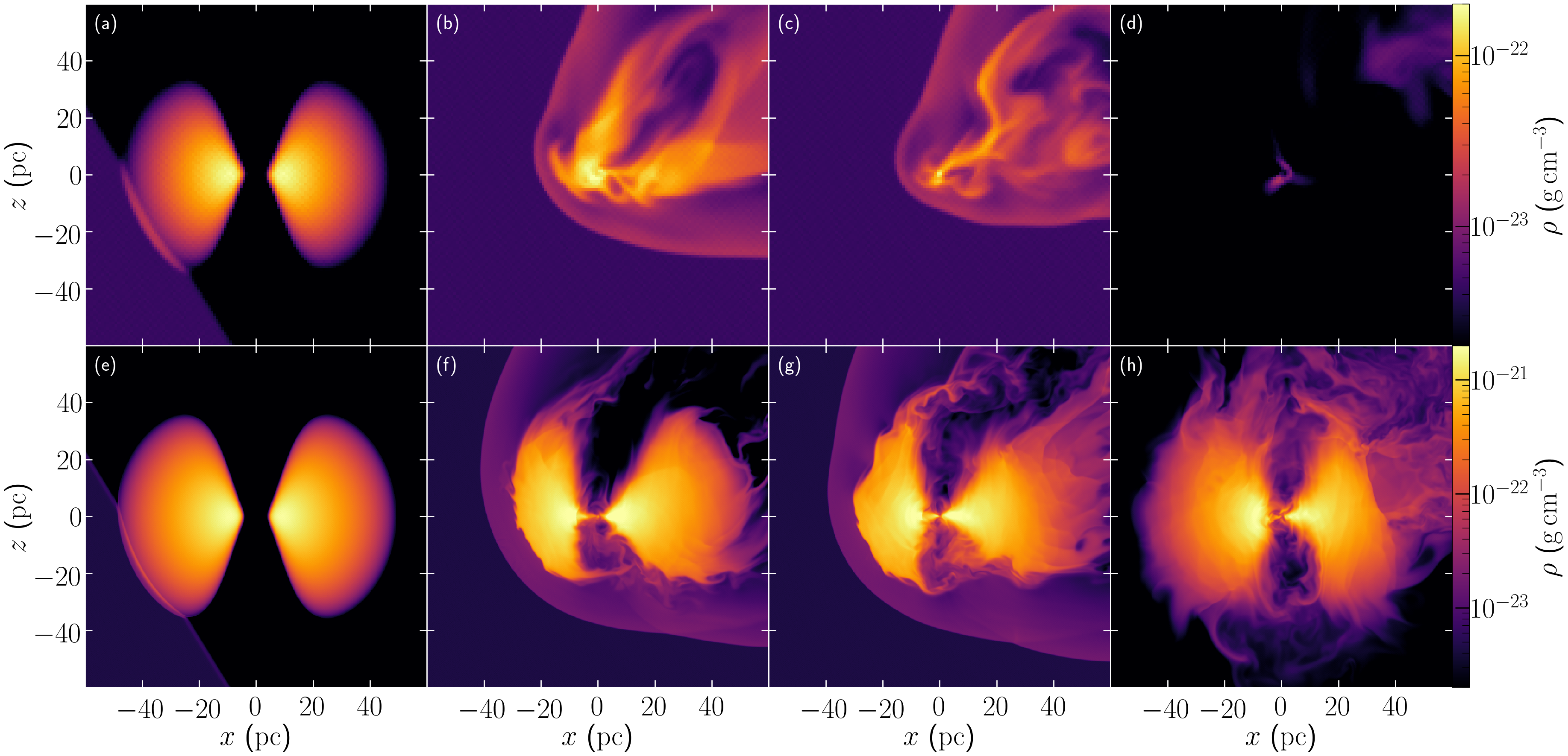
Galaxies collide. Visualizations of the dynamic model simulating two different scenarios. The top row shows a collision reducing core activity, the bottom row shows a collision increasing it. © 2021 Miki et al.

It was previously thought that collisions between galaxies would necessarily add to the activity of the massive black holes at their centers. However, researchers have performed the most accurate simulations of a range of collision scenarios and have found that some collisions can reduce the activity of their central black holes. The reason is that certain head-on collisions may in fact clear the galactic nuclei of the matter which would otherwise fuel the black holes contained within.

When you think about gargantuan phenomena such as the collision of galaxies, it might be t...

Read More
New Model explains what we see when a Massive Black Hole Devours a Star

Illustration of emissions from a tidal disruption event shows in cross section what happens when the material from a disrupted star is devoured by a black hole. The material forms an accretion disk, which heats up and emits vast amounts of light and radiation. The emissions we are able to see from Earth depend on our viewing angle with respect to the orientation of the black hole. Credit: Illustration by Jane Lixin Dai

Illustration of emissions from a tidal disruption event shows in cross section what happens when the material from a disrupted star is devoured by a black hole. The material forms an accretion disk, which heats up and emits vast amounts of light and radiation. The emissions we are able to see from Earth depend on our viewing angle with respect to the orientation of the black hole. Credit: Illustration by Jane Lixin Dai

A star that wanders too close to the supermassive black hole in the center of its galaxy will be torn apart by the black hole’s gravity in a violent cataclysm called a tidal disruption event (TDE), producing a bright flare of radiation...

Read More

Supermassive Black Holes control Star Formation in large galaxies

centaurus-a-410.jpg

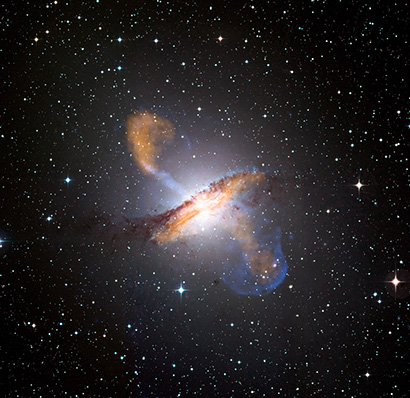
The power of a supermassive black hole is seen in this image of Centaurus A, one of the active galactic nuclei closest to Earth. The image combines data from several telescopes at different wavelengths, showing jets and lobes powered by the supermassive black hole at the center of the galaxy. Image credit: ESO/WFI (Optical); MPIfR/ESO/APEX/A.Weiss et al. (Submillimetre); NASA/CXC/CfA/R.Kraft et al. (X-ray)

Young galaxies blaze with bright new stars forming at a rapid rate, but star formation eventually shuts down as a galaxy evolves. A new study shows that the mass of the black hole in the center of the galaxy determines how soon this “quenching” of star formation occurs...

Read More
