
metasurface tagged posts

Ultrathin display technology shows dozens of images hidden in a single screen

Ultra-thin display technology shows dozens of images hidden in a single screen
Schematic of a spin- and wavelength-multiplexed metahologram. This hologram encodes multiple holographic images using a single-cell metasurface, where distinct images appear on the same image plane based on the incident spin states and operating wavelengths. Credit: Advanced Science (2025). DOI: 10.1002/advs.202504634

From smartphones and TVs to credit cards, technologies that manipulate light are deeply embedded in our daily lives, many of which are based on holography. However, conventional holographic technologies have faced limitations, particularly in displaying multiple images on a single screen and in maintaining high-resolution image quality.

Recently, a research team led by Professor Junsuk Rho at POSTECH (Pohang University of Science and Technology) has developed a groun...

Read More
Researchers use Ultrasound Waves to Move Objects Hands-Free

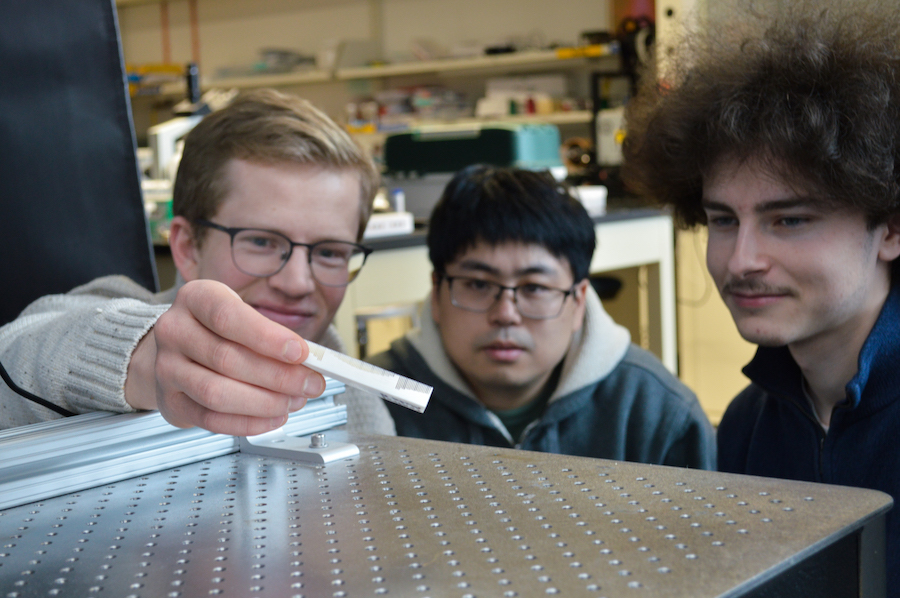
CSE students Matt Stein, Yujie Luo, and Sam Keller
University of Minnesota Twin Cities researchers have discovered a new method to move objects using ultrasound waves, opening the door for using contactless manipulation in industries such as robotics and manufacturing. In the above image, University of Minnesota students Matthew Stein, Yujie Luo, and Sam Keller interact with an object that has a metamaterial surface. Photo by Olivia Hultgren.

Contactless manipulation method could be used in industries such as robotics and manufacturing,where devices wouldn’t need a built-in power source in order to move.

University of Minnesota Twin Cities researchers have discovered a new method to move objects using ultrasound waves. The study is published in Nature Communications, a peer-reviewed, open-access scientific journal.

While it’s bee...

Read More

Through the Quantum Looking Glass

Green laser light illuminates a metasurface that is a hundred times thinner than paper, that was fabricated at the Center for Integrated Nanotechnologies. CINT is jointly operated by Sandia and Los Alamos national laboratories for the Department of Energy Office of Science. (Photo by Craig Fritz) Click on the thumbnail for a high-resolution image.

A thin device triggers one of quantum mechanics’ strangest and most useful phenomena. An ultrathin invention could make future computing, sensing and encryption technologies remarkably smaller and more powerful by helping scientists control a strange but useful phenomenon of quantum mechanics, according to new research recently published in the journal Science.

Scientists at Sandia National Laboratories and the Max Planck Institute for the...

Read More
