microgravity tagged posts

Microbes harvest metals from meteorites aboard space station

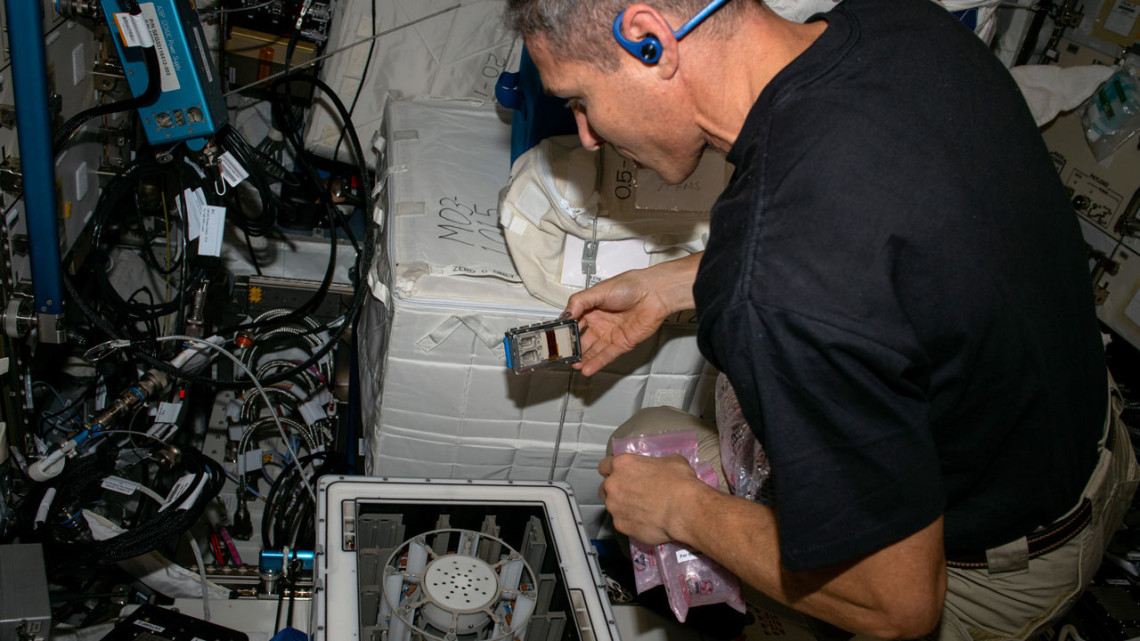
Michael Scott Hopkins performs a microgravity experiment on the International Space Station.

If humankind is to explore deep space, one small passenger should not be left behind: microbes. In fact, it would be impossible to leave them behind, since they live on and in our bodies, surfaces and food. Learning how they react to space conditions is critical, but they could also be invaluable fellows in our endeavor to explore space.

Microorganisms such as bacteria and fungi can harvest crucial minerals from rocks and could provide a sustainable alternative to transporting much-needed resources from Earth.

Researchers from Cornell and the University of Edinburgh collaborated to study how those microbes extract platinum group elements from a meteorite in microgravity, with an experimen...

Read More
Spaceflight causes astronauts’ brains to shift, stretch and compress in microgravity

iss
Credit: CC0 Public Domain

Spaceflight takes a physical toll on astronauts, causing muscles to atrophy, bones to thin and bodily fluids to shift. According to a new study published in the journal PNAS, we can now add another major change to that list. Being in microgravity causes the brain to change shape.

Here on Earth, gravity helps to keep the brain anchored in place while the cerebrospinal fluid that surrounds it acts as a cushion. Scientists already knew that, without gravity’s steady pull, the brain moves upward, but this new research showed that it is also stretched and compressed in several areas.

Brains on the move
Researchers led by Rachel Seidler at the University of Florida reached this conclusion after studying MRI scans of 26 astronauts taken before and after their mi...

Read More

Space mice come home and start families

The rodent research facility for the International Space Station (Credit : NASA/Ames Research Center/Dominic Hart)

Four mice went to space as astronauts. One came back and became a mother. And that simple fact might matter more than you’d think for humanity’s future beyond Earth.

On 31 October, China launched four mice numbered 6, 98, 154, and 186, aboard the Shenzhou-21 spacecraft to the country’s space station, roughly 400 kilometers above Earth. For two weeks, the rodents lived in microgravity, exposed to space radiation and the peculiar conditions of orbital life. They returned safely on 14 November. Then, on 10 December, one of the females gave birth to nine healthy pups.

In a previous study, sperm from mice that had been in space had been used to fertilize female mice back ...

Read More

Astronauts’ Eyes Weaken during Long Space Missions, Raising Concerns for Mars Travel

Spaceflight-associated neuroocular syndrome, which makes the eyes weaker, affects at least 70 percent of crew members on the International Space Station.

The low levels of gravity (microgravity) in space cause significant changes in astronauts’ eyes and vision after six to 12 months aboard the International Space Station (ISS), according to a study published in the IEEE Open Journal of Engineering in Medicine and Biology.

Université de Montréal ophthalmologist Santiago Costantino found that at least 70% of astronauts on the ISS have been affected by spaceflight-associated neuro-ocular syndrome, or SANS.

In the biophotonics research unit he runs at the UdeM-affiliated Maisonneuve-Rosemont Hospital, Costantino assembled a group of researchers to identify the biomechanical changes responsible for this disorder.

They analyzed data collected by the Canadian team at NASA on 13 astronauts who spent between 157 and 186 days on the I...

Read More