
Muons tagged posts

The Higgs boson just revealed a new secret at the Large Hadron Collider

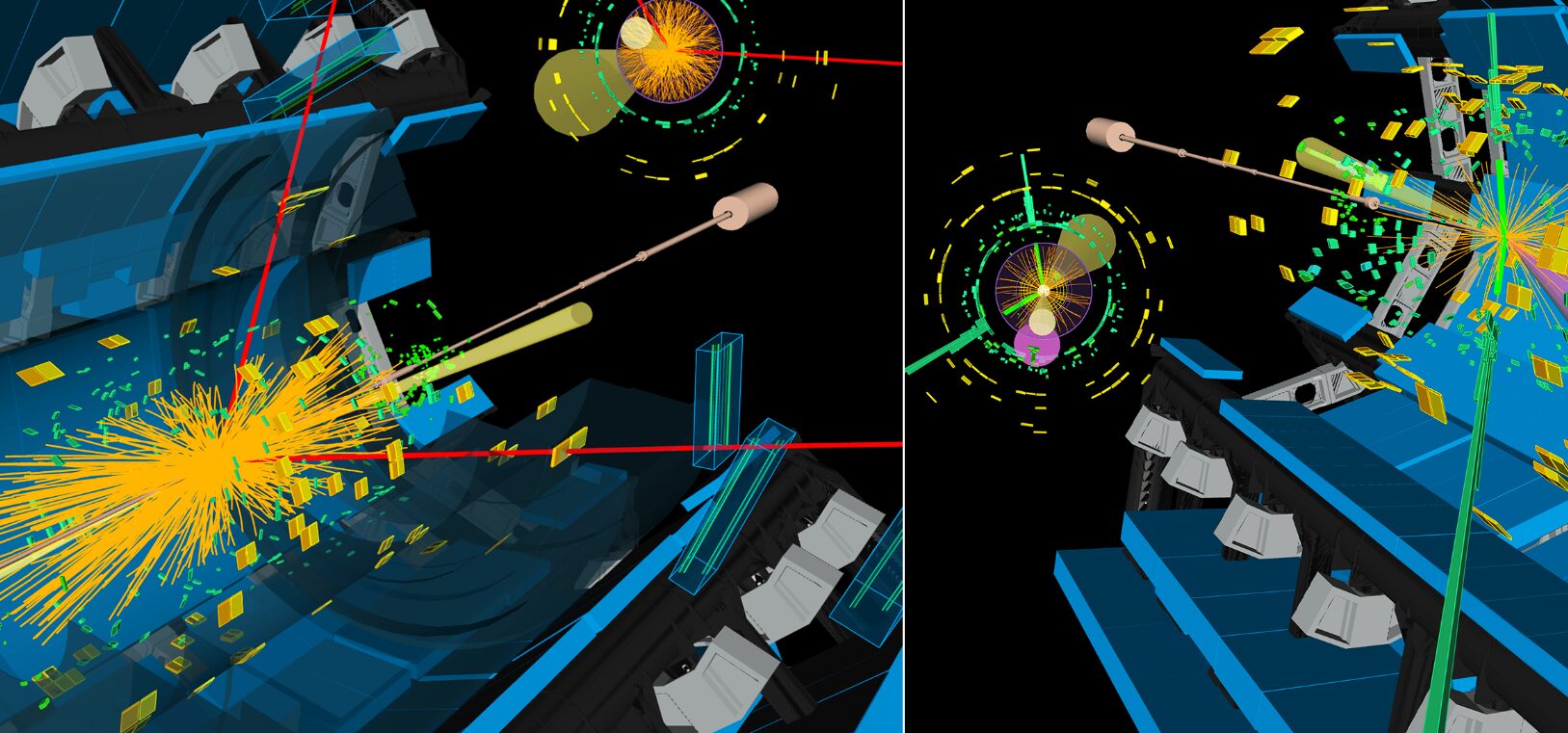
Scientists at CERN’s ATLAS experiment have uncovered compelling evidence of Higgs bosons decaying into muons, an incredibly rare event that could deepen our understanding of how particles acquire mass. They also sharpened their ability to detect the even rarer Higgs decay into a Z boson and a photon—a process that might reveal hidden physics beyond the Standard Model.

The ATLAS Collaboration finds evidence of Higgs-boson decays to muons and improves sensitivity to Higgs-boson decays to a Z boson and a photon.

Since the discovery of the Higgs boson in 2012, physicists have made major strides in exploring its properties...

Read More

Many Muons: Imaging the underground with help from the cosmos

This illustration shows how a series of five borehole muon detectors could be deployed in a horizontal well below a carbon dioxide reservoir. Credit: PNNL

This illustration shows how a series of five borehole muon detectors could be deployed in a horizontal well below a carbon dioxide reservoir. Credit: PNNL

Muons, once used to explore the inside of pyramids and volcanoes alike, are enabling researchers to see deep underground with a technological breakthrough from PNNL. Invisible to the naked eye, muons are elementary particles created by the collisions of cosmic rays with molecules in the atmosphere. Muons are constantly raining down on the earth at various angles. They can pass through materials, such as earth and rock, and detecting these particles have helped researchers “see” the inside of structures such as the pyramids of Giza...

Read More
