neurofibrillary tangles tagged posts

Lithium loss ignites Alzheimer’s, but lithium compound can reverse disease in mice

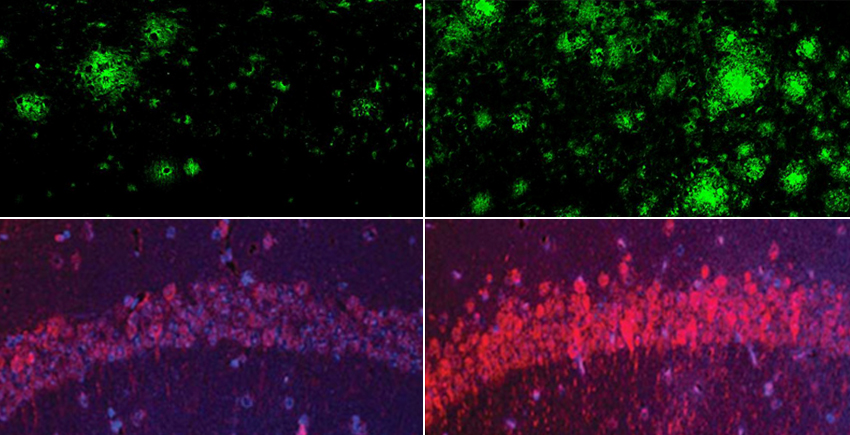
One pair of boxes shows fewer green amyloid clusters on the left and more on the right. Another pair of boxes shows a dim arc of purple and red tau on the left and a brighter arc on the right.
Top row: In a mouse model of Alzheimer’s disease, lithium deficiency (right) dramatically increased amyloid beta deposits in the brain compared with mice that had normal physiological levels of lithium (left). Bottom row: The same was true for the Alzheimer’s neurofibrillary tangle protein tau. Images: Yankner Lab

What is the earliest spark that ignites the memory-robbing march of Alzheimer’s disease? Why do some people with Alzheimer’s-like changes in the brain never go on to develop dementia? These questions have bedeviled neuroscientists for decades.

Now, a team of researchers at Harvard Medical School may have found an answer: lithium deficiency in the brain.

The work, published in Nature, shows for the first time that lithium occurs naturally in the brain, shields it from ...

Read More

New Insight into How Alzheimer’s disease Begins

Tau aggregation in disease

Tau aggregation in disease

A relationship between inflammation, a toxic protein and the onset of the disease has been found. The study also identified a way that doctors can detect early signs of Alzheimer’s by looking at the back of patients’ eyes. “Early detection of Alzheimer’s warning signs would allow for early intervention and prevention of neurodegeneration before major brain cell loss and cognitive decline occurs,” said Ashley Nilson, a neuroscience graduate student. “Using the retina for detecting AD and other neurodegenerative diseases would be non-invasive, inexpensive and could become a part of a normal screening done at patient checkups.”

UTMB researchers have previously found evidence that a toxic form of tau protein may underlie the early stages of Alzheimer’s...

Read More