
neuromorphic computing tagged posts

New Information Storage and Processing Device

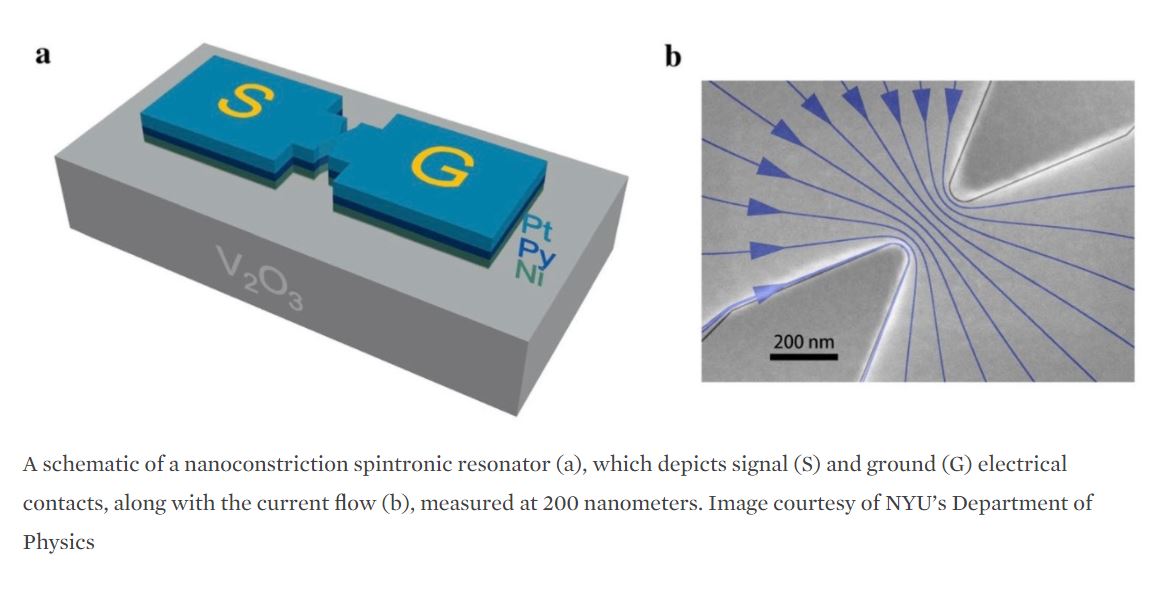
A team of scientists has developed a means to create a new type of memory, marking a notable breakthrough in the increasingly sophisticated field of artificial intelligence.

“Quantum materials hold great promise for improving the capacities of today’s computers,” explains Andrew Kent, a New York University physicist and one of the senior investigators. “The work draws upon their properties in establishing a new structure for computation.”

The creation, designed in partnership with researchers from the University of California, San Diego (UCSD) and the University of Paris-Saclay, is reported in Scientific Reports.

“Since conventional computing has reached its limits, new computational methods and devices are being developed,” adds Ivan Schuller, a UCSD physicist and one of the...

Read More
Silicon Nanowire Transistors with both Learning and Memory Functions

The brain-inspired dynamic neurotransistor chip developed by the researchers. Credit: Baek et al.

Neuromorphic computing entails building architectures inspired by elements of the human brain, such as neural organization and synapses. These architectures have proved to be highly promising and advantageous for a number of applications, as they can have both memory and learning functions.

Most current neuromorphic architectures artificially recreate the plasticity (i.e., ability to be easily shaped over time) of synapses, which are junctions between nerve cells that enable the propagation of impulses across brain regions...

Read More

New Devices Emulate Human Biological Synapses

Highly nonlinear, fast and repeatable threshold switching behaviours of diffusive memristors.

Highly nonlinear, fast and repeatable threshold switching behaviours of diffusive memristors.

A new type of nanodevice for computer microprocessors that can mimic the functioning of a neural synapse has been developed by Engineers at the University of Massachusetts Amherst. Such neuromorphic computing in which microprocessors are configured more like human brains is one of the most promising transformative computing technologies currently under study. Prof. Yang describes the research as part of collaborative work on a new type of memristive device.

Memristive devices are electrical resistance switches that can alter their resistance based on the history of applied voltage and current...

Read More
