
NIRSpec (Near-Infrared Spectrograph) tagged posts

Webb spots first hints of atmosphere on a potentially habitable world

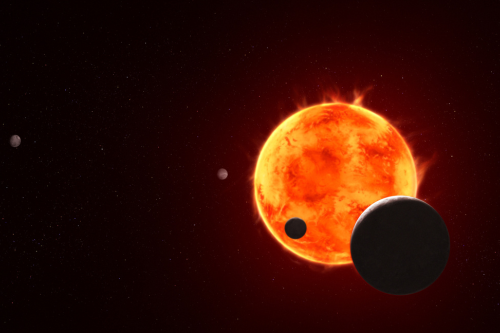
The Earth-size exoplanet TRAPPIST-1 e, depicted at the lower right, is silhouetted as it passes in front of its flaring host star in this artist’s concept of the TRAPPIST-1 system.
Image credit: NASA, ESA, CSA, J. Olmsted (STScI)

Hints of an atmosphere on TRAPPIST-1e raise hopes it could be a watery, potentially habitable world. Astronomers using the James Webb Space Telescope are unraveling the mysteries of TRAPPIST-1e, an Earth-sized exoplanet 40 light years away that could harbor liquid water. Early data suggests hints of an atmosphere, but much remains uncertain. Researchers have already ruled out a hydrogen-rich primordial atmosphere, pointing instead to the possibility of a secondary atmosphere that could sustain oceans or ice.

University of Bristol astrophysicists are helpin...

Read More

TRAPPIST-1e observations narrow down possibilities for atmosphere and surface water on elusive exoplanet

Transmission spectroscopy of the habitable zone planet TRAPPIST-1 e
Scientists call this event a transit, when valuable data can be gathered as the exoplanet passes between the star and the telescope and starlight illuminates the atmosphere, if one is present. NASA’s James Webb Space Telescope has made initial observations of planets b, c, d, and e during their transits, with additional observations of planet e underway. While the star’s frequent flares make it difficult to detect an atmosphere, each transit builds up more and more information for scientists to get a more complete picture of these distant worlds. Credit: NASA, ESA, CSA, J. Olmsted (STScI)

University of Bristol astrophysicists are helping shed new light on an Earth-sized exoplanet 40 light years away where liquid water in the form of a global ocean or icy expanse might exist on its surf...

Read More

Webb reveals New Structures within Ionic Supernova

A pale red ring made up of small white circles surrounds a bright blue spot in the center. Three bright spots are on the outside of the ring, all against a black background speckled with stars.
Webb’s NIRCam (Near-Infrared Camera) captured this detailed image of SN 1987A (Supernova 1987A). At the center, material ejected from the supernova forms a keyhole shape. Just to its left and right are faint crescents newly discovered by Webb. Beyond them an equatorial ring, formed from material ejected tens of thousands of years before the supernova explosion, contains bright hot spots. Exterior to that is diffuse emission and two faint outer rings. In this image blue represents light at 1.5 microns (F150W), cyan 1.64 and 2.0 microns (F164N, F200W), yellow 3.23 microns (F323N), orange 4.05 microns (F405N), and red 4.44 microns (F444W).
Credits: NASA, ESA, CSA, M. Matsuura (Cardiff University), R. Arendt (NASA’s Goddard Spaceflight Center & University of Maryland, Baltimore County), C...
Read More
