
OLED tagged posts

Organic molecule achieves both strong light emission and absorption for displays and imaging

Dual-function organic molecule may advance display technologies and medical imaging
This image depicts the structure of the proposed organic molecule, alongside the energy level diagrams of two-photon absorption (left side) and thermally activated delayed fluorescence (right side). Credit: Youhei Chitose/Kyushu University

Researchers at Kyushu University have developed a novel organic molecule that simultaneously exhibits two highly sought-after properties: efficient light emission suitable for advanced displays and strong light absorption for deep-tissue bioimaging. This breakthrough addresses a long-standing challenge in molecular design, paving the way for next-generation multifunctional materials.

Their study, published online in the journal Advanced Materials on July 29, 2025, was conducted in collaboration with the National Taipei University of Technology and...

Read More
Scientists Advance Affordable, Sustainable Solution for Flat-Panel Displays and Wearable Tech

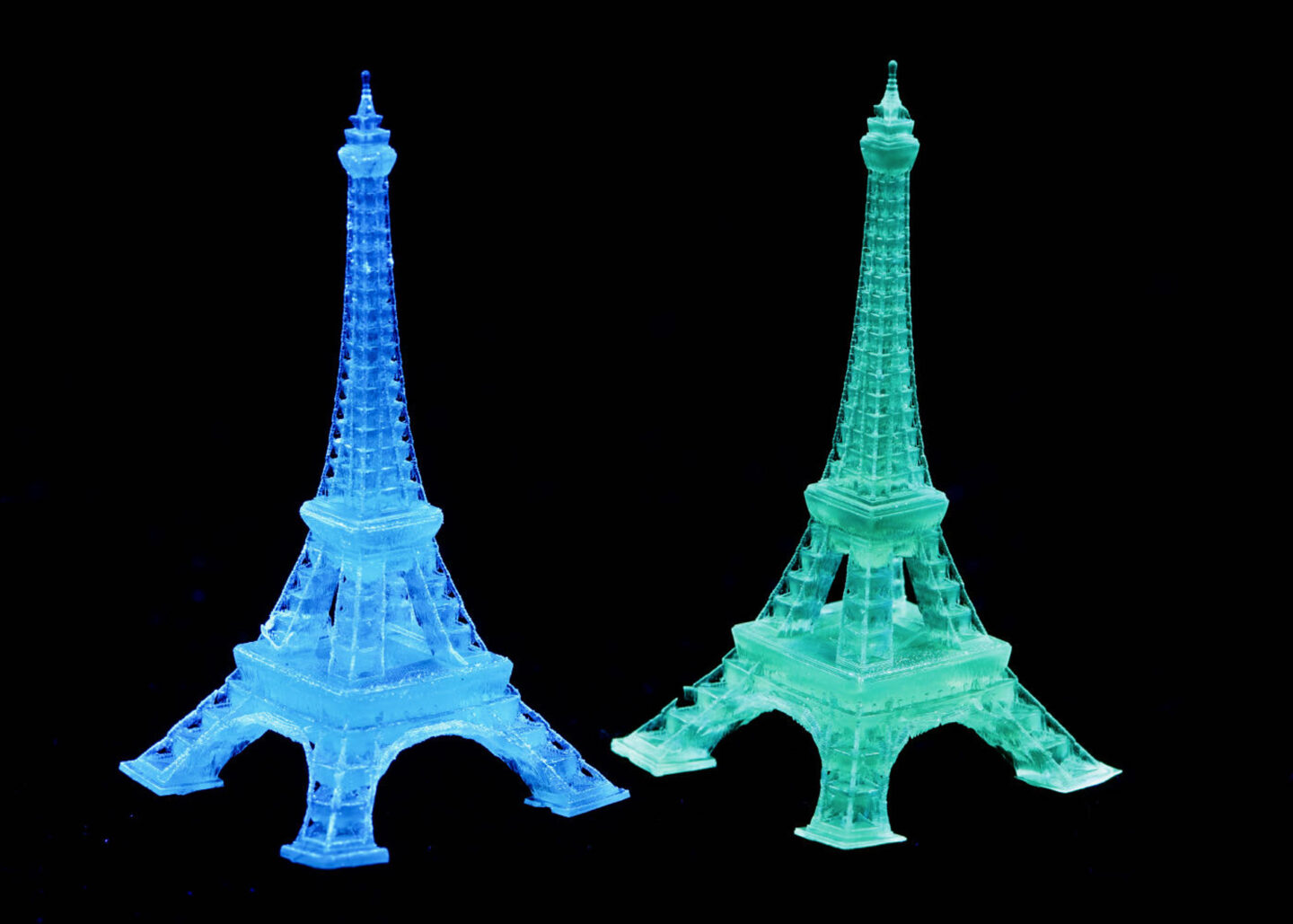
Blue and green Eiffel Tower-shaped luminescent structures 3D-printed from supramolecular ink.
Eiffel Tower-shaped luminescent structures 3D-printed from supramolecular ink. Each 2-centimeter-tall device is fabricated from supramolecular ink that emits blue or green light when exposed to 254-nanometer ultraviolet light. (Credit: Peidong Yang and Cheng Zhu/Berkeley Lab. Courtesy of Science)

A research team led by Lawrence Berkeley National Laboratory (Berkeley Lab) has developed “supramolecular ink,” a new technology for use in OLED (organic light-emitting diode) displays or other electronic devices. Made of inexpensive, Earth-abundant elements instead of costly scarce metals, supramolecular ink could enable more affordable and environmentally sustainable flat-panel screens and electronic devices.

“By replacing precious metals with Earth-abundant materials, our supramolecular...

Read More

Electric Light Transmits Data 100 times Faster than WiFi

Electric light transmits data 100 times faster than Wi-Fi
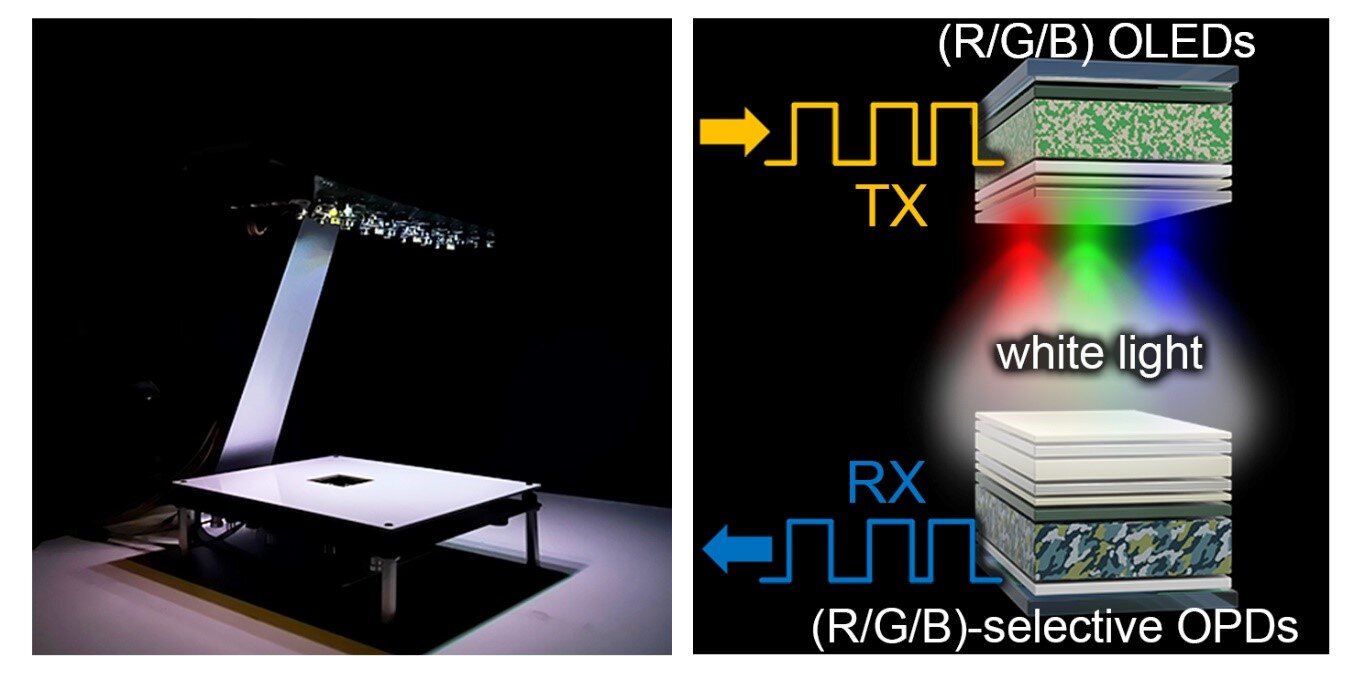
Organic visible light communication system based on mixed white light illumination and color-selective OPDs fabricated with OLEDs. Credit: POSTECH

Li-fi, a communication technology harnessing visible light for data transmission, has a potential to surpass Wi-Fi’s speed by more than 100 times and boasts a high bandwidth, facilitating the simultaneous transmission of copious information. Notably, Li-fi ensures robust security by exclusively transmitting data to areas illuminated by light.

Most important, it capitalizes on existing indoor lighting infrastructure, such as LEDs, eliminating the need for separate installations. However, implementing visible light communication (VLC) in practical lighting systems poses an issue of diminished stability and accuracy in data transmission.

Read More

Minuscule Amounts of Impurities in Vacuum greatly affecting OLED lifetime

New research shows that miniscule amounts of impurities in vacuum are being incorporated into OLEDs during fabrication and leading to large variations in lifetime. By reducing the time OLEDs spend in the deposition chamber during fabrication, impurities can be reduced and lifetime enhanced. Analysis of the impurities indicates sources that include previously deposited materials and plasticizers from chamber components. Credit: Hiroshi Fujimoto and William J. Potscavage, Jr.

New research shows that miniscule amounts of impurities in vacuum are being incorporated into OLEDs during fabrication and leading to large variations in lifetime. By reducing the time OLEDs spend in the deposition chamber during fabrication, impurities can be reduced and lifetime enhanced. Analysis of the impurities indicates sources that include previously deposited materials and plasticizers from chamber components. Credit: Hiroshi Fujimoto and William J. Potscavage, Jr.

Reproducibility is a necessity for science but has often eluded researchers studying the lifetime of organic light-emitting diodes (OLEDs). Recent research from Japan sheds new light on why: impurities present in the vacuum chamber during fabrication but in amounts so small that they are easily overlooked...

Read More
