
optical quantum computers tagged posts

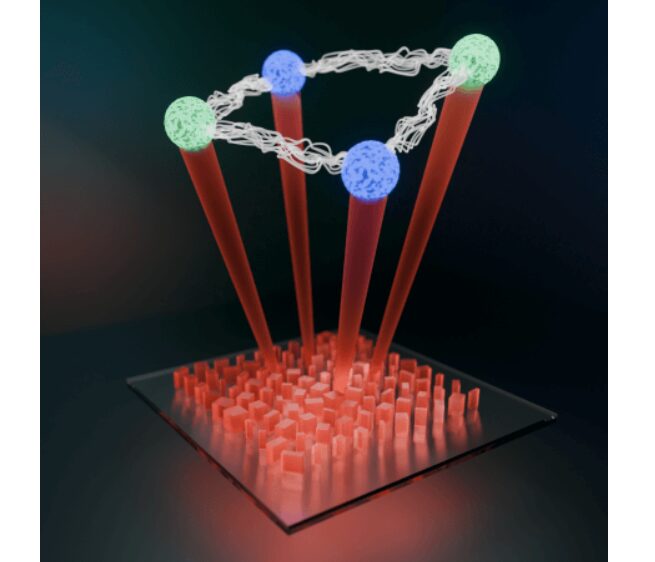
Metasurfaces could be the next quantum information processors

In the race toward practical quantum computers and networks, photons hold intriguing possibilities as fast carriers of information at room temperature.

Photons are typically controlled and coaxed into quantum states via waveguides on extended microchips, or through bulky devices built from lenses, mirrors, and beam splitters. The photons become entangled—enabling them to encode and process quantum information in parallel—through complex networks of these optical components. But such systems are notoriously difficult to scale up due to the large numbers and imperfections of parts required to do any meaningful computation or networking.

Could all those optical components be collapsed into a single, flat, ultra-thin array of subwavelength elements that control light in the exac...

Read More

Ultra-Bright light: A New Source of Quantum Light

3 sources of single photons: represented by a red dot at the center of the cavity, the semiconductor quantum dots (of nanometric size) is inserted in the center of the cavity, which consists of a 3 µm pillar connected to a circular frame by guides that are 1.3 µm wide. By applying electrical voltage to the cavity, the wavelength of the emitted photons can be tuned and the charge noise totally eliminated. Credit: © Niccolo Somaschi – Laboratoire de photonique et de nanostructures (CNRS)

3 sources of single photons: represented by a red dot at the center of the cavity, the semiconductor quantum dots (of nanometric size) is inserted in the center of the cavity, which consists of a 3 µm pillar connected to a circular frame by guides that are 1.3 µm wide. By applying electrical voltage to the cavity, the wavelength of the emitted photons can be tuned and the charge noise totally eliminated. Credit: © Niccolo Somaschi – Laboratoire de photonique et de nanostructures (CNRS)

A new ultra-bright source of single photons – 15X brighter than commonly used sources and emitting photons that are 99.5% indistinguishable from one another – has been developed by researchers from the CNRS, Université Paris Diderot, and Université Paris-Sud...

Read More
