Organic Molecules tagged posts

Retreating Snow Line reveals Organic Molecules around Young Star

The distribution of dust is shown in orange and the distribution of methanol, an organic molecule, is shown in blue.
Credit: ALMA (ESO/NAOJ/NRAO), Lee et al. V883Ori

Astronomers using ALMA have detected various complex organic molecules around the young star V883 Ori. A sudden outburst from this star is releasing molecules from the icy compounds in the planet forming disk. The chemical composition of the disk is similar to that of comets in the modern Solar System. Sensitive ALMA observations enable astronomers to reconstruct the evolution of organic molecules from the birth of the Solar System to the objects we see today.

The research team led by Jeong-Eun Lee (Kyung Hee University, Korea) used the Atacama Large Millimeter/submillimeter Array (ALMA) to detect complex organic molec...

Read More

Life’s Building Blocks observed in Spacelike environment

Low-energy electron impact mediates the creation of new complex organic molecules, such as ethanol, in astrophysical/planetary model ices containing methane and oxygen; while some of the new species desorb as ions, many remain in the surface ices. Credit: The photo of Jupiter's moon Europa, inserted for the Platinum (Pt) substrate (bottom of the graphic), is credited to NASA.

Low-energy electron impact mediates the creation of new complex organic molecules, such as ethanol, in astrophysical/planetary model ices containing methane and oxygen; while some of the new species desorb as ions, many remain in the surface ices. Credit: The photo of Jupiter’s moon Europa, inserted for the Platinum (Pt) substrate (bottom of the graphic), is credited to NASA.

Where do the molecules required for life originate? A new study shows that a number of small organic molecules can form in a cold, spacelike environment full of radiation. Investigators at the University of Sherbrooke in Canada have created simulated space environments in which thin films of ice containing methane and oxygen are irradiated by electron beams...

Read More

Researchers present list of Comet 67P/Churyumov-Gerasimenko Ingredients

Overview of the chemical elements that make up Rosetta’s comet. Right: Average mass distribution of organic and mineral substances in Rosetta’s comet.

1. Left: The surface of Rosetta’s comet. As the comet approaches the Sun, frozen gases evaporate from below the surface, dragging tiny particles of dust along with them. Right: These dust grains can be captured and examined using the COSIMA instrument. Targets such as this one measuring only a few centimeters act as dust collectors. They retain dust particles of up to 100 microns in size. 2. Left: Overview of the chemical elements that make up Rosetta’s comet. Right: Average mass distribution of organic and mineral substances in Rosetta’s comet.

The dust that comet 67P/Churyumov-Gerasimenko emits into space consists to about one half of organic molecules. The dust belongs to the most pristine and carbon-rich material known in our solar system and has hardly changed since its birth...

Read More

Successful Synthesis of pure Organic Molecules that shows Metallic Conduction under Ambient Pressure

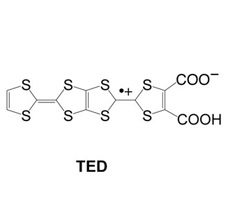
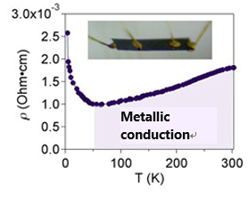
Picture: Figure 1. Molecular structure of TED Picture: Figure 2. Temperature dependence of electrical resistivity in TED self-supporting film. Inserted photo shows a self-supporting film with four gold terminals attached.

For the first time, a NIMS research team designed and fabricated single-component organic molecules that are conductive like metal under normal pressure, despite the fact that the molecules contain neither multiple molecules nor metal elements. Because the molecules are completely pure, they are more durable and stable compared to conventional chemically doped organic conductive materials. The new molecules may be applied to solar cell electrodes and touch panels.

Organic molecules consisting solely of light elements essentially do not have carriers by which an electric charge can pass through. As such, they are not high quality conductors...

Read More