
origami tagged posts

Spacecraft design gets a boost with new origami flower-like patterns

Spacecraft design gets a boost with new origami flower-like patterns
Examples of bloom patterns in different folded states. Credit: Proceedings of the Royal Society A: Mathematical, Physical and Engineering Sciences (2025). DOI: 10.1098/rspa.2025.0299

The ancient Japanese art of paper-folding, or origami, is already inspiring the design of the next generation of space vehicles, but now there’s a new family of origami shapes that could make them even more compact and reliable.

Larry Howell at Brigham Young University and his colleagues have developed a new class of origami structures called bloom patterns that fold up flat and unfold like flower petals. These clever folding designs could also be used for other structures in space, such as telescopes and solar arrays.

Origami-based designs are perfect for spacecraft because they can be made to fol...

Read More
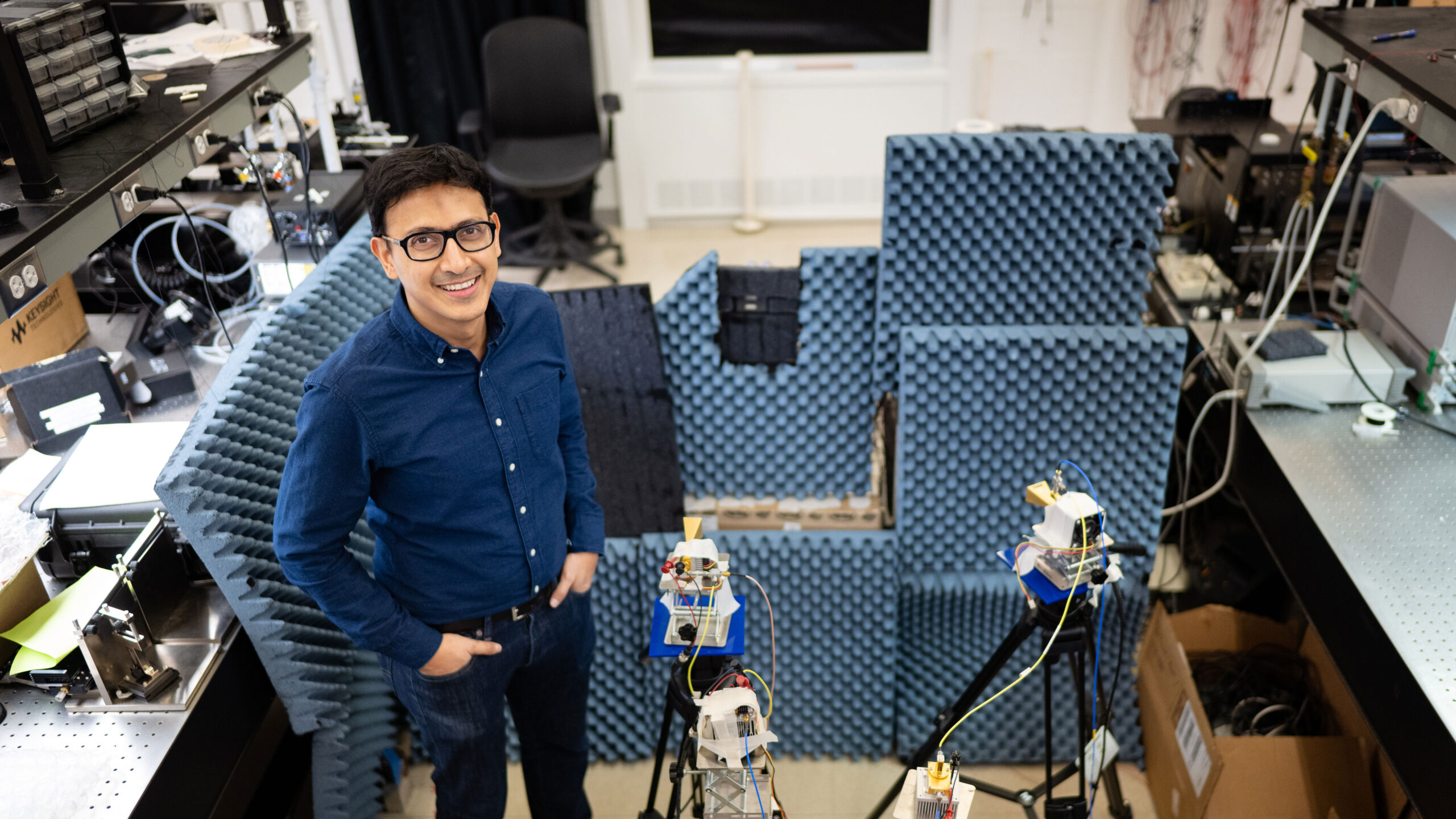
New Antennas and Microchips help Electronics blur the line between Science and Sci-fi

Kaushik Sengupta in his lab at Princeton
Researchers in Kaushik Sengupta’s lab work to expand the capabilities of modern electronics. Photos by Sameer A. Khan/Fotobuddy

Sophisticated antenna arrays paired with high-frequency wireless chips act like superpowers for modern electronics, boosting everything from sensing to security to data processing. In his lab at Princeton, Kaushik Sengupta is working to expand those powers even further.

In recent years, Sengupta’s lab has designed antenna arrays that help engineers make strides toward peering through matter, boosting communications in canyons of skyscrapers, putting a medical lab on a smart phone, and encrypting critical data with electromagnetic waves instead of software.

In a new article in Advanced Science, Sengupta’s research team presented a new type of antenna arra...

Read More

Developable Mechanisms can Reside inside the Surface of a Structure

This image shows how developable mechanisms reside in the surface of an object.
Credit: BYU Photo

It took just over 10 years, but real science has finally caught up to the science fiction of Iron Man’s transforming exoskeleton suit. Engineers at Brigham Young University detail new technology that allows them to build complex mechanisms into the exterior of a structure without taking up any actual space below the surface.

This new class of mechanisms, called “developable mechanisms,” get their name from developable surfaces, or materials that can take on 3D shapes from flat conformations without tearing or stretching, like a sheet of paper or metal...

Read More
