origins of life tagged posts

Life forms can planet hop on asteroid debris—and survive

Microbes before and after extreme impact
Image credit: Lisa Orye / Johns Hopkins University

Tiny life forms tucked into debris from an asteroid hit could catapult to other planets—including Earth—and survive, a new Johns Hopkins University study finds. The work demonstrates that a certain hardy bacterium easily withstands extreme pressure comparable to an ejection from Mars after an asteroid hit, as well as the inhospitable conditions it would face during the ensuing interplanetary journey.

The study, published today in PNAS Nexus, suggests that microorganisms can survive remarkably more extreme conditions than expected, and raises questions about origins of life. The work also has significant implications for planetary protection and space missions.

“Life might actually survive being ejected from one planet and mo...

Read More
Complex organic molecules found in young star’s disk hint at cosmic origins of life

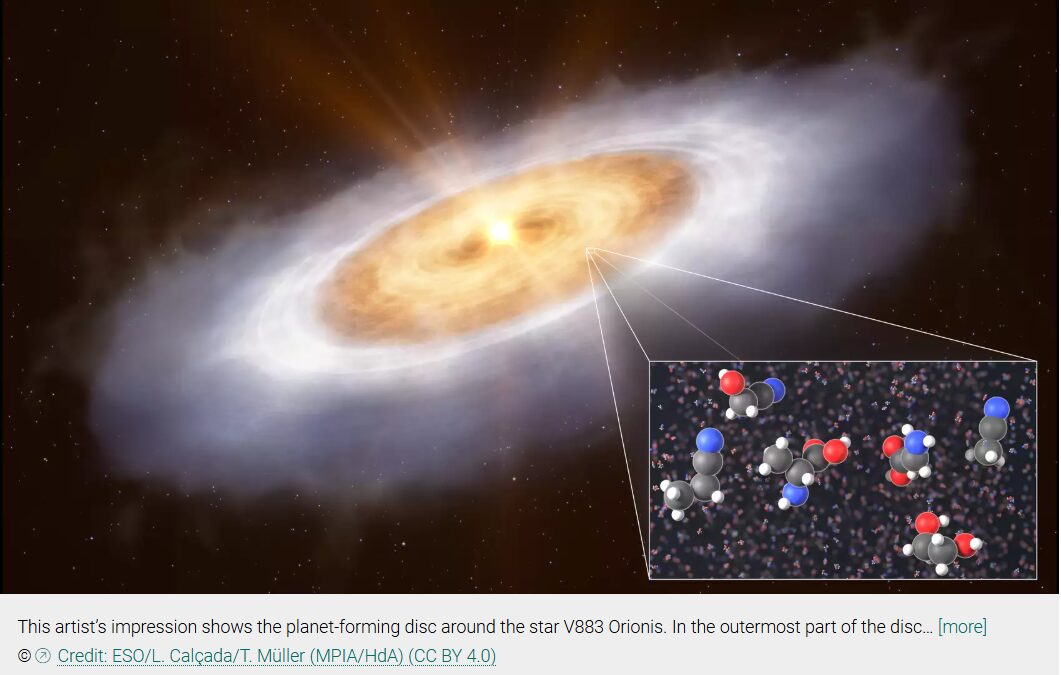
Using the Atacama Large Millimeter/submillimeter Array (ALMA), a team of astronomers led by Abubakar Fadul from the Max Planck Institute for Astronomy (MPIA) has discovered complex organic molecules—including the first tentative detection of ethylene glycol and glycolonitrile—in the protoplanetary disk of the outbursting protostar V883 Orionis.

These compounds are considered precursors to the building blocks of life. Comparing different cosmic environments reveals that the abundance and complexity of such molecules increase from star-forming regions to fully evolved planetary systems. This suggests that the seeds of life are assembled in space and are widespread.

The findings are published in the Astrophysical Journal Letters.

Astronomers have discovered complex organic m...

Read More

Origin of Life: Which Came First?

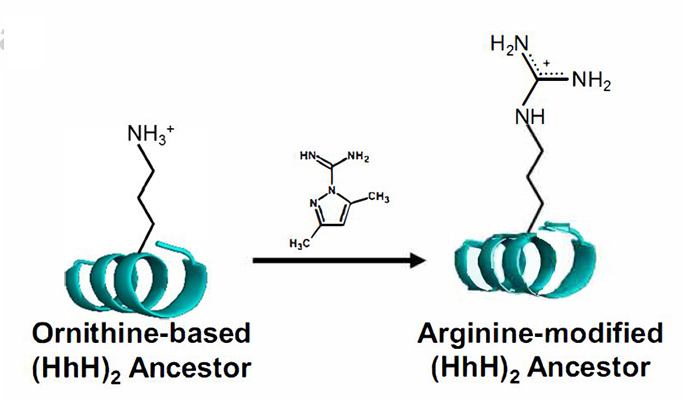
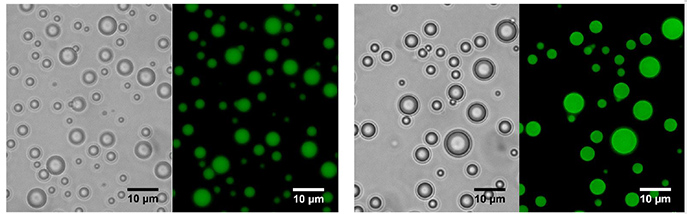
Proteins with primitive arginine-based proteins (right) might have been capable of self-assembly and phase separation to create cell-like droplets

An experiment in recreating primordial proteins solves a long-standing riddle. What did the very first proteins look like — those that appeared on Earth around 3.7 billion years ago? Prof. Dan Tawfik of the Weizmann Institute of Science and Prof. Norman Metanis of the Hebrew University of Jerusalem have reconstructed protein sequences that may well resemble those ancestors of modern proteins, and their research suggests a way that these primitive proteins could have progressed to forming living cells. Their findings were published in the Proceedings of the National Academy of Sciences (PNAS).

The proteins encoded in a cell’s genet...

Read More