The core of the Phoenix cluster is shown across the whole electromagnetic spectrum. The bright purples represent X-rays produced by the hot gas, and the dashed purple outlines show regions where this hot gas has been pushed away by the radio jets from the supermassive black hole. The radio jets themselves are shown in red colors. The blues and yellows represent visible light emitted by cool gas and stars. The green contours show the “warm” gas that is in the process of cooling, newly measured in the MIT study with JWST. Credit: NASA
The core of a massive cluster of galaxies appears to be pumping out far more stars than it should. Now researchers at MIT and elsewhere have discovered a key ingredient within the cluster that explains the core’s prolific starburst.
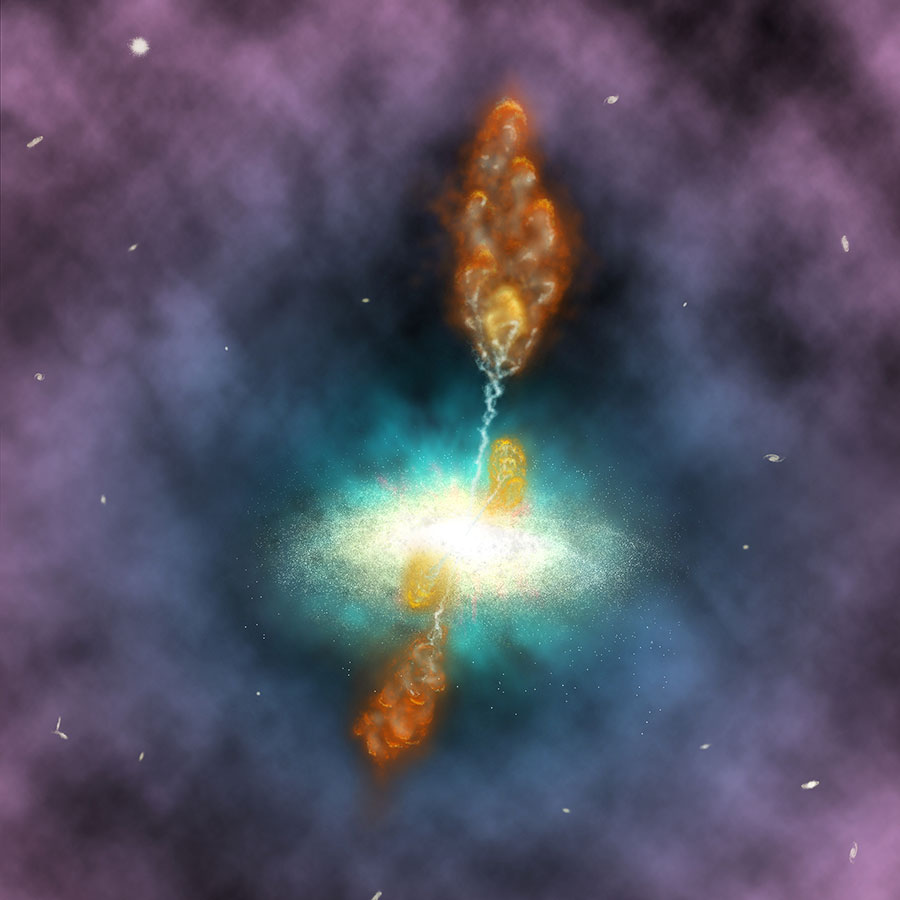
Artist’s illustration of the structures seen in the observations. (Credit: NAOJ)
Radio astronomers have detected jets of hot gas blasted out by a black hole in the galaxy at the heart of the Phoenix Galaxy Cluster, located 5.9 billion light-years away in the constellation Phoenix. This is an important result for understanding the coevolution of galaxies, gas, and black holes in galaxy clusters.
Galaxies are not distributed randomly in space. Through mutual gravitational attraction, galaxies gather together to form collections known as clusters. The space between galaxies is not entirely empty. There is very dilute gas throughout a cluster which can be detected by X-ray observations.
If this intra-cluster gas cooled, it would condense under its own gravity to form stars at the ...






Recent Comments