planet formation tagged posts

By measuring gases around young stars, astronomers unlock major clues to planet formation

By measuring gases around young stars, astronomers unlock major clues to planet formation
1.3 mm (Left panels) and 12CO (2-1) moment zero images (Right panels) of the AGE-PRO sample. Credit: arXiv (2025). DOI: 10.48550/arxiv.2506.10719

An international team of scientists led by astronomers from the University of Wisconsin–Madison has produced the most accurate measurement of the gases swirling around young stars and how their mass changes over time. The discovery joins many pieces of a puzzle that may reveal which kinds of planets form—rocky Earth-types, gas giants like Jupiter, or balls of ice in the Neptune mold—as star systems mature.

The researchers used an array of 66 massive radio telescopes, the Atacama Large Millimeter/submillimeter Array, perched at 16,000 feet in the Chilean Andes Mountains, to study the disks of gas spinning in the gravity of each of 3...

Read More
Planets Form through Domino Effect

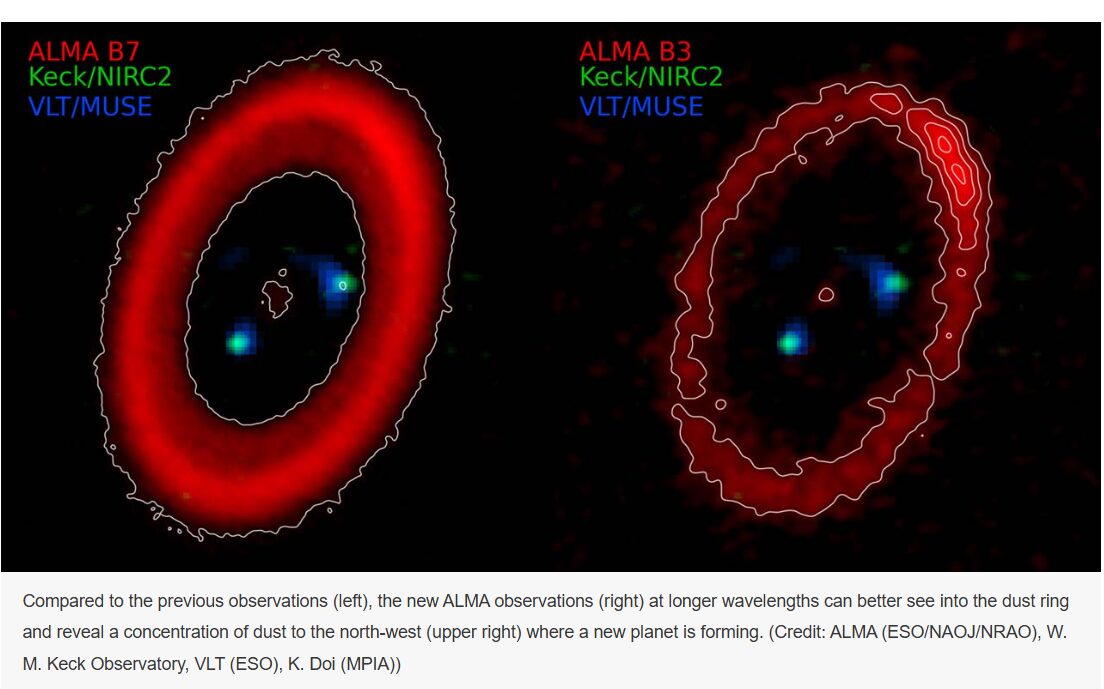
New radio astronomy observations of a planetary system in the process of forming show that once the first planets form close to the central star, these planets can help shepherd the material to form new planets farther out. In this way each planet helps to form the next, like a line of falling dominos each triggering the next in turn.

To date over 5000 planetary systems have been identified. More than 1000 of those systems have been confirmed to host multiple planets. Planets form in clouds of gas and dust known as protoplanetary disks around young stars. But the formation process of multi-planet systems, like our own Solar System, is still poorly understood.

The best example object to study multi-planet system formation is a young star known as PDS 70, located 367 light years a...

Read More

Groundbreaking Survey reveals Secrets of Planet Birth around Dozens of Stars

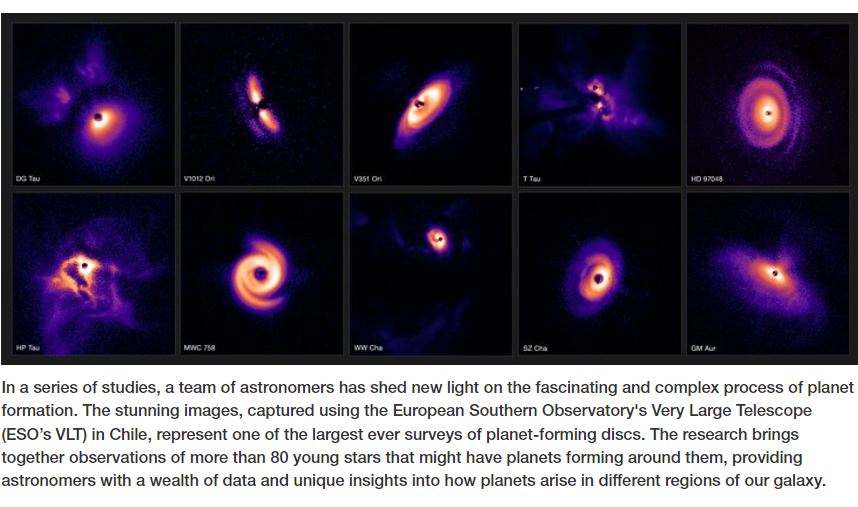
A team of astronomers has shed new light on the fascinating and complex process of planet formation. The research brings together observations of more than 80 young stars that might have planets forming around them, providing astronomers with a wealth of data and unique insights into how planets arise in different regions of our galaxy.

In a series of studies, a team of astronomers has shed new light on the fascinating and complex process of planet formation. The stunning images, captured using the European Southern Observatory’s Very Large Telescope (ESO’s VLT) in Chile, represent one of the largest ever surveys of planet-forming discs...

Read More

To Stick or to Bounce: Size determines the Stickiness of Cosmic Dust Aggregates

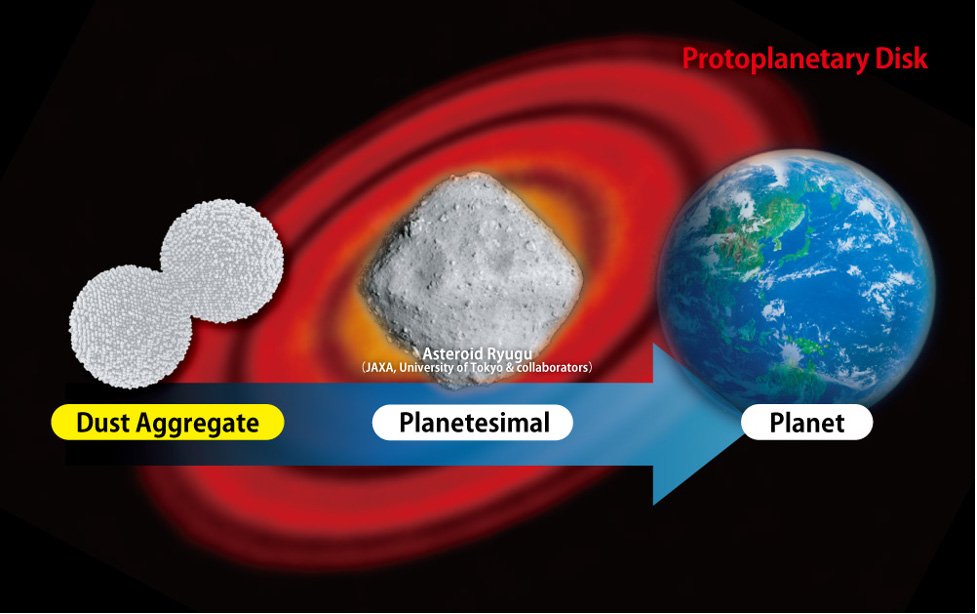
Micrometer-scale dust particles from protoplanetary disks, or sites around stars with particles and hydrogen and/or other gasses, aggregate to form planetesimals, or kilometer-scale building blocks of planets. Planetesimals, in turn, merge due to mutual gravity. ©JAMSTEC

Microparticle dust aggregates, which are thought to play a role in the formation of new planets, are less likely to stick together after a collision when the aggregates are larger.

Current evidence suggests that microparticles of cosmic dust collide and stick together to form larger dust aggregates that may eventually combine and develop into planets...

Read More