
Psyche Mission tagged posts

NASA’s Deep Space communications demo exceeds project expectations

A wide-angle, long-exposure shot of an astronomical observatory on a hill at night. The dome glows with a faint green light against a deep purple and blue sky filled with stars. Dark silhouettes of pine trees are visible in the foreground.
In this infrared photograph, the Optical Communications Telescope Laboratory at JPL’s Table Mountain Facility near Wrightwood, California, beams its eight-laser beacon to the Deep Space Optical Communications flight laser transceiver aboard NASA’s Psyche spacecraft.
 Credit: NASA/JPL-Caltech

NASA’s Deep Space Optical Communications technology has successfully shown that data encoded in lasers can be reliably transmitted, received, and decoded after traveling millions of miles from Earth at distances comparable to Mars. Nearly two years after launching aboard the agency’s Psyche mission in 2023, the technology demonstration recently completed its 65th and final pass, sending a laser signal to Psyche and receiving the return signal from 218 million miles away.

“NASA is setting Ame...

Read More
Computer Simulation Models Potential Asteroid Collisions

Results to provide data for NASA’s upcoming Psyche mission. An asteroid impact can be enough to ruin anyone’s day, but several small factors can make the difference between an out-of-this-world story and total annihilation. In)l AIP Advances, by AIP Publishing, a researcher from the National Institute of Natural Hazards in China developed a computer simulation of asteroid collisions to better understand these factors.NASA’s Psyche mission aims to be the first spacecraft to explore an asteroid made entirely of metal. CREDIT: NASA/JPL-Caltech/ASU

The computer simulation initially sought to replicate model asteroid strikes performed in a laboratory...

Read More

Deep-Space Mission to metal asteroid

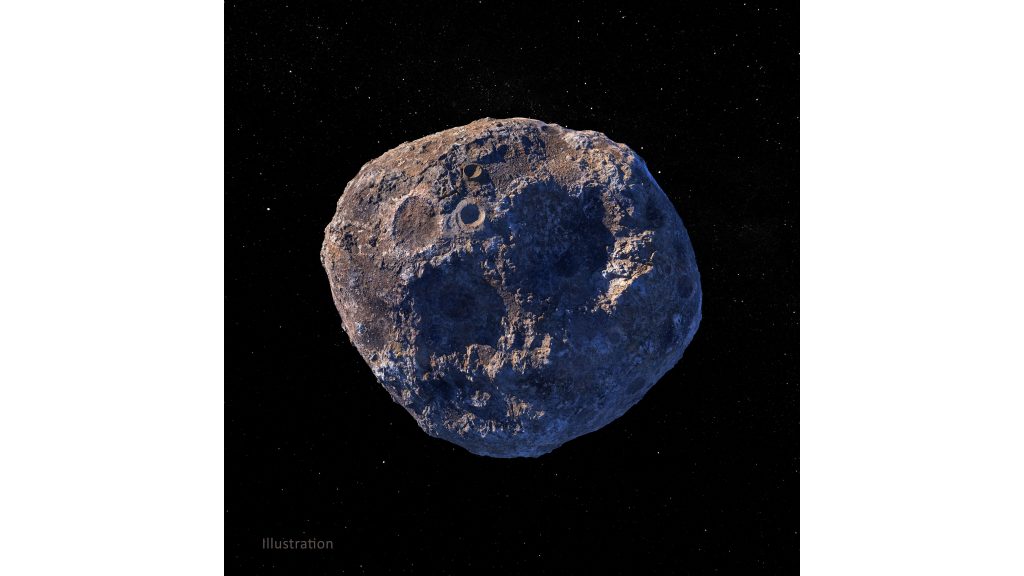
Artist rendition of the asteroid Psyche. Credit: Image by Peter Rubin/ASU

Artist rendition of the asteroid Psyche. Credit: Image by Peter Rubin/ASU

Psyche to offer unique look into violent collisions that created Earth, terrestrial planets. Arizona State University’s Psyche Mission, a journey to a metal asteroid, has been selected for flight, marking the first time the school will lead a deep-space NASA mission and the first time scientists will be able to see what is believed to be a planetary core. It will launch in 2023, arriving at the asteroid in 2030, where it will spend 20 months in orbit, mapping it and studying its properties.

It will be part of NASA’s Discovery Program, a series of lower-cost, highly focused robotic space missions that are exploring the solar system. The Psyche project is capped at $450 million...

Read More
