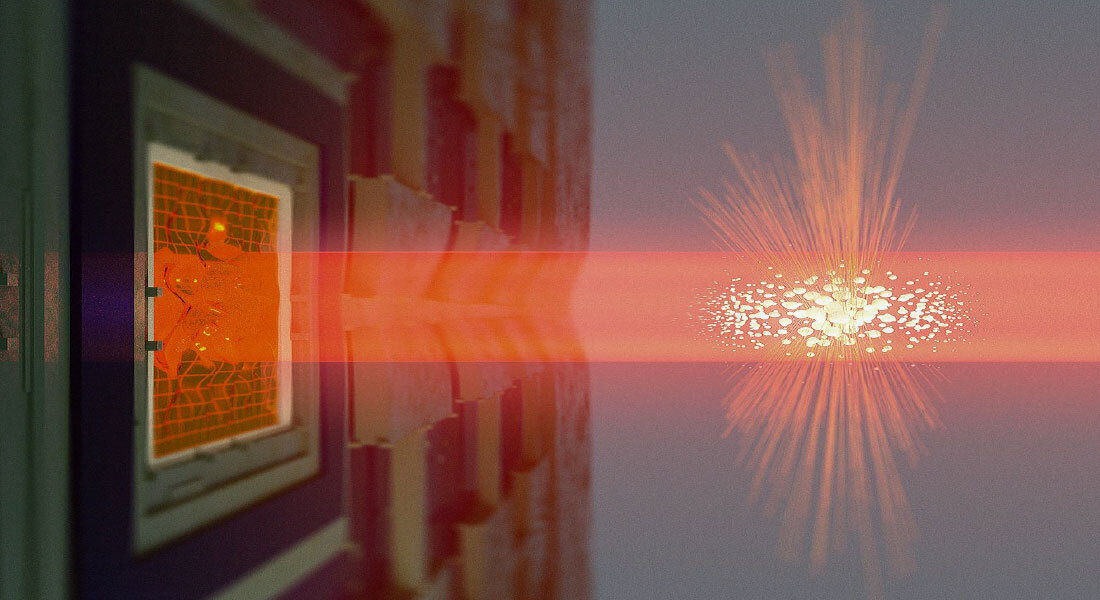
Light propagates through the atomic cloud shown in the center and then falls onto the SiN membrane shown on the left. As a result of interaction with light the precession of atomic spins and vibration of the membrane become quantum correlated. This is the essence of entanglement between the atoms and the membrane. Credit: Niels Bohr Institute
A team of researchers at the Niels Bohr Institute, University of Copenhagen, have succeeded in entangling two very different quantum objects. The result has several potential applications in ultra-precise sensing and quantum communication and is now published in Nature Physics.
Entanglement is the basis for quantum communication and quantum sensing...
Physicists at the Institute of Science and Technology Austria (IST Austria) have invented a new radar prototype that utilizes quantum entanglement as a method of object detection. This successful integration of quantum mechanics into our everyday devices could significantly impact the biomedical and security industries. The research is published in the journal Science Advances.
Quantum entanglement is a physical phenomenon where two particles remain inter-connected, sharing physical traits regardless of how far apart they are from one another...
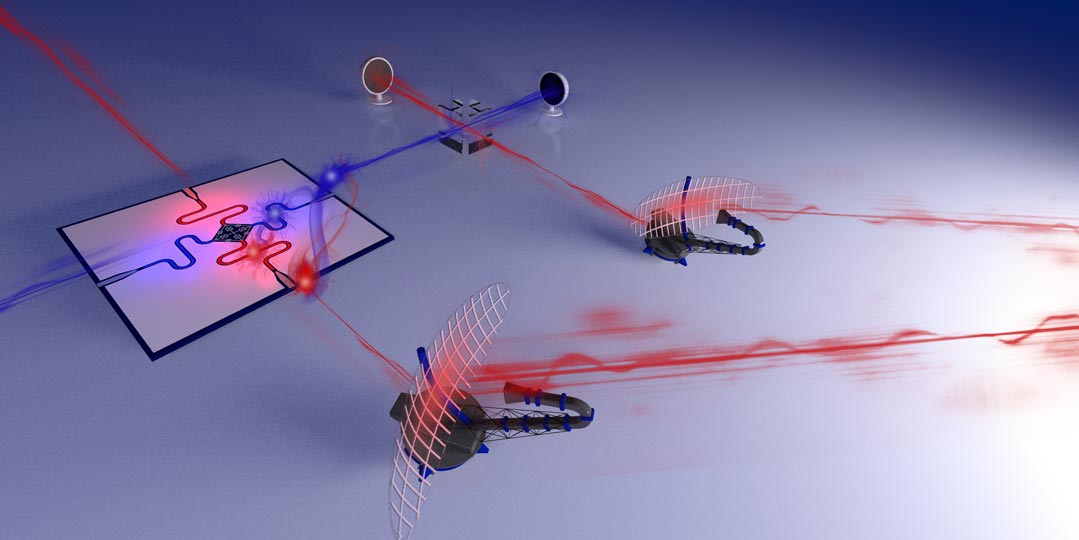
A graphic demonstrating the team’s quantum metrology experiment.
Engineers have demonstrated for the first time that it’s possible to connect a network of sensors through quantum entanglement. The experiment opens a door to unprecedented levels of sensitivity in GPS navigation, medical imaging and astronomy.
Your phone’s GPS, the WiFi in your house and communications on aircraft are all powered by radio-frequency waves, or waves, which carry information from a transmitter at one point to a sensor at another. The sensors interpret this information in different ways. For example, a GPS sensor uses the angle at which it receives an RF wave to determine its own relative location. The more precisely it can measure the angle, the more accurately it can determine location.
This artist’s impression of one of the most distant, oldest, brightest quasars ever seen is hidden behind dust. The quasar dates back to less than one billion years after the big bang. Credit: NASA/ESA/G.Bacon, STScI
Results are among the strongest evidence yet for ‘spooky action at a distance’. New research boosts the case for quantum entanglement. Scientists have used distant quasars, one of which emitted its light 7.8 billion years ago and the other 12.2 billion years ago, to determine the measurements to be made on pairs of entangled photons. They found correlations among more than 30,000 pairs of photons – far exceeding the limit for a classically based mechanism.
Take, for instance, two particles sitting on opposite edges of the universe...







Recent Comments