
quantum physics tagged posts

Physicists Create Extremely Compressible ‘Gas of Light’ – Paving the way to new types of highly sensitive sensors

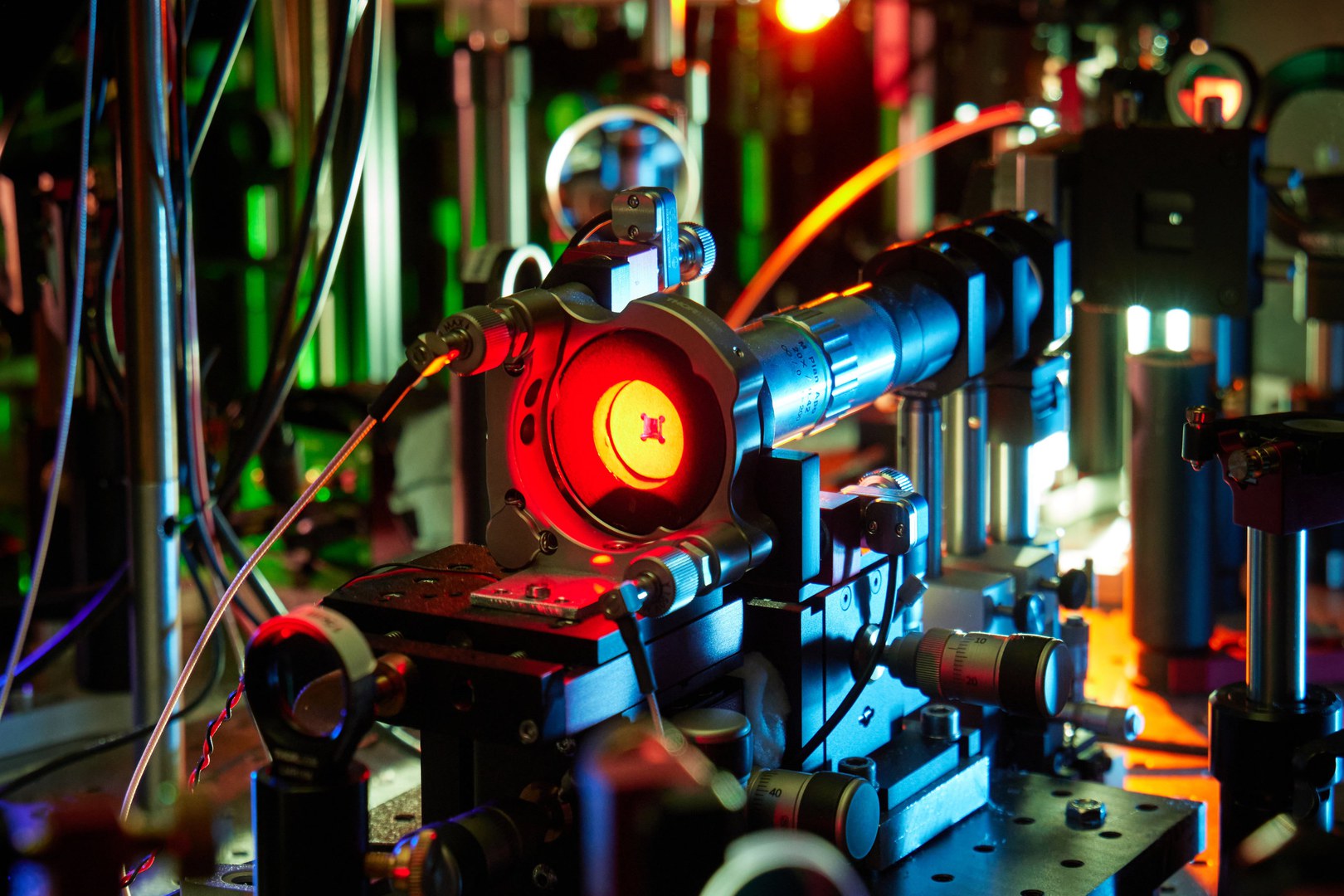
The centerpiece of the experiment: – the optical microresonator realizes the ‘photon box’.
Photo: Volker Lannert/University of Bonn

Researchers at the University of Bonn have created a gas of light particles that can be extremely compressed. Their results confirm the predictions of central theories of quantum physics. The findings could also point the way to new types of sensors that can measure minute forces. The study is published in the journal Science.

If you plug the outlet of an air pump with your finger, you can still push its piston down. The reason: Gases are fairly easy to compress — unlike liquids, for example. If the pump contained water instead of air, it would be essentially impossible to move the piston, even with the greatest effort.

Gases usually consist of at...

Read More

Quantum Weirdness in ‘Chicken or Egg’ paradox

What came first, the chicken or the egg? Or both? Credit: © olhastock / Fotolia

What came first, the chicken or the egg? Or both?
Credit: © olhastock / Fotolia

The “chicken or egg” paradox was first proposed by philosophers in Ancient Greece to describe the problem of determining cause-and-effect. Now, a team of physicists from The University of Queensland and the NÉEL Institute has shown that, as far as quantum physics is concerned, the chicken and the egg can both come first.

Dr Jacqui Romero from the ARC Centre of Excellence for Engineered Quantum Systems said that in quantum physics, cause-and-effect is not always as straightforward as one event causing another. “The weirdness of quantum mechanics means that events can happen without a set order,” she said. “Take the example of your daily trip to work, where you travel partly by bus and partly by train...

Read More

Nanomagnets Levitate thanks to Quantum Physics

Cosimo Rusconi (l.) and Oriol Romero-Isart (r.) play with a levitron to illustrate their work on nano magnets. Credit: IQOQI Innsbruck/M.R.Knabl

Cosimo Rusconi (l.) and Oriol Romero-Isart (r.) play with a levitron to illustrate their work on nano magnets.
Credit: IQOQI Innsbruck/M.R.Knabl

Quantum physicists have now shown that, despite Earnshaw’s theorem, nanomagnets can be stably levitated in an external static magnetic field owing to quantum mechanical principles. The quantum angular momentum of electrons, which also causes magnetism, is accountable for this mechanism.

Already in 1842, British mathematician Samuel Earnshaw proved that there is no stable configuration of levitating permanent magnets. If one magnet is levitated above another, the smallest disturbance will cause the system to crash...

Read More

A Future without Fakes thanks to Quantum Technology

This is a gold microchip. Credit: Lancaster University

This is a gold microchip. Credit: Lancaster University

1st demo of patented technology smartphone app aims to eliminate counterfeiting. Counterfeit products are a huge problem – from medicines to car parts, fake technology costs lives. Every year, imports of counterfeited and pirated goods around the world cost nearly US $0.5 trillion in lost revenue. Counterfeit medicines alone cost the industry over US $200 billion every year. They are also dangerous to our health – around a third contain no active ingredients, resulting in a million deaths a year. As the Internet of Things expands, there is the need to trust the identity of smart systems, such as the brake system components within connected and driverless cars.

But researchers exhibiting at the Royal Society Summer Science Exhibition be...

Read More
