Quantum Sensors tagged posts

Searching for light dark matter by tracking its direction with quantum sensors

dark matter
Credit: Scott Lord from Pexels

Dark matter is an elusive type of matter that does not emit, absorb or reflect light, interacting very weakly with ordinary matter. These characteristics make it impossible to detect using conventional technologies used by physicists to study matter particles.

As it has never been observed before, the exact composition of dark matter remains unknown. One proposed theory is that this elusive type of matter is comprised of light particles with very small masses, below 1 eV (electronvolt), which behave more like waves than particles.

Researchers at the University of Tokyo and Chuo University recently explored the possibility of searching for sub-GeV dark matter using quantum sensors, advanced systems that rely on quantum mechanical effects to detect ex...

Read More

Molecular qubits can communicate at telecom frequencies

Grant Smith and Leah Weiss in Awschalom Lab
PhD students Leah Weiss (left) and Grant Smith work in the lab of Professor David Awschalom. (Photo by John Zich)

A team of scientists from the University of Chicago, the University of California Berkeley, Argonne National Laboratory, and Lawrence Berkeley National Laboratory has developed molecular qubits that bridge the gap between light and magnetism—and operate at the same frequencies as telecommunications technology. The advance, published today in Science, establishes a promising new building block for scalable quantum technologies that can integrate seamlessly with existing fiber-optic networks.

Because the new molecular qubits can interact at telecom-band frequencies, the work points toward future quantum networks—sometimes called the “quantum internet...

Read More

Diamond nanoparticles get a quantum upgrade with shell inspired by TV technology

New biosensor solves old quantum riddle
By encasing a diamond nanoparticle with a specially engineered shell—a technique inspired by QLED televisions—the team created a quantum biosensor ideal for a living cell. Credit: Jason Smith

Putting hypersensitive quantum sensors in a living cell is a promising path for tracking cell growth and diagnosing diseases—even cancers—in their early stages.

Many of the best, most powerful quantum sensors can be created in small bits of diamond, but that leads to a separate issue: It’s hard to stick a diamond in a cell and get it to work.

“All kinds of those processes that you really need to probe on a molecular level, you cannot use something very big. You have to go inside the cell...

Read More

Physicists create New Form of Antenna for Radio Waves

Susi Otto image
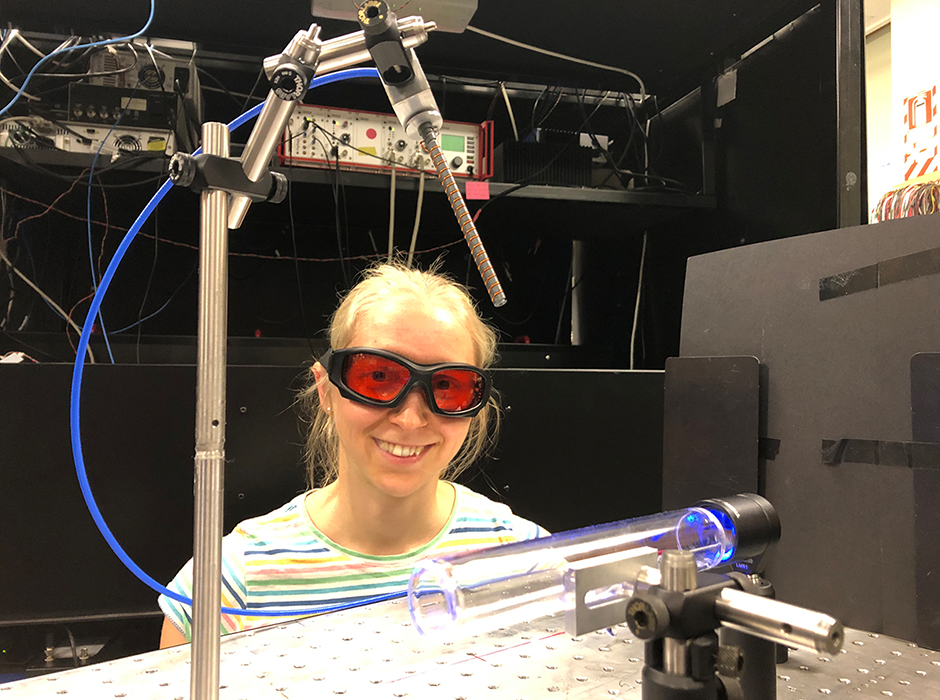
Dr Susi Otto with the portable Rydberg sensor created by researchers at the Dodd-Walls Centre.

University of Otago physicists have used a small glass bulb containing an atomic vapor to demonstrate a new form of antenna for radio waves. The bulb was “wired up” with laser beams and could therefore be placed far from any receiver electronics.

Dr Susi Otto, from the Dodd-Walls Centre for Photonic and Quantum Technologies, led the field testing of the portable atomic radio frequency sensor.

Such sensors, that are enabled by atoms in a so-called Rydberg state, can provide superior performance over current antenna technologies as they are highly sensitive, have broad tunability, and small physical size, making them attractive for use in defence and communications.

For example, they c...

Read More