
quasicrystals tagged posts

Wild new “gyromorph” materials could make computers insanely fast

Gyromorphs Boost Light Computing Power
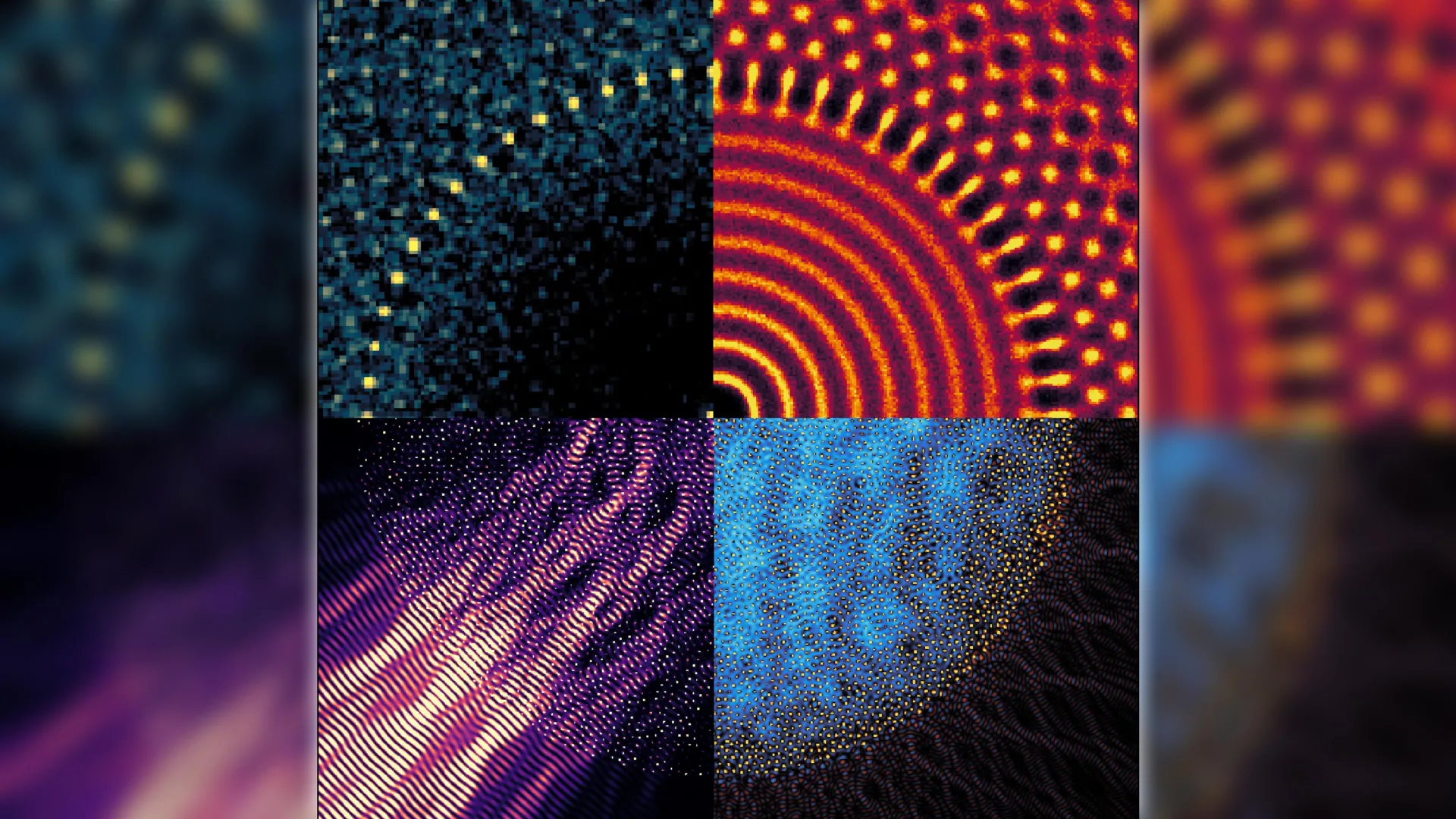
Illustration of a 60-fold gyromorph’s properties. Top row: Structure of the gyromorph. Left: Structure factor. Right: Pair correlation function. Bottom row: Optical properties. Left: Polarized light beam fully reflected by a gyromorph. Right: Density of states depletion in the gyromorph. Credit: The Martiniani lab at NYU

Gyromorphs merge order and disorder to deliver unprecedented light-blocking power for next-generation photonic computers. Researchers engineered “gyromorphs,” a new type of metamaterial that combines liquid-like randomness with large-scale structural patterns to block light from every direction. This innovation solves longstanding limitations in quasicrystal-based designs and could accelerate advances in photonic computing.

Researchers are exploring a new genera...

Read More

Physicists Coax Superconductivity and more from Quasicrystals

Image of a moiré quasicrystal (center column) created by three overlapping sheets of atomically thin graphene.
Credit: Sergio C. de la Barrera, University of Toronto

In research that could jumpstart interest into an enigmatic class of materials known as quasicrystals, MIT scientists and colleagues have discovered a relatively simple, flexible way to create new atomically thin versions that can be tuned for important phenomena. In work reported in Nature they describe doing just that to make the materials exhibit superconductivity and more.

The research introduces a new platform for not only learning more about quasicrystals, but also exploring exotic phenomena that can be hard to study but could lead to important applications and new physics...

Read More

Resurrecting Quasicrystals: Findings make an Exotic Material Commercially Viable

An X-ray tomography visualization shows a top-down view of two quasicrystals as they start to meld together during cooling. Image credit: Shahani Group, University of Michigan

Self-healing phenomenon could reduce defects that rendered quasicrystals impractical. A class of materials that once looked as if it might revolutionize everything from solar cells to frying pans — but fell out of favor in the early 2000s — could be poised for commercial resurrection, findings from a University of Michigan-led research team suggest.

Published in Nature Communications, the study demonstrates a way to make much larger quasicrystals than were possible before, without the defects that plagued past manufacturers and led quasicrystals to be dismissed as an intellectual curiosity.

“One reason why ...

Read More
