Radio Signal tagged posts

Radio signal from the very early universe offers clues about the first stars

The image shows a deep galaxy field, featuring thousands of galaxies of various shapes and sizes

Understanding how the universe transitioned from darkness to light with the formation of the first stars and galaxies is a key turning point in the universe’s development, known as the Cosmic Dawn. However, even with the most powerful telescopes, we can’t directly observe these earliest stars, so determining their properties is one of the biggest challenges in astronomy.

Now, an international group of astronomers led by the University of Cambridge has shown that we will be able to learn about the masses of the earliest stars by studying a specific radio signal—created by hydrogen atoms filling the gaps between star-forming regions—originating just a hundred million years after the Big Bang.

By studying how the first stars and their remnants affected this signal, called the 2...

Read More
Radio Signal Reveals Supernova Origin

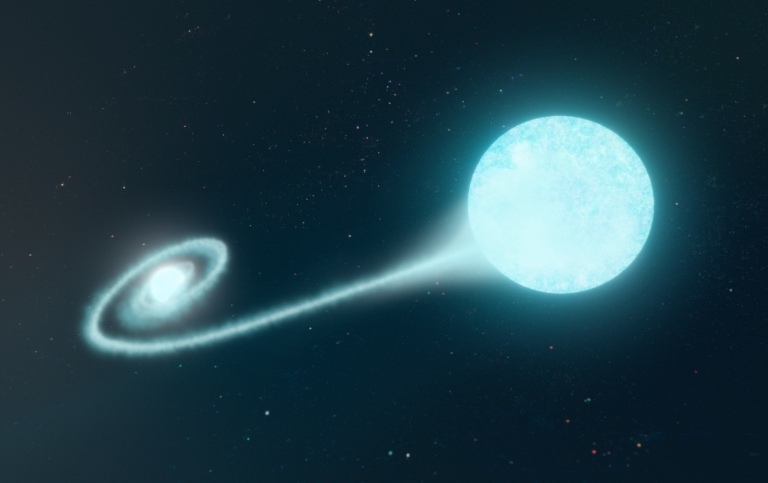
Artists impression of a white dwarf accreting matter from a helium rich companion
Artist impression of the double star system with a compact white dwarf star accreting matter from a helium-rich donor companion. The accretion eventually leads to the white dwarf going supernova. (credit: Adam Makarenko/W. M. Keck Observatory)

In the latest issue of the journal Nature, astronomers from Stockholm University reveal the origin of a thermonuclear supernova explosion. Strong emission lines of helium and the first detection of such a supernova in radio waves show that the exploding white dwarf star had a helium-rich companion.

Supernovae of Type Ia are important for astronomers since they are used to measure the expansion of the Universe. However, the origin of these explosions has remained an open question...

Read More