
REACH tagged posts

Radio signal from the very early universe offers clues about the first stars

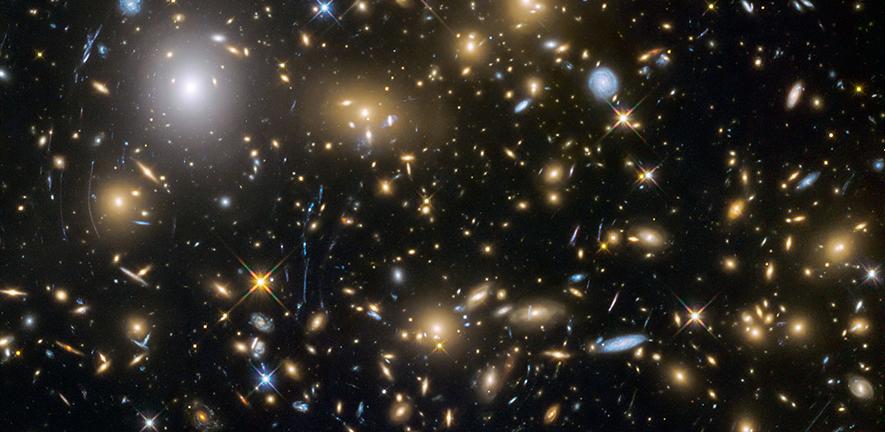
The image shows a deep galaxy field, featuring thousands of galaxies of various shapes and sizes

Understanding how the universe transitioned from darkness to light with the formation of the first stars and galaxies is a key turning point in the universe’s development, known as the Cosmic Dawn. However, even with the most powerful telescopes, we can’t directly observe these earliest stars, so determining their properties is one of the biggest challenges in astronomy.

Now, an international group of astronomers led by the University of Cambridge has shown that we will be able to learn about the masses of the earliest stars by studying a specific radio signal—created by hydrogen atoms filling the gaps between star-forming regions—originating just a hundred million years after the Big Bang.

By studying how the first stars and their remnants affected this signal, called the 2...

Read More
Non-detection of Key Signal allows Astronomers to Determine what the First Galaxies were – and weren’t – like

Observations by the NASA/ESA Hubble Space Telescope have taken advantage of gravitational lensing to reveal the largest sample of the faintest and earliest known galaxies in the universe.
Early galaxies capture by the NASA/ESA Hubble Telescope
Credit: NASA Goddard

Researchers have been able to make some key determinations about the first galaxies to exist, in one of the first astrophysical studies of the period in the early Universe when the first stars and galaxies formed, known as the cosmic dawn.

Using data from India’s SARAS3 radio telescope, researchers led by the University of Cambridge were able to look at the very early Universe — just 200 million years after the Big Bang — and place limits on the mass and energy output of the first stars and galaxies.

Counterintuitively, the researchers were able to place these limits on the earliest galaxies by not finding the signal they had been looking for, known as the 21-centimetre hydrogen line.

This non-detectio...

Read More
