
schizophrenia tagged posts

A “dormant” brain protein turns out to be a powerful switch

Delta-type ionotropic glutamate receptors, or GluDs, are made of four GluD protein subunits that make a single receptor. The blue is D-serine, which is the neurotransmitter that activates the receptor
Delta-type ionotropic glutamate receptors, or GluDs, are made of four GluD protein subunits that make a single receptor. The blue is D-serine, which is the neurotransmitter that activates the receptor. Credit: Edward Twomey, Ph.D.

Researchers at Johns Hopkins Medicine report that they have uncovered a promising drug target that could allow scientists to increase or decrease the activity of specific brain proteins. The discovery may lead to new treatments for psychiatric conditions such as anxiety and schizophrenia, as well as a neurological disorder that affects movement and balance. The work was supported by funding from the National Institutes of Health.

The proteins at the center of the research are known as delta-type ionotropic glutamate receptors, or GluDs...

Read More
Body Versus Brain: New evidence for an Autoimmune cause of Schizophrenia

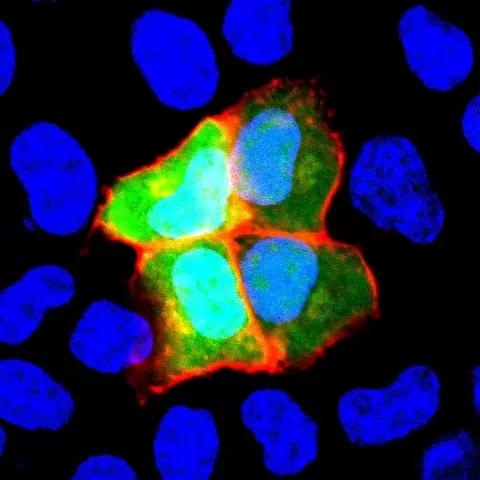
Cell-based assay to detect the anti-NCAM1 autoantibody
NCAM1 is induced only in green cells (HeLa cells). Serum from patients with anti-NCAM1 autoantibody react only to green cells (framed in red).

Researchers have found that some people with schizophrenia have autoantibodies — which are made by the immune system and recognize the body’s own proteins, rather than outside threats such as viruses or bacteria — against NCAM1, a protein that’s importa.nt for communication between brain cells. The patients’ autoantibodies also caused schizophrenia-related behaviors in mice. These findings may improve the diagnosis and treatment of a subset of patients with schizophrenia.

Schizophrenia is a disorder that affects how people act, think, and perceive reality...

Read More
Hippocampus MRI
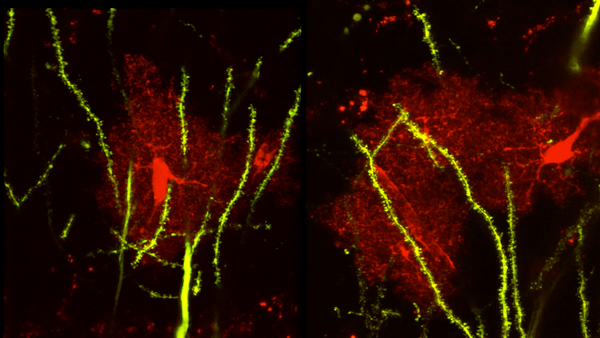
Confocal image of a mouse brain tissue shows the astrocytes (red) and neurons (green). (UCR/Ethell lab)

A team led by a biomedical scientist at the University of California, Riverside has found a new mechanism responsible for the abnormal development of neuronal connections in the mouse brain that leads to seizures and abnormal social behaviors.

The researchers focused on the hippocampus, which plays an important role in learning and social interactions; and synapses, specialized contacts between neurons.

Each neuron in the brain receives numerous excitatory and inhibitory synaptic inputs...

Read More

Broccoli Sprout compound may Restore Brain Chemistry Imbalance linked to Schizophrenia


Sedlak’s daughter grows broccoli sprouts Credit: Thomas Sedlak

In a series of recently published studies using animals and people, Johns Hopkins Medicine researchers say they have further characterized a set of chemical imbalances in the brains of people with schizophrenia related to the chemical glutamate. And they figured out how to tweak the level using a compound derived from broccoli sprouts.

They say the results advance the hope that supplementing with broccoli sprout extract, which contains high levels of the chemical sulforaphane, may someday provide a way to lower the doses of traditional antipsychotic medicines needed to manage schizophrenia symptoms, thus reducing unwanted side effects of the medicines.

“It’s possible that future studies could show sulforaphane to ...

Read More
