
Schwinger Effect tagged posts

Physicists just found a way to make “something from nothing”

AI generated image of a pair of tornadoes
AI generated image of a pair of tornadoes. DeepAI.

Researchers at UBC have found a way to mimic the elusive Schwinger effect using superfluid helium, where vortex pairs appear out of thin films instead of electron-positron pairs in a vacuum. Their work not only offers a cosmic laboratory for otherwise unreachable phenomena, but also changes the way scientists understand vortices, superfluids, and even quantum tunneling.

In 1951, physicist Julian Schwinger theorized that by applying a uniform electrical field to a vacuum, electron-positron pairs would be spontaneously created out of nothing, through a phenomenon called quantum tunneling.

The problem with turning the matter-out-of-nowhere theory into Star Trek replicators or transporters? Enormously high electric fields would be re...

Read More
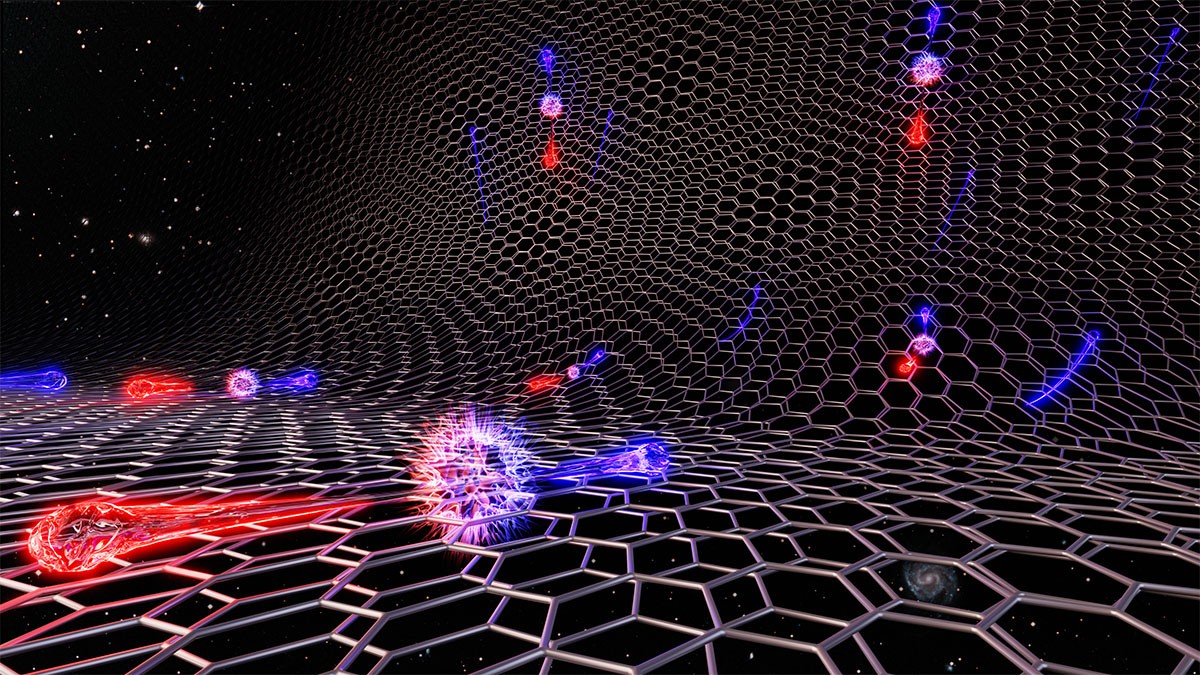
Cosmic Physics Mimicked on Table-Top as Graphene enables Schwinger Effect

Science_final_4k_compositeMatteo

Researchers at The University of Manchester have succeeded in observing the so-called Schwinger effect, an elusive process that normally occurs only in cosmic events. By applying high currents through specially designed graphene-based devices, the team — based at the National Graphene Institute — succeeded in producing particle-antiparticle pairs from a vacuum.

A vacuum is assumed to be completely empty space, without any matter or elementary particles. However, it was predicted by Nobel laureate Julian Schwinger 70 years ago that intense electric or magnetic fields can break down the vacuum and spontaneously create elementary particles.

This requires truly cosmic-strength fields such as those around magnetars or created transitorily during high-e...

Read More
