
seizures tagged posts

Clearing the brain of aging cells could aid epilepsy and reduce seizures

epilepsy
Credit: Pixabay/CC0 Public Domain

Temporal lobe epilepsy, which results in recurring seizures and cognitive dysfunction, is associated with premature aging of brain cells.

A new study by researchers at Georgetown University Medical Center found that this form of epilepsy can be treated in mice by either genetically or pharmaceutically eradicating the aging cells, thereby improving memory and reducing seizures as well as protecting some animals from developing epilepsy.

The study appears in the journal Annals of Neurology.

Current challenges and hopes for treatment
“A third of individuals living with epilepsy don’t achieve freedom from seizures with current medications,” says senior author Patrick A. Forcelli, Ph.D...
Read More
Hippocampus MRI
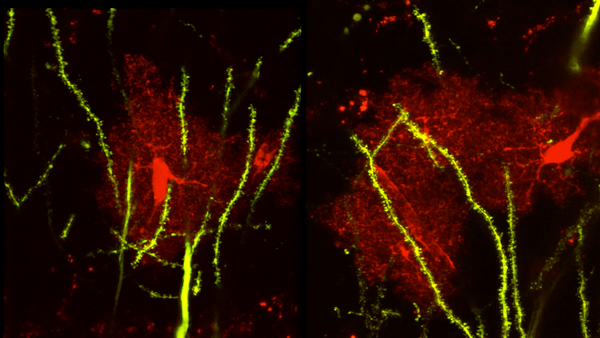
Confocal image of a mouse brain tissue shows the astrocytes (red) and neurons (green). (UCR/Ethell lab)

A team led by a biomedical scientist at the University of California, Riverside has found a new mechanism responsible for the abnormal development of neuronal connections in the mouse brain that leads to seizures and abnormal social behaviors.

The researchers focused on the hippocampus, which plays an important role in learning and social interactions; and synapses, specialized contacts between neurons.

Each neuron in the brain receives numerous excitatory and inhibitory synaptic inputs...

Read More

Genetic Body/Brain Connection Identified in Genomic Region linked to Autism

Jasmine M. McCammon, Alicia Blaker-Lee, Xiao Chen, Hazel Sive. The 16p11.2 homologs fam57ba and doc2a generate certain brain and body phenotypes. Human Molecular Genetics, 2017; DOI: 10.1093/hmg/ddx255

Jasmine M. McCammon, Alicia Blaker-Lee, Xiao Chen, Hazel Sive. The 16p11.2 homologs fam57ba and doc2a generate certain brain and body phenotypes. Human Molecular Genetics, 2017; DOI: 10.1093/hmg/ddx255

For the first time, Whitehead Institute scientists have documented a direct link between deletions in two genes – fam57ba and doc2a – in zebrafish and certain brain and body traits, such as seizures, hyperactivity, enlarged head size, and obesity. “Finding the molecular connections between a brain and a body phenotype is indeed really paradigm shifting,” says Whitehead Institute Member Hazel Sive, who is also a professor of biology at MIT...

Read More
