
shape-shifting tagged posts

Carbon-fiber smart plastic: Self-healing, shape-shifting and stronger than steel

Breakthrough smart plastic: Self-healing, shape-shifting, and stronger than steel

Aerospace engineering and materials science researchers at Texas A&M University have uncovered new properties of an ultra-durable, recyclable, smart plastic—paving the way for transformative applications in the defense, aerospace and automotive industries.

The research, published in Macromolecules and the Journal of Composite Materials, was led by Dr. Mohammad Naraghi, director of the Nanostructured Materials Lab and professor of aerospace engineering at Texas A&M, in close collaboration with Dr. Andreas Polycarpou at The University of Tulsa.

Their work explored the mechanical integrity, shape-recovery and self-healing properties of an advanced carbon-fiber plastic composite called Aromatic Thermosetting Copolyester (ATSP).

Healing damage on demand
ATSP opens new frontiers i...
Read More

Exploding and Weeping Ceramics Provide Path to New Shape-Shifting Material

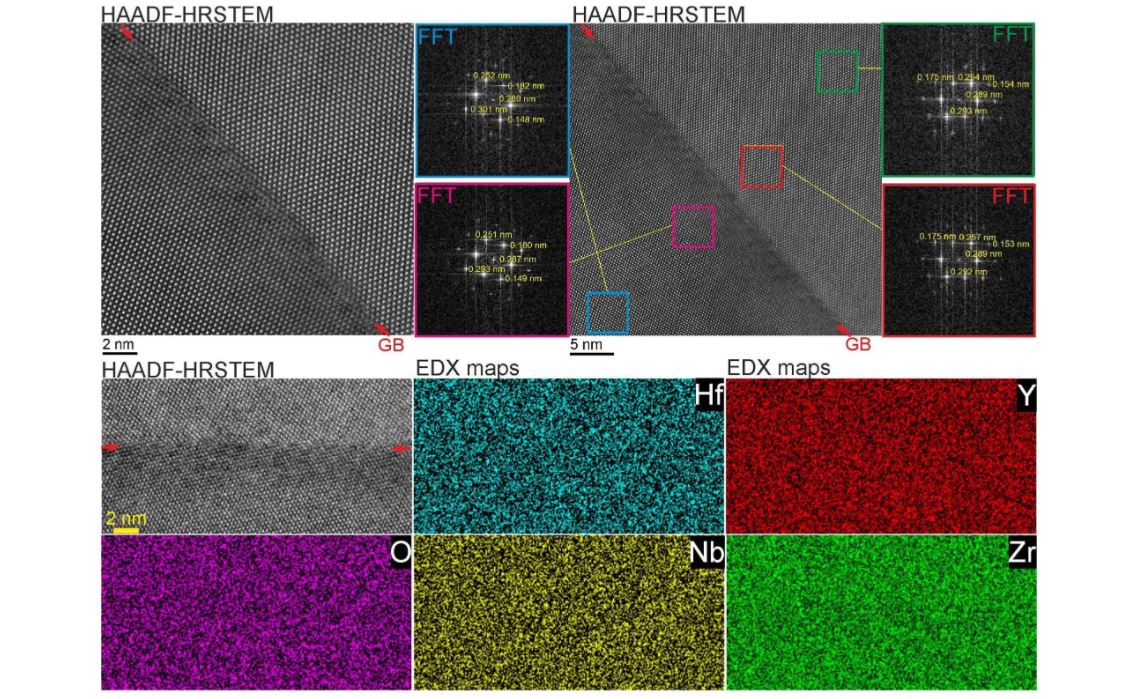
Nanoscale study and local chemical analysis of a grain boundary of a (Zr0.9 Hf0.1 O2)0.775 (Y0.5 Nb0.5 O2)0.225 (weeping) sample prepared by FIB. The micrographs are HAADF-STEM and HAADF-HRSTEM images as well as high resolution EDX elemental maps of the sample. Atomic-resolution HAADF micrographs are raw images, showing no significant intensity variation along the grain boundary (GB). The high resolution EDX maps suggest no significant element segregation at the grain boundary.

Discovery could lead to improvements in medical devices and electronics. An international team of researchers from the University of Minnesota Twin Cities and Kiel University in Germany have discovered a path that could lead to shape-shifting ceramic materials...

Read More

New Shape-Shifting Building Material Based on Pinecones

It’s surface changes appearance automatically when exposed to water, whether directly, or via humidity. Pinecones open when dry and close when wet, to provide optimal conditions for spreading seeds. They do so by simply reacting to water—it seeps into the woody leaves (microsporophylls) and causes them to droop. Inspired by this simple process, student Chao Chen of the Royal College of Art in London dissected cones to see how they were put together and then used what he learned to create objects or coverings.

He has created an artificial pinecone, a wall hanging (or covering) that self-modifies when it gets wet to reveal artful coloring, an overhang that allows light to pass through when the sun is shining, but closes when it rains to keep those underneath dry and a strip for insert...

Read More
