SHARAD tagged posts

Martian volcanoes could be hiding massive glaciers under a blanket of ash

When we think of ice on Mars, we typically think of the poles, where we can see it visibly through probes and even ground-based telescopes. But the poles are hard to access, and even more so given the restrictions on exploration there due to potential biological contamination. Scientists have long hoped to find water closer to the equator, making it more accessible to human explorers. There are parts of the mid-latitudes of Mars that appear to be glaciers covered by thick layers of dust and rock.

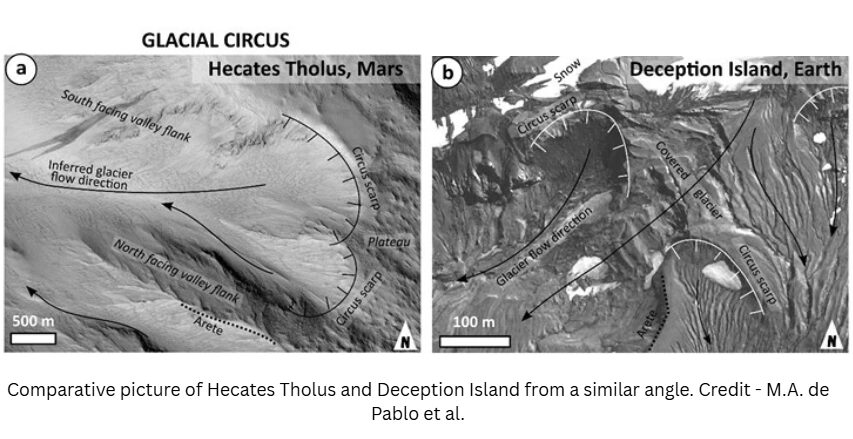
So are these features really holding massive reserves of water close to where humans might first step foot on the red planet? They might be, according to a new paper from M.A. de Pablo and their co-authors, recently published in Icarus.

The key might be a small, volcanic island in Antar...

Read More

Mars Ice Deposit holds as much water as Lake Superior

This vertically exaggerated view shows scalloped depressions in a part of Mars where such textures prompted researchers to check for buried ice, using ground-penetrating radar aboard NASA's Mars Reconnaissance Orbiter. Credit: NASA/JPL-Caltech/Univ. of Arizona

This vertically exaggerated view shows scalloped depressions in a part of Mars where such textures prompted researchers to check for buried ice, using ground-penetrating radar aboard NASA’s Mars Reconnaissance Orbiter. Credit: NASA/JPL-Caltech/Univ. of Arizona

Frozen beneath a region of cracked and pitted plains on Mars lies about as much water as what’s in Lake Superior, largest of the Great Lakes, researchers using NASA’s Mars Reconnaissance Orbiter have determined. Scientists examined part of Mars’ Utopia Planitia region, in the mid-northern latitudes, with the orbiter’s ground-penetrating Shallow Radar (SHARAD) instrument. Analyses of data from >600 overhead passes with the onboard radar instrument reveal a deposit more extensive in area than the state of New Mexico...

Read More