

simulation tagged posts

Photons collide in the void: Quantum simulation creates light out of nothing

Illustration of photon-photon scattering in the laboratory. Two green petawatt lasers beams collide at the focus with a third red beam to polarise the quantum vacuum. This allows a fourth blue laser beam to be generated, with a unique direction and colour, which conserves momemtum and energy.

Using advanced computational modelling, a research team led by the University of Oxford, working in partnership with the Instituto Superior Técnico in the University of Lisbon, has achieved the first-ever real-time, three-dimensional simulations of how intense laser beams alter the ‘quantum vacuum’ — a state once assumed to be empty, but which quantum physics predicts is full of virtual electron-positron pairs.

The results have been published in Communications Physics.
Using advanced computational modelling, a research team led by the University of Oxford, working in partnership with the Instituto Superior Técnico in the University of Lisbon, has achieved the first-ever real-time, three-dimensional simulations of how intense laser beams alter the ‘quantum vacuum’ — a state once ass...

Read More

Simulation Sheds Light on Earth’s Magnetic Field Generation while Advancing Neuromorphic Computing

New simulation method sharpens our view into the Earth’s interior—method could advance neuromorphic computing for AI
Structure of the Earth. Credit: B. Schröder/HZDR/NASA/Goddard Space Flight Center Scientific Visualization Studio

How does the Earth generate its magnetic field? While the basic mechanisms seem to be understood, many details remain unresolved. A team of researchers from the Center for Advanced Systems Understanding at the Helmholtz-Zentrum Dresden-Rossendorf, Sandia National Laboratories (U.S.) and the French Alternative Energies and Atomic Energy Commission has introduced a simulation method that promises new insights into the Earth’s core.

The method, presented in the Proceedings of the National Academy of Sciences, simulates not only the behavior of atoms, but also the magnetic properties of materials...

Read More

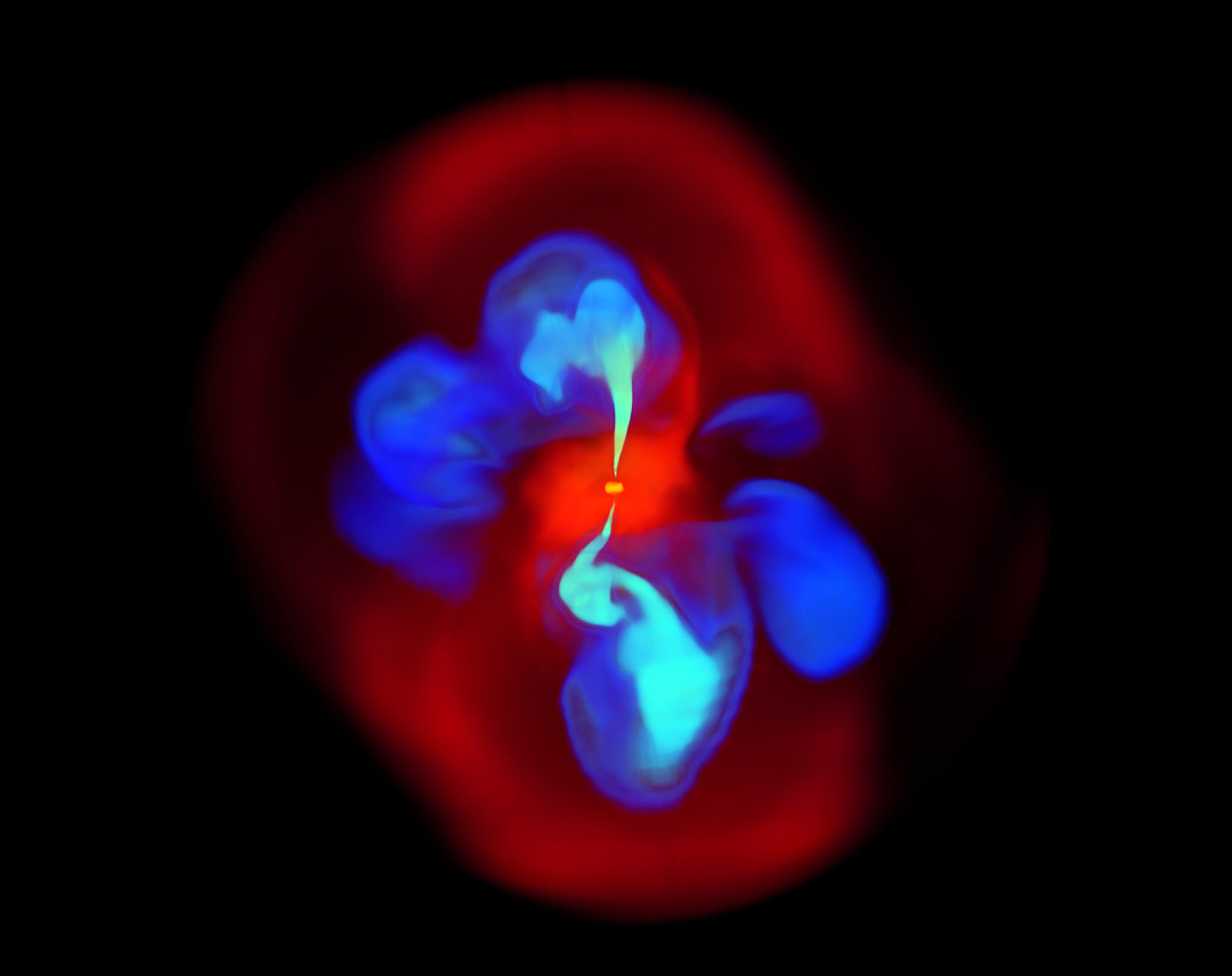
X-Shaped Radio Galaxies might Form More Simply than expected

X-shaped radio galaxies might form more simply than expected

Simple simulation accidentally leads to X-shaped galaxy for first time. When astronomers use radio telescopes to gaze into the night sky, they typically see elliptical-shaped galaxies, with twin jets blasting from either side of their central supermassive black hole. But every once in a while — less than 10% of the time — astronomers might spot something special and rare: An X-shaped radio galaxy, with four jets extending far into space.

Although these mysterious X-shaped radio galaxies have confounded astrophysicists for two decades, a new Northwestern University study sheds new insight into how they form — and its surprisingly simple. The study also found that X-shaped radio galaxies might be more common than previously thought.

The study will be published on Aug...

Read More
