
solar storm tagged posts

“This Appears To Be A Universal Law”: 50-Year-Old Mystery About Our Sun’s Storms May Have Been Solved

For around half a century, scientists have been puzzled by the odd spectral lines produced by solar flares. Now we may have some answers.
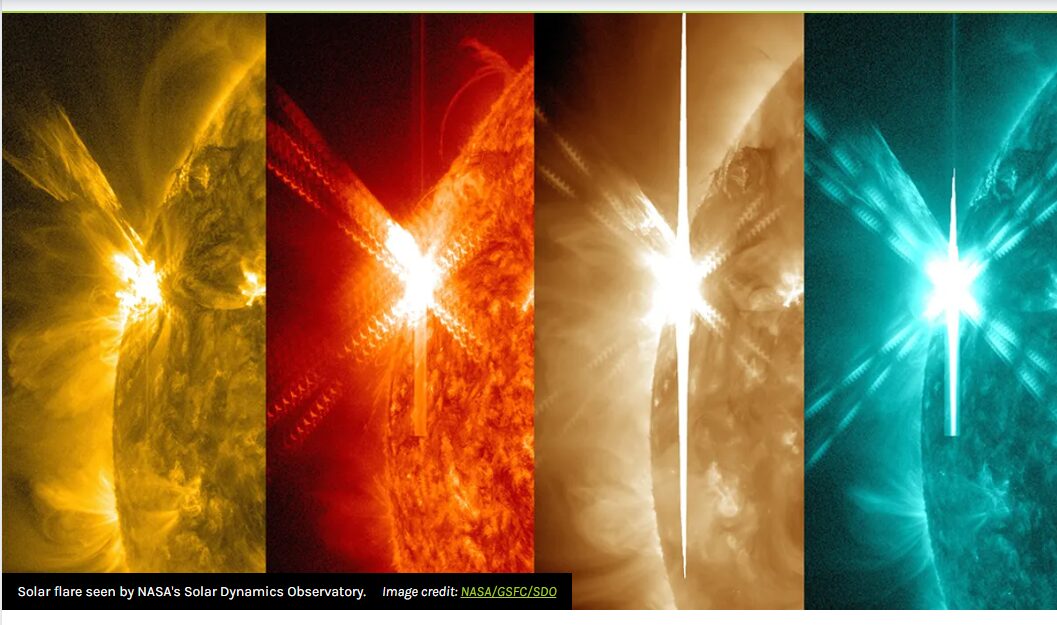
Anew study looking at solar flares may have solved a 50-year-old mystery about our host star, finding that solar flares may be far hotter than we realized.

Solar flares are a common event on the Sun’s surface. They can be seen regularly throughout the year, and particularly during the solar maximum phase of the Sun’s cycle.

“A solar flare is an intense burst of radiation coming from the release of magnetic energy associated with sunspots. Flares are our solar system’s largest explosive events. They are seen as bright areas on the Sun and they can last from minutes to hours,” NASA explains...

Read More
Sun unleashes monster solar storm: Rare G4 alert issued for earth

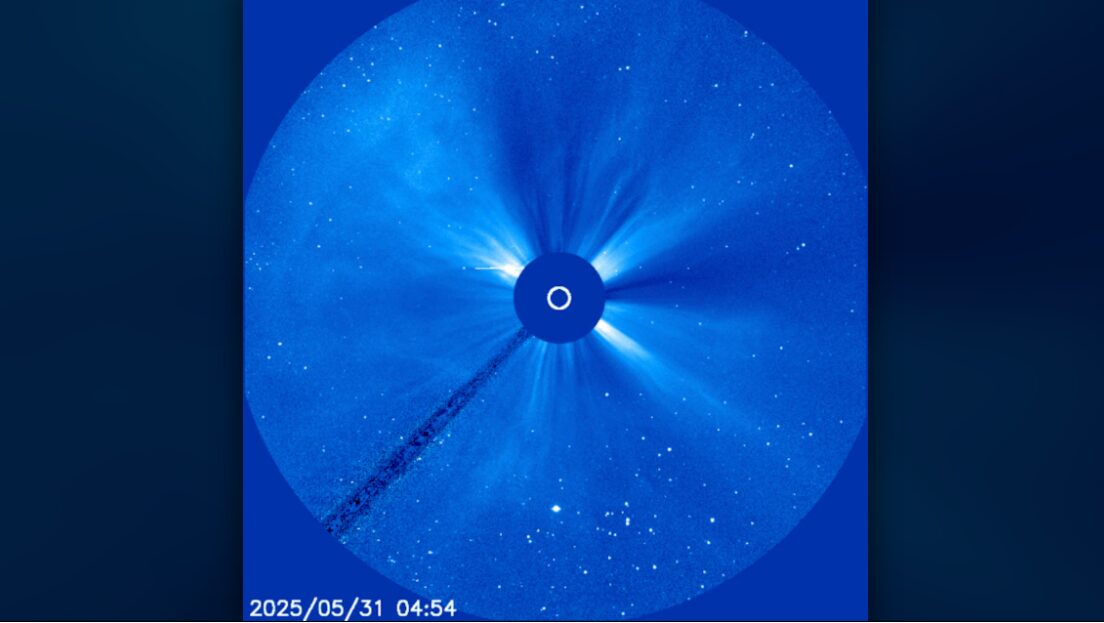
A violent solar eruption on May 31 launched a coronal mass ejection (CME) hurtling toward Earth, triggering a rare G4-level geomagnetic storm alert. Captured in real-time by U.S. Naval Research Laboratory instruments, this cosmic blast has the potential to disrupt satellites, communications, and military systems.

Local weather alerts are familiar warnings for potentially dangerous conditions, but an alert that puts all of Earth on warning is rare.

On May 31, U.S. Naval Research Laboratory’s (NRL) space-based instrumentation captured real-time observations of a powerful Coronal Mass Ejection (CME) that erupted from the Sun initiating a “severe geomagnetic storm” alert for Earth.

“Our observations demonstrated that the eruption was a so-called ‘halo CME,’ meaning it was Earth-d...

Read More

Magnetic Field Maps of the Sun’s Corona

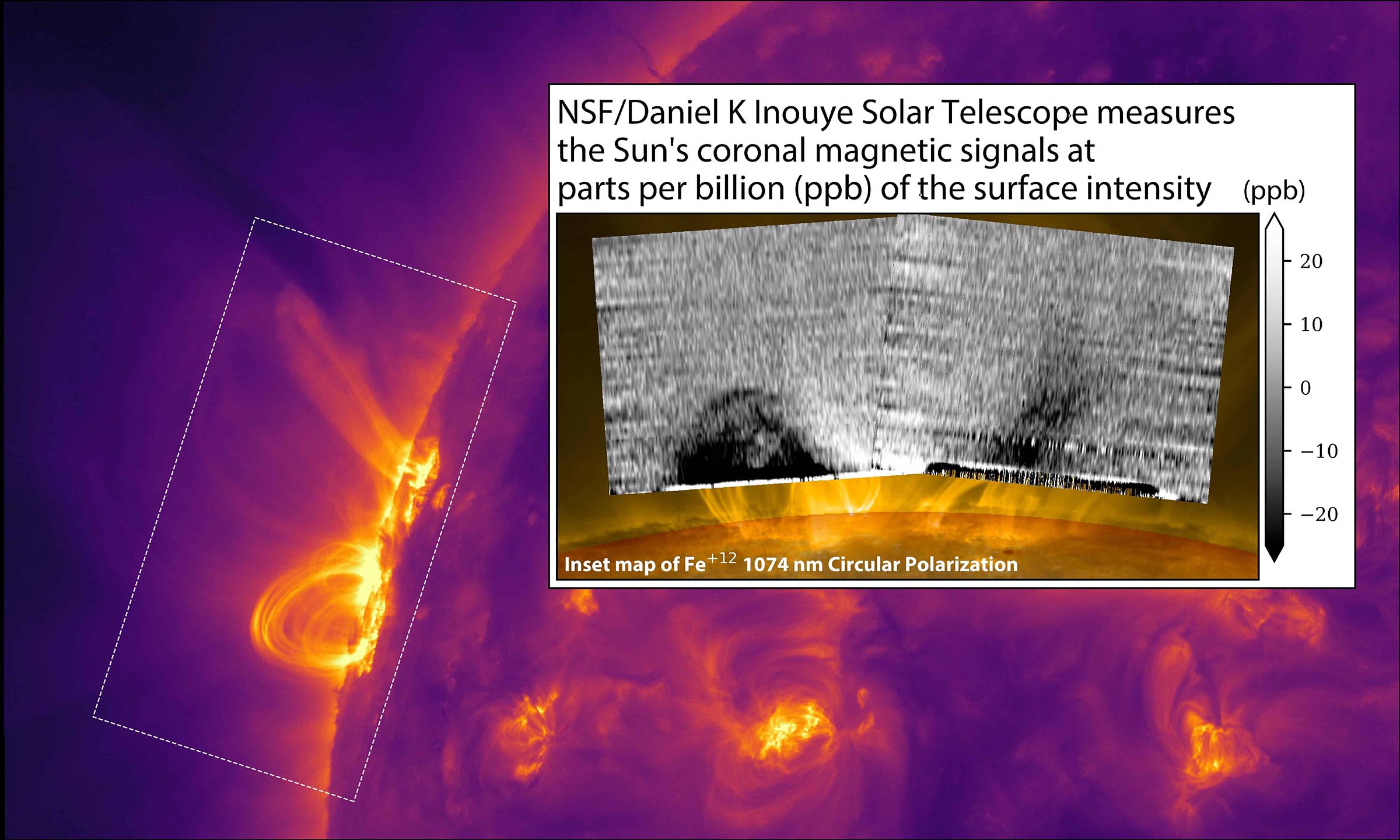
A purple and yellow image shows flares coming off the side of the sun and looping back. An inset shows the actual data of the coronal map  in black and white
The NSF Daniel K. Inouye Solar Telescope presents its first map of the solar coronal magnetic field signals as measured using the Zeeman Effect. The Zeeman Effect polarizes the coronal emission, which requires the advancements of the Inouye Solar Telescope to measure as its signals are only a few parts per billion of the Sun’s surface brightness. The background image identifies the region observed in detail by Inouye as imaged by NASA’s Solar Dynamics Observatory in ultraviolet light. Credit: NSF/NSO/AURA

The U.S. National Science Foundation (NSF) Daniel K...

Read More

New Tools for Predicting Arrival, Impact of Solar Storms

On Jan. 7, 2014, the Sun's surface erupted with an unusually large explosion, called coronal mass ejection (CME), with NOAA releasing a significant false alarm geomagnetic storm at Earth. Credit: NASA

On Jan. 7, 2014, the Sun’s surface erupted with an unusually large explosion, called coronal mass ejection (CME), with NOAA releasing a significant false alarm geomagnetic storm at Earth. Credit: NASA

When the sun hurls a billion tons of high-energy particles and magnetic fields into space at speeds of >a million miles/ hour and the ‘space weather’ conditions are right, the resulting geomagnetic storm at Earth can wreak havoc on communication and navigation systems, electrical power grids, and pose radiation hazards to astronauts and airline passengers and crew.

University of New Hampshire’s Space Science Center (SSC) scientists are now adding some powerful tools to the predictive toolbox using data from NASA’s MErcury Surface, Space ENvironment, Geo-chemistry, and Ranging, or MESSENGER,...

Read More
