solar system tagged posts

Astronomers uncover enormous bubble bigger than our Solar System

Colourful clouds of gas against a dark background - a huge bubble ejected from a supergiant star thousands of years ago
The vast bubble around red supergiant star DFK 52, imaged by Alma. Red colours indicate gas moving away from us, blue denotes gas moving toward us. Credit: ALMA(ESO/NAOJ/NRAO)/M. Siebert et al.

A giant bubble of gas and dust surrounds the red supergiant DFK 52, likely created in a powerful outburst 4,000 years ago. Astronomers are baffled at how the star survived without going supernova, and suspect a hidden companion may have played a role. This discovery could reveal clues about the final stages of massive stars.

Astronomers from Chalmers University of Technology, Sweden, have discovered a vast and expanding bubble of gas and dust surrounding a red supergiant star – the largest structure of its kind ever seen in the Milky Way...

Read More
The solar system’s greatest mystery may finally be solved

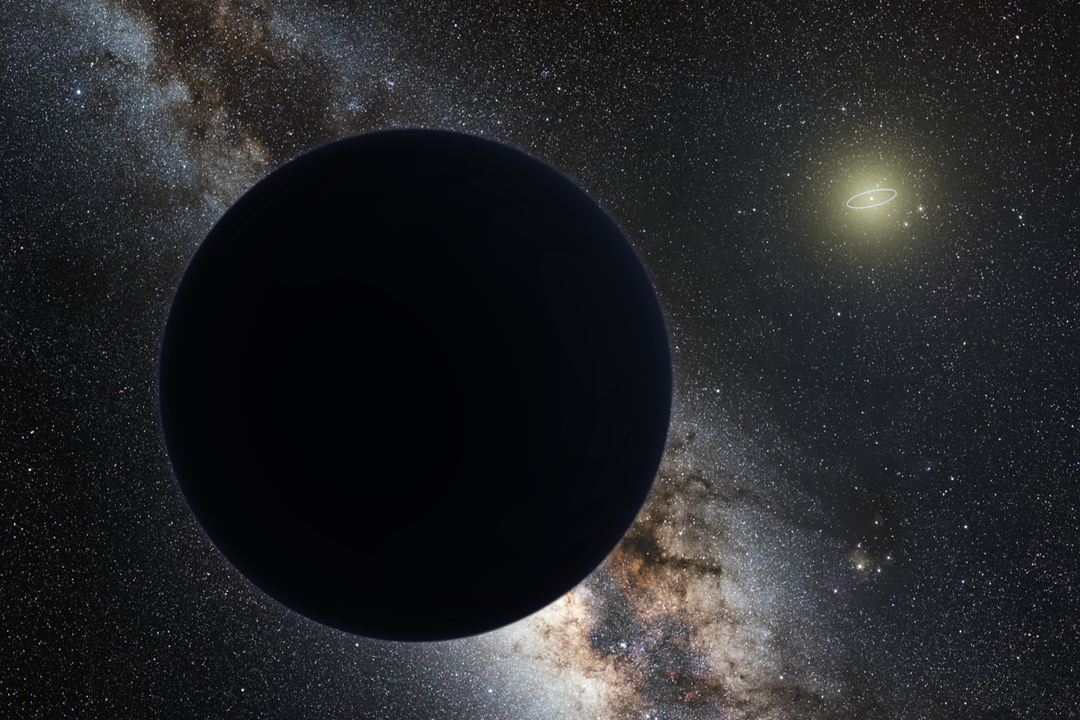
Artist's impression of Planet Nine as an ice giant eclipsing the central Milky Way, with a star-like Sun in the distance. Neptune's orbit is shown as a small ellipse around the Sun. (Credit : Nagual Design)
Artist’s impression of Planet Nine as an ice giant eclipsing the central Milky Way, with a star-like Sun in the distance. Neptune’s orbit is shown as a small ellipse around the Sun. (Credit : Nagual Design)

For years, astronomers have been searching for a mysterious ninth planet lurking in the dark outer reaches of our solar system. Now, a team of researchers have taken a completely different approach to this cosmic detective story—instead of looking for reflected sunlight, they’re hunting for the planet’s own heat signature.

The story begins with a puzzle in the outer solar system. Scientists noticed that small icy bodies called Kuiper Belt Objects, which orbit far beyond Neptune, seem to be clustered together in unusual ways...

Read More

JWST captures its first direct images of carbon dioxide outside solar system

HR 8799
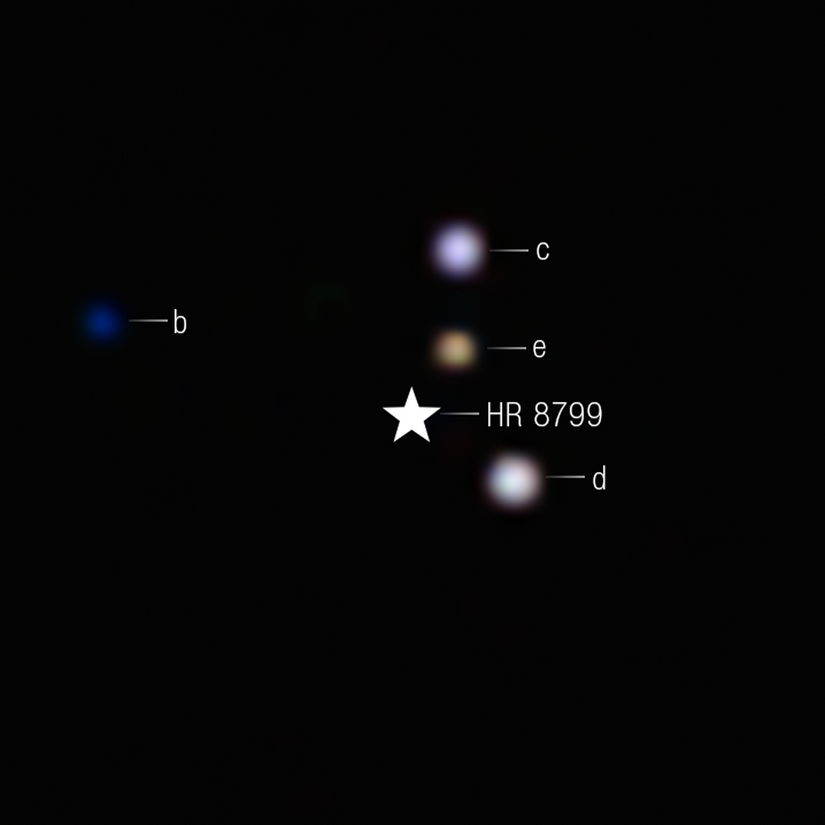
The clearest look yet in the infrared at the iconic multi-planet system HR 8799. Colors are applied to filters from Webb’s NIRCam (Near-Infrared Camera). A star symbol marks the location of the host star HR 8799, whose light has been blocked by the coronagraph. In this image, the color blue is assigned to 4.1 micron light, green to 4.3 micron light, and red to the 4.6 micron light.
Image credit: NASA, ESA, CSA, STScI, W. Balmer (JHU), L. Pueyo (STScI), M. Perrin (STScI)

The James Webb Space Telescope has captured its first direct images of carbon dioxide in a planet outside the solar system in HR8799, a multiplanet system 130 light-years away that has long been a key target for planet formation studies.

The observations provide strong evidence that the system’s four giant planets ...

Read More

Meteorites likely Source of Nitrogen for Early Earth

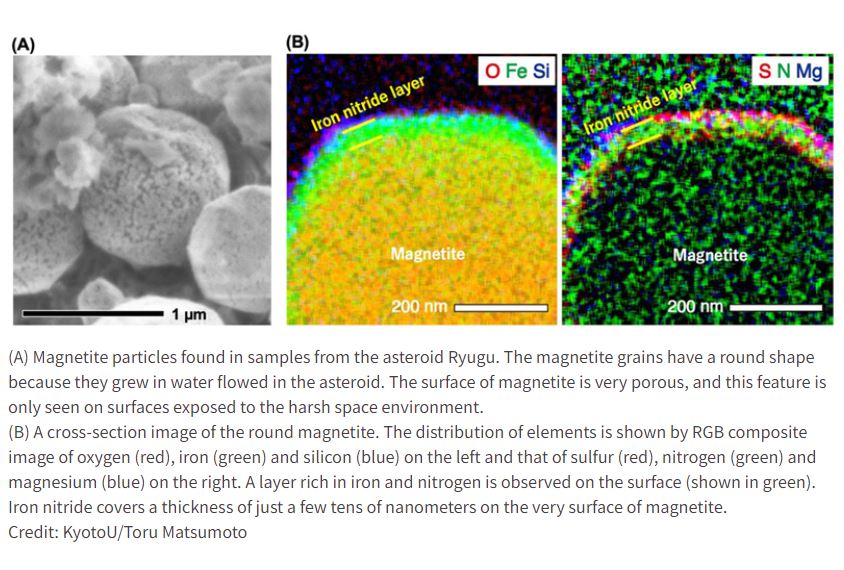
Results of study from Ryugu samples.

Micrometeorites originating from icy celestial bodies in the outer Solar System may be responsible for transporting nitrogen to the near-Earth region in the early days of our solar system. That discovery was published today in Nature Astronomy by an international team of researchers, including University of Hawai’i at Manoa scientists, led by Kyoto University.

Nitrogen compounds, such as ammonium salts, are abundant in material born in regions far from the sun, but evidence of their transport to Earth’s orbital region had been poorly understood.

“Our recent findings suggests the possibility that a greater amount of nitrogen compounds than previously recognized was transported near Earth, potentially serving as building blocks for life on o...

Read More