
Space tagged posts

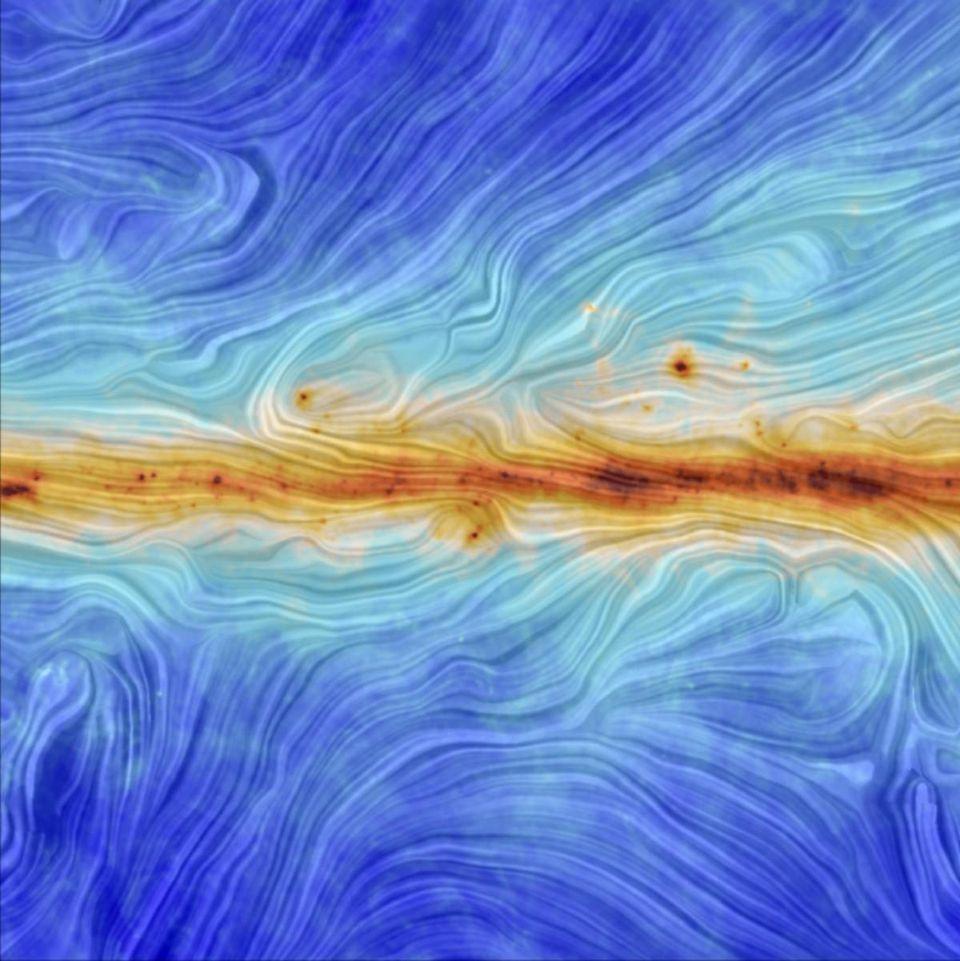
Unlocking the secrets of our galaxy’s heart using magnetic fields

The dust in the Milky Way, shown in darker and redder colours, are regions where new star formation is taking place. These dusty regions are correlated with the magnetic fields present in our galaxy, and the background light gets polarised in a measurable way as a result. (Credit : NASA/ESA)

Deep in the heart of our galaxy lies one of the most chaotic and mysterious regions in space. Now, scientists have created the first detailed map of magnetic fields in this turbulent zone, providing crucial insights into how stars form and evolve in extreme environments.

The research, led by University of Chicago Ph.D. student Roy Zhao, focused on a region called Sagittarius C, located in the c near the center of the Milky Way...

Read More

Astronomers see Ring of Rocks Circling Very Young Star


These ‘pebbles’ detected for 1st time: crucial link in building planets. Since1990s, astronomers have found both disks of gas and dust, and nearly 2000 fully formed planets, but the intermediate stages of formation are harder to detect.

Dr Greaves and Dr Anita Richards from Manchester University used e-MERLIN array of radio telescopes centred on Jodrell Bank, Cheshire, and that stretches across England in an interferometer, mimicking resolution of a single large telescope. They observed the star DG Tauri, a youthful star just 2.5 million years old and 450 light years away in constellation of Taurus. Looking at radio wavelengths, they discovered a faint glow characteristic of rocks in orbit around the newly formed star.

An artist's impression of the belt of ‘pebbles’ in orbit around the star DG Tauri. The inset is a close up view of a section of the belt.

An artist’s imp...

Read More

Universe’s Hidden Supermassive Black Holes revealed

 An artist’s illustration of a supermassive black hole, actively feasting on its surroundings. The central black hole is hidden from direct view by a thick layer of encircling gas and dust

An artist’s illustration of a supermassive black hole, actively feasting on its surroundings. The central black hole is hidden from direct view by a thick layer of encircling gas and dust. Credit: NASA/ESA.

Using NASA’s Nuclear Spectroscopic Telescope Array (NuSTAR) satellite observatory, a Durnham University team detected high-energy xrays from 5 supermassive black holes previously clouded from direct view by dust and gas. It supports the theory that potentially millions more supermassive black holes exist in the Universe, but are hidden from view.

The scientists pointed NuSTAR at 9 candidate hidden supermassive black holes that were thought to be extremely active at the centre of galaxies, but where the full extent of this activity was potentially obscured from view.
High-energy x-r...

Read More
