
spinal cord injuries tagged posts

Clinical trial shows improvements for spinal cord injuries

The leadership group for the Texas Biomedical Device Center includes, from left, Dr. Michael Kilgard, Dr. Jane Wigginton, Dr. Seth Hays and Dr. Robert Rennaker.

Researchers demonstrated unprecedented rates of recovery for spinal cord injuries. Individuals with incomplete spinal cord injury safely received a combination of stimulation of a nerve in the neck with progressive, individualized rehabilitation. This approach, called closed-loop vagus nerve stimulation (CLV), produced meaningful improvements in arm and hand function in these individuals.

In a new clinical study, researchers from the Texas Biomedical Device Center (TxBDC) at The University of Texas at Dallas demonstrated unprecedented rates of recovery for spinal cord injuries.

In this study, published in the journal Natu...

Read More
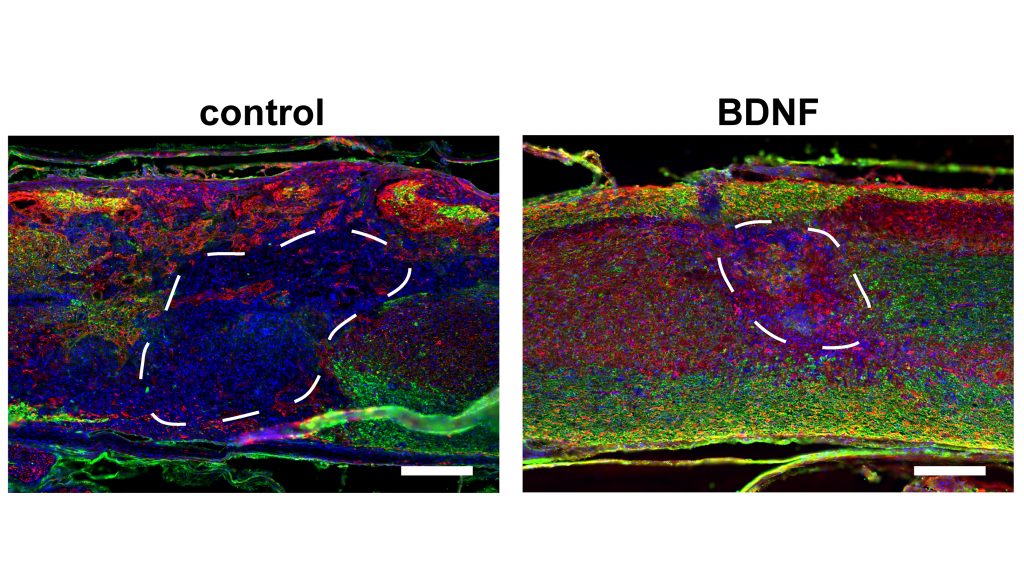
Injectable Porous Scaffolds Promote Better, Quicker Healing after Spinal Cord Injuries

Images show myelinated axons in biomaterial scaffolds eight weeks after injection into the injured cord of a mouse. Scaffolds were fabricated from hyaluronic acid (HA) with a regular network of cell-scale macropores and loaded with gene therapy vectors encoding for brain-derived neurotrophic factor (BDNF), to promote axonal survival and regeneration. These were compared to control scaffolds, which were lacking the BDNF vector. Images show dense infiltration of cells (shown in blue, cell nuclei), axons (shown in red in A, NF200 protein) and myelinating glial cells (shown in green, myelin basic protein) in the BDNF-laden scaffolds. Scale bars = 200 µm. CREDIT: Seidlits et al.
Images show myelinated axons in biomaterial scaffolds eight weeks after injection into the injured cord of a mouse. 

Hydrogel scaffolds with regularly spaced pores encourage spinal cords cells to grow, improve regeneration of nerve cells. Researchers have developed materials that can interface with an injured spinal cord and provide a scaffolding to facilitate healing. To do this, scaffolding materials need to mimic the natural spinal cord tissue, so they can be readily populated by native cells in the spinal cord, essentially filling in gaps left by injury. The researchers show how the pores improve efficiency of gene therapies administered locally to the injured tissues, which can further promote tissue regeneration.

Spinal cord injuries can be life-changing and alter many importa...

Read More

Protein found that Improves Mobility after Spinal Cord Injuries

Injured mouse spinal cord. Credit: UAB

Injured mouse spinal cord. Credit: UAB

Spinal cord injuries cause severe functional disabilities in those who sustain them, including paraplegia or tetraplegia, depending on the scale of the injury. This is due to the degeneration of the spinal pathways that carry nerve signals from the brain to the different parts of the body and vice versa, resulting in loss of mobility and sensitivity underneath the injured area. Over the past few years, different studies have shown that the inflammatory response that develops after an injury contributes to the degeneration of these pathways, thus increasing the functional deficits brought by the injury. However, clinical trials using anti-inflammatory drugs like methylprednisolone have not proven their efficacy.

This work shows for the first time that ...

Read More
