Standard Model of Particle Physics tagged posts

Is there a Right-handed version of our Left-handed Universe?

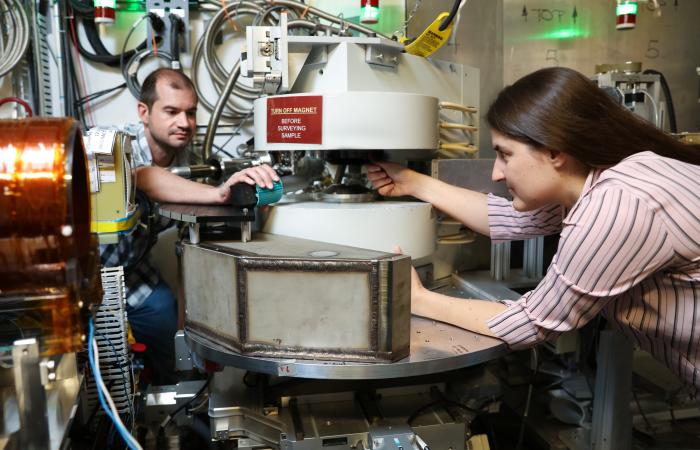
From left, ORNL’s Matthew Frost and Leah Broussard used a neutron scattering instrument at the Spallation Neutron Source to search for a dark matter twin to the neutron. Credit: Genevieve Martin/ORNL, U.S. Dept. of Energy

To solve a long-standing puzzle about how long a neutron can “live” outside an atomic nucleus, physicists entertained a wild but testable theory positing the existence of a right-handed version of our left-handed universe. They designed a mind-bending experiment at the Department of Energy’s Oak Ridge National Laboratory to try to detect a particle that has been speculated but not spotted...

Read More

How Earth Stops High-Energy Neutrinos in their Tracks

This image shows a visual representation of one of the highest-energy neutrino detections superimposed on a view of the IceCube Lab at the South Pole. Credit: IceCube Collaboration

This image shows a visual representation of one of the highest-energy neutrino detections superimposed on a view of the IceCube Lab at the South Pole. Credit: IceCube Collaboration

For the first time, a science experiment has measured Earth’s ability to absorb neutrinos – the smaller-than-an-atom particles that zoom throughout space and through us by the trillions every second at nearly the speed of light. The experiment was achieved with the IceCube detector, an array of 5,160 basketball-sized sensors frozen deep within a cubic kilometer of very clear ice near the South Pole.

“This achievement is important because it shows, for the first time, that very-high-energy neutrinos can be absorbed by something – in this case, the Earth,” said Doug Cowen, professor of physics and astronomy & as...

Read More

Neutrino discovery—a step closer to finding Charge-Parity Violation

The detected pattern of an electron neutrino candidate event observed by Super-Kamiokande. Credit: University of Tokyo Read more at: https://phys.org/news/2017-06-neutrino-discoverya-closer-charge-parity-violation.html#jCp

The detected pattern of an electron neutrino candidate event observed by Super-Kamiokande. Credit: University of Tokyo

The different rates of neutrino and anti-neutrino oscillations recorded by an international collaboration of researchers in Japan—including from Kavli IPMU—is an important step in the search for a new source of asymmetry in the laws that govern matter and antimatter. The Standard Model of particle physics describes the basic building blocks of matter and how they interact. It also makes a point that for every particle created, there is an anti-particle...

Read More