
stellar explosions tagged posts

Close-up images show how stars explode in real time

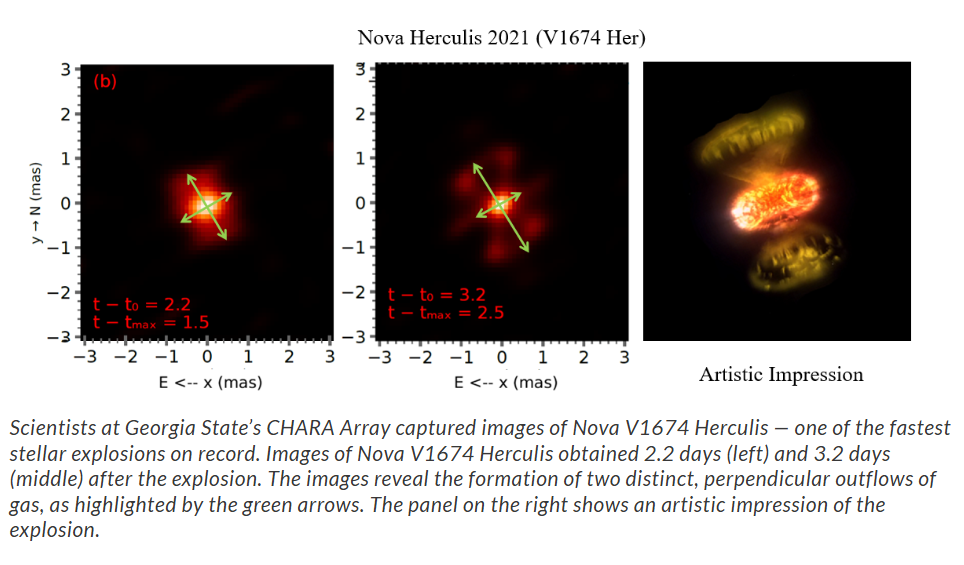
Astronomers have captured images of two stellar explosions—known as novae—within days of their eruption and in unprecedented detail. The breakthrough provides direct evidence that these explosions are more complex than previously thought, with multiple outflows of material and, in some cases, dramatic delays in the ejection process.

The international study, published in the journal Nature Astronomy, used a cutting-edge technique called interferometry at the Center for High Angular Resolution Astronomy (CHARA Array) in California. This approach allowed scientists to combine the light from multiple telescopes, achieving the sharp resolution needed to directly image the rapidly evolving explosions.

“The images give us a close-up view of how material is ejected away from the sta...

Read More

Stardust in the Antarctic Snow

Antarctica illustration (stock image).
Credit: © Elenarts / Adobe Stock

Iron-60 discovery in the Antarctic provides information on the environment of solar system. The rare isotope iron-60 is created in massive stellar explosions. Only a very small amount of this isotope reaches Earth from distant stars. Now, a research team with significant involvement from the Technical University of Munich (TUM) has discovered iron-60 in Antarctic snow for the first time. The scientists suggest that the iron isotope comes from the interstellar neighborhood.

The quantity of cosmic dust that trickles down to Earth each year ranges between several thousand and ten thousand tons. Most of the tiny particles come from asteroids or comets within our solar system...

Read More
