
Stellar-mass black holes tagged posts

Scientists discover how stellar-mass black holes emit powerful plasma jets

Scientists discover how stellar-mass black holes emit powerful plasma jets
The inner edge of the gas disk rapidly shrinks towards the innermost stable circular orbit (ISCO) near the stellar black hole, triggering the eruption of a plasma jet. The jet continues to erupt until the inner edge stops moving, at which point the jet ceases. Credit: T. Kawaguchi (University of Toyama) & K. Yamaoka (Nagoya University)

Black holes are fundamental to the structure of galaxies and critical in our understanding of gravity, space, and time. A stellar mass black hole is a type of black hole that forms from the gravitational collapse of a massive star at the end of its life cycle. These black holes typically have masses ranging from about 3 to 20 times the mass of our sun.

Sometimes black holes generate beams of ionized gas (plasma) that shoot outward at nearly light spee...

Read More
Study Predicts Black Hole Chirps occur in Two Universal Frequency Ranges

The universal sound of black holes
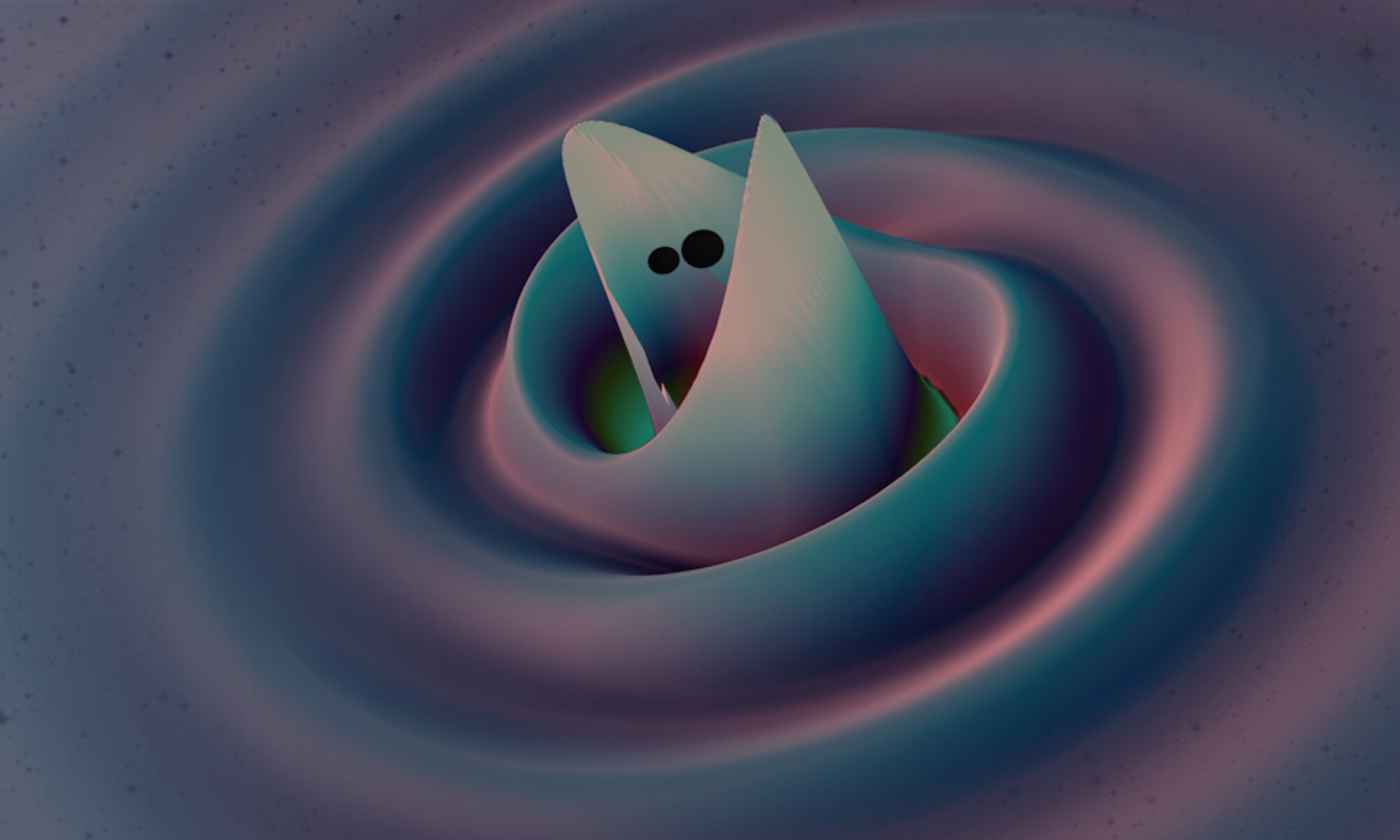
Ripples in the spacetime around a merging binary black-hole system from a numerical relativity simulation. Credit: Deborah Ferguson, Karan Jani, Deirdre Shoemaker, Pablo Laguna, Georgia Tech, MAYA Collaboration

They are mysterious, exciting and inescapable—black holes are some of the most exotic objects in the universe. With gravitational-wave detectors, it is possible to detect the chirp sound that two black holes produce when they merge, approximately 70 such chirps have been found so far.

A team of researchers at the Heidelberg Institute for Theoretical Studies (HITS) now predicts that in this “ocean of voices” chirps preferentially occur in two universal frequency ranges. The study has been published in The Astrophysical Journal Letters.

The discovery of gravitational waves...

Read More
