sun's corona tagged posts

Scientists discover elusive solar waves that could power the sun’s corona

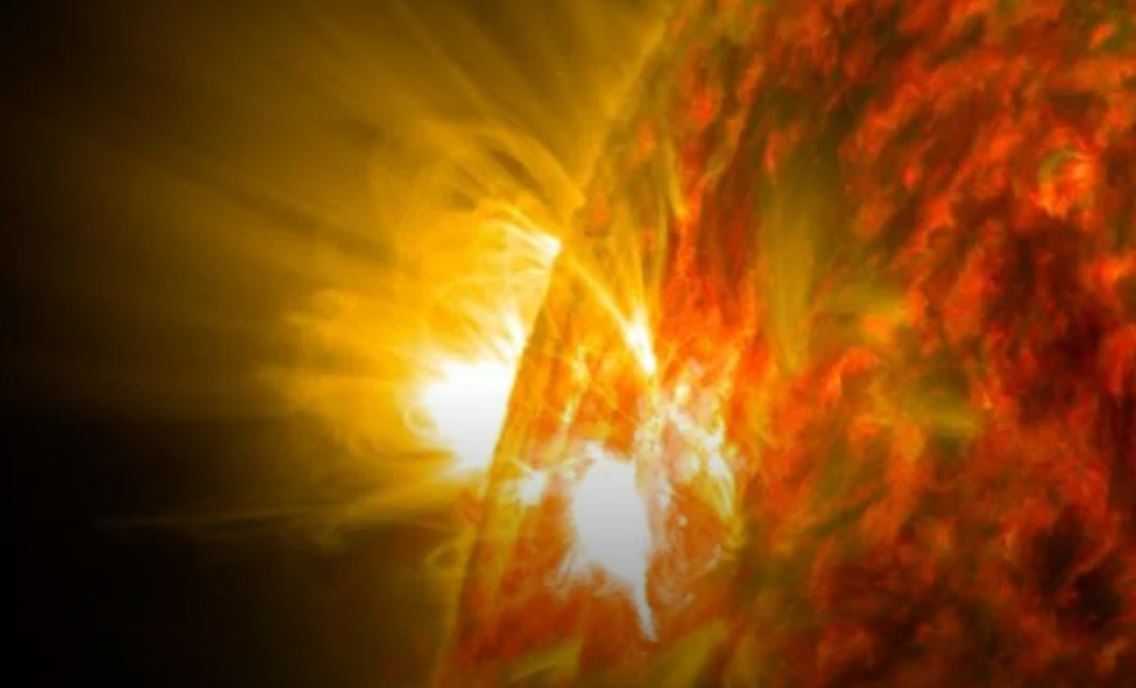
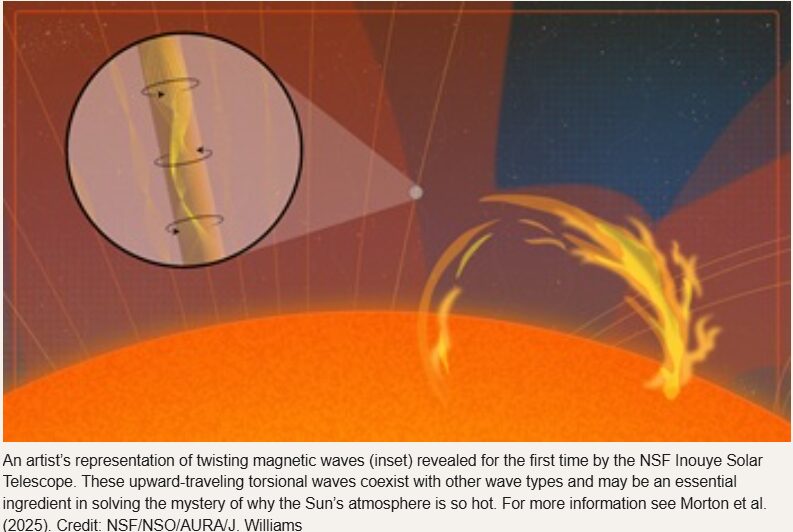
Researchers have achieved a breakthrough in solar physics by providing the first direct evidence of small-scale torsional Alfvén waves in the sun’s corona—elusive magnetic waves that scientists have been searching for since the 1940s.

The discovery, published in Nature Astronomy, was made using unprecedented observations from the world’s most powerful solar telescope, the U.S. National Science Foundation (NSF) Daniel K. Inouye Solar Telescope in Hawaii.

The findings could finally explain one of the sun’s greatest mysteries—how its outer atmosphere, the corona, reaches temperatures of millions of degrees while its surface is only around 5,500°C.

Alfvén waves, named after Nobel Prize winner Hannes Alfvén who predicted their existence in 1942, are magnetic disturbances tha...

Read More

‘Raindrops in the Sun’s corona’: New adaptive optics shows stunning details of our star’s atmosphere

This image of a prominence above the solar surface is a snapshot of a 4-minute time-lapse movie that reveals its rapid, fine, and turbulent restructuring with unprecedented detail. The Sun’s fluffy-looking surface is covered by “spicules”, short-lived plasma jets, whose creation is still the subject of scientific debate. The streaks on the right of this image are coronal rain falling down onto the Sun’s surface. This image was taken by the Goode Solar Telescope at Big Bear Solar Observatory using the new coronal adaptive optics system Cona. The image shows the hydrogen-alpha light emitted by the solar plasma. The image is artificially colorized, yet based on the color of hydrogen-alpha light, and darker color is brighter light. Credit: Schmidt et al./NJIT/NSO/AURA/NSF

Scientist...

Read More

Magnetic Field Maps of the Sun’s Corona

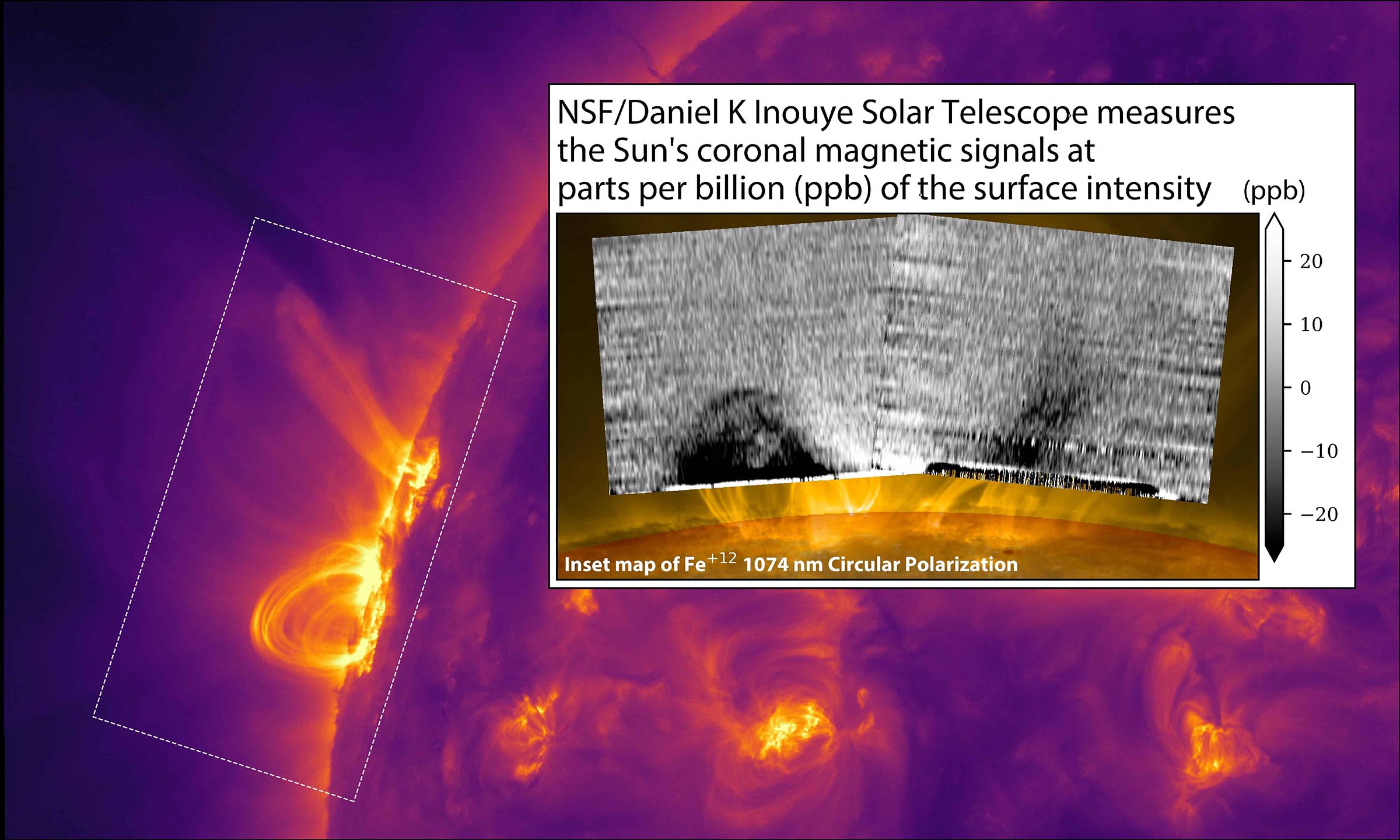
A purple and yellow image shows flares coming off the side of the sun and looping back. An inset shows the actual data of the coronal map  in black and white
The NSF Daniel K. Inouye Solar Telescope presents its first map of the solar coronal magnetic field signals as measured using the Zeeman Effect. The Zeeman Effect polarizes the coronal emission, which requires the advancements of the Inouye Solar Telescope to measure as its signals are only a few parts per billion of the Sun’s surface brightness. The background image identifies the region observed in detail by Inouye as imaged by NASA’s Solar Dynamics Observatory in ultraviolet light. Credit: NSF/NSO/AURA

The U.S. National Science Foundation (NSF) Daniel K...

Read More

How 1,000 Undergraduates helped Solve an Enduring Mystery about the Sun

For a new study, a team of physicists recruited roughly 1,000 undergraduate students at the University of Colorado Boulder to help answer one of the most enduring questions about the sun: How does the star’s outermost atmosphere, or “corona,” get so hot?

The research represents a nearly-unprecedented feat of data analysis: From 2020 to 2022, the small army of mostly first- and second-year students examined the physics of more than 600 real solar flares—gigantic eruptions of energy from the sun’s roiling corona.

The researchers, including 995 undergraduate and graduate students, published their finding in The Astrophysical Journal. The results suggest that solar flares may not be responsible for superheating the sun’s corona, as a popular theory in astrophysics suggests.

“We...

Read More