
Supercomputer Simulations tagged posts

Dark energy might be changing and so is the Universe

Dark Energy Might Be Changing
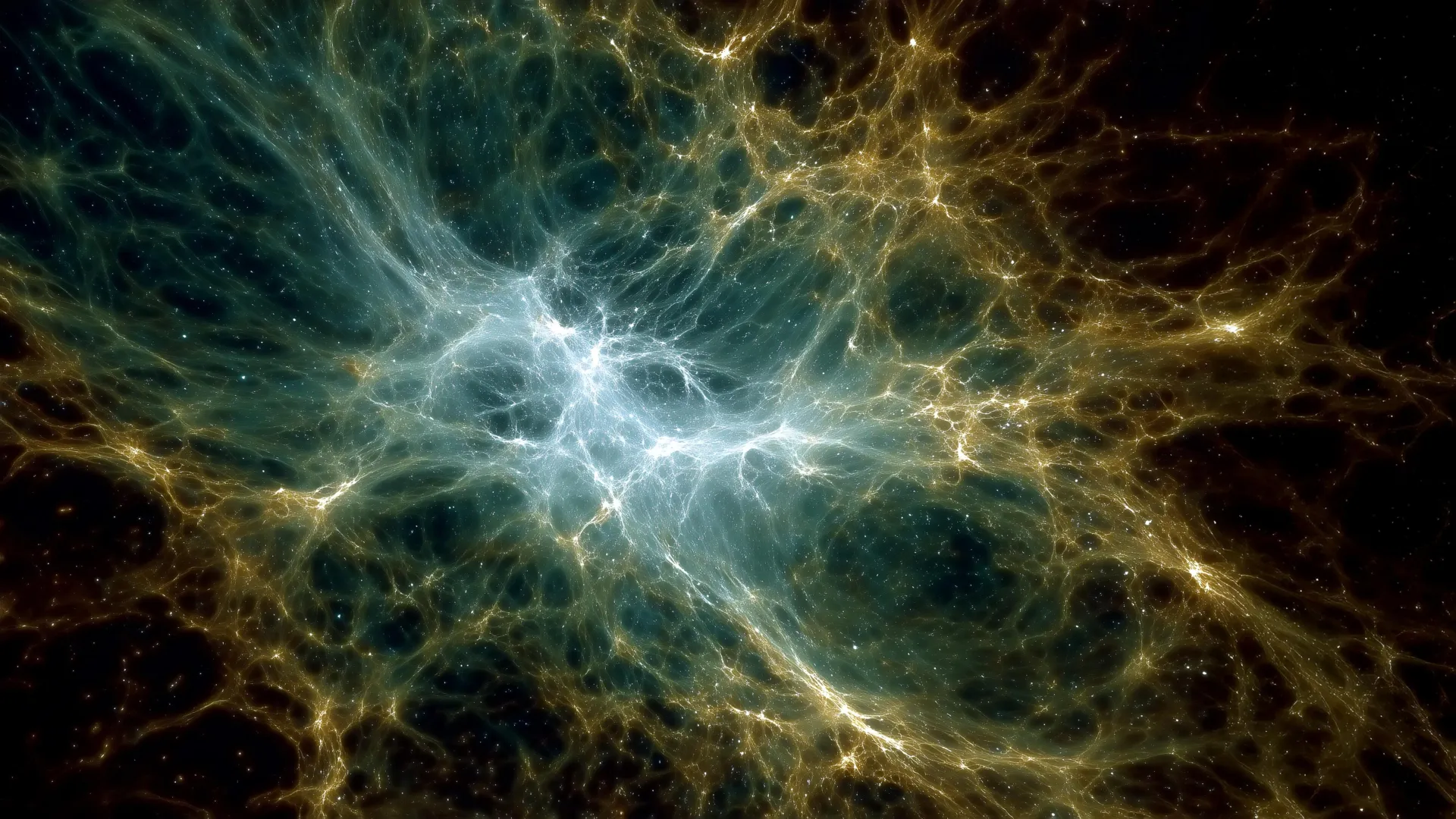
A groundbreaking simulation study has revealed that dark energy, the mysterious force driving the Universe’s accelerated expansion, may not be constant after all. Credit: AI/ScienceDaily.com

Dark energy may be alive and changing, reshaping the cosmos in ways we’re only beginning to uncover. New supercomputer simulations hint that dark energy might be dynamic, not constant, subtly reshaping the Universe’s structure. The findings align with recent DESI observations, offering the strongest evidence yet for an evolving cosmic force.

Since the early 20th century, scientists have gathered convincing evidence that the Universe is expanding — and that this expansion is accelerating...

Read More

Cosmological Enigma of Milky Way’s Satellite Galaxies Solved

Simulation.jpeg
One of the new high-resolution simulations of the dark matter enveloping the Milky Way and its neighbour, the Andromeda galaxy. The new study shows that earlier, failed attempts to find counterparts of the plane of satellites which surrounds the Milky Way in dark matter simulations was due to a lack of resolution.
CREDIT
Till Sawala/Sibelius collaboration

Astronomers say they have solved an outstanding problem that challenged our understanding of how the universe evolved—the spatial distribution of faint satellite galaxies orbiting the Milky Way.

These satellite galaxies exhibit a bizarre alignment—they seem to lie on an enormous thin rotating plane—called the “plane of satellites.”

This seemingly unlikely arrangement had puzzled astronomers for over 50 years, leading many to...

Read More

Cracking a Mystery of Massive Black Holes and Quasars with Supercomputer Simulations

Distribution of gas across scales, with the gas density increasing from purple to yellow. The top left panel shows a large region containing tens of galaxies (6 million light-years across). Subsequent panels zoom in progressively into the nuclear region of the most massive galaxy and down to the vicinity of the central supermassive black hole. Gas clumps and filaments fall from the inner edge of the central cavity occasionally feeding the black hole. Credit: Anglés-Alcázar et al. 2021, ApJ, 917, 53.
Distribution of gas across scales, with the gas density increasing from purple to yellow. The top left panel shows a large region containing tens of galaxies (6 million light-years across). Subsequent panels zoom in progressively into the nuclear region of the most massive galaxy and down to the vicinity of the central supermassive black hole. Gas clumps and filaments fall from the inner edge of the central cavity occasionally feeding the black hole.
(Credit: Anglés-Alcázar et al. 2021, ApJ, 917, 53.)

Cracking a mystery of massive black holes and quasars with supercomputer simulations. At the center of galaxies, like our own Milky Way, lie massive black holes surrounded by spinning gas...

Read More
