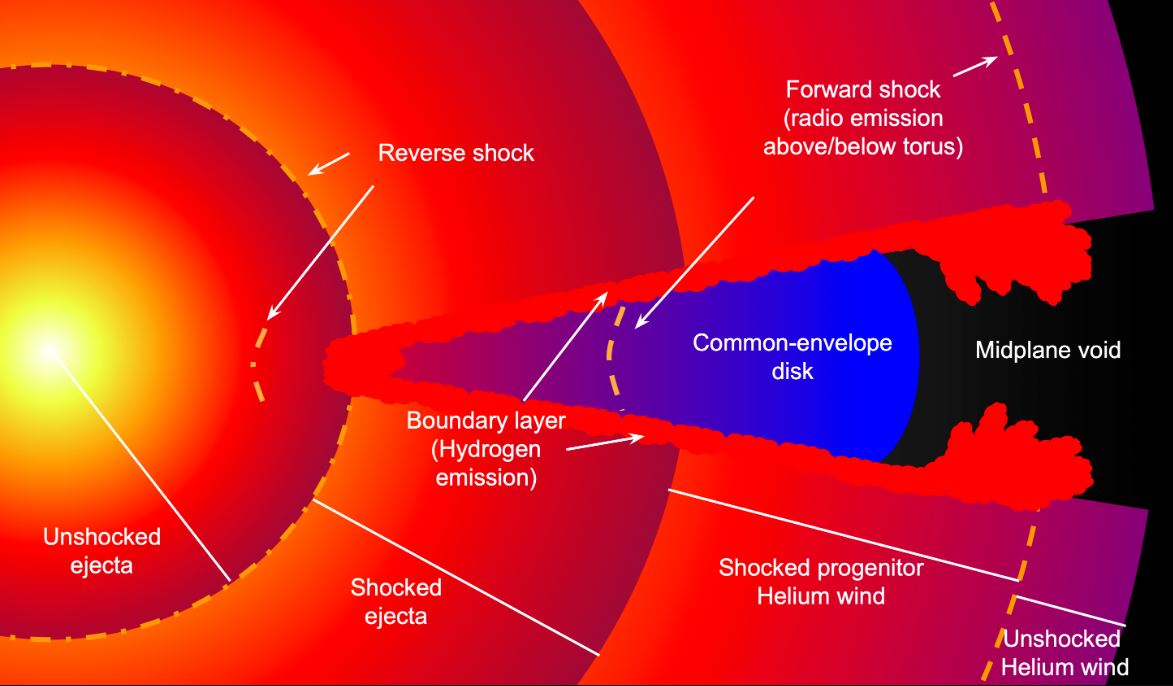
This schematic of Supernova 2014C shows the various ejecta and winds (red and purple) given off by the exploding star (left, yellow). The common-envelope disk (blue) surrounds both stars, the one exploding as a supernova and its binary partner (not shown). The boundary layer around the common-envelope disk is the source of the hydrogen the team detected. (credit: B. Thomas et al./UT Austin)
An international group of astronomers led by Benjamin Thomas of The University of Texas at Austin has used observations from the Hobby-Eberly Telescope (HET) at the university’s McDonald Observatory to unlock a puzzling mystery about a stellar explosion discovered several years ago and evolving even now...






Recent Comments