
telecommunications tagged posts

Record-breaking photons at telecom wavelengths – on-demand

Record-breaking photons at telecom wavelengths — on demand
Nico Hauser (left) with other researchers from the Barz group, University of Stuttgart. Credit: Barz Group, University of Stuttgart / Ludmilla Parsyak

A team of researchers from the University of Stuttgart and the Julius-Maximilians-Universität Würzburg led by Prof. Stefanie Barz (University of Stuttgart) has demonstrated a source of single photons that combines on-demand operation with record-high photon quality in the telecommunications C-band—a key step toward scalable photonic quantum computation and quantum communication. “The lack of a high-quality on-demand C-band photon source has been a major problem in quantum optics laboratories for over a decade—our new technology now removes this obstacle,” says Prof. Stefanie Barz.

The key: Identical photons on demand
In everyday ...
Read More

Telecommunications beyond 6G: the first standalone spinwave chip with a built-in magnetic field

Cross-section and top view of the magnonic device with integrated micromagnets

Credit
Politecnico di Milano

The Politecnico di Milano has created the first integrated and fully tunable device based on spin waves, opening up new possibilities for the telecommunications of the future, far beyond current 5G and 6G standards. The study, published in the journal Advanced Materials, was conducted by a research group led by Riccardo Bertacco of the Department of Physics of the Politecnico di Milano, in collaboration with Philipp Pirro of Rheinland-Pfälzische Technische Universität and Silvia Tacchi of Istituto Officina dei Materiali—CNR-IOM.

Magnonics is an emerging technology that uses spin waves—collective excitations of electronic spins in magnetic materials—as an alternative to elect...

Read More

Intelligent Optical Chip to Improve Telecommunications

Intelligent optical chip to improve telecommunications
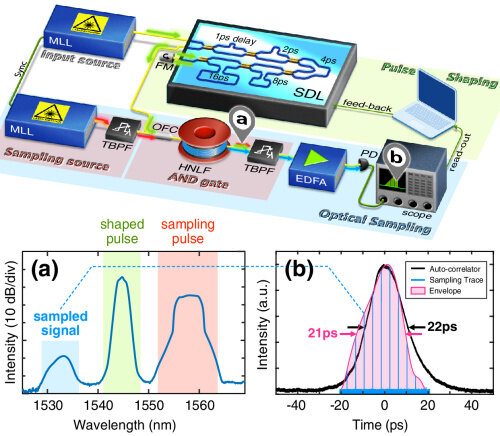
Experimental setup for the optical pulse shaping. SDL, split-and-delay line; MLL, mode-locked laser; PD, photodiode; FM, Faraday mirror; TBPF, tunable bandpass filter; HNLF, highly nonlinear fiber; EDFA, erbium-doped fiber amplifier; OFC, optical fiber coupler. Inset (a) Optical FWM spectrum after HNLF; inset (b) sampling characterization: sampled waveform from the oscilloscope after calibration (in blue), retrieved waveform from the sampling (pink area), and autocorrelation trace (solid black line, measured with a Femtochrome FR-103XL autocorrelator). The autocorrelation factor (i.e., 0.707) has been applied to the presented time axis. Hence, both displayed values show the FWHM pulse width. Credit: Institut national de la recherche scientifique – INRS

From the internet, to fiber or sa...

Read More

Graphene paves the way to Faster High-speed Optical Communications

Electrical control of third harmonic generation (THG) can be obtained in single-layer graphene. In THG three low-frequency photons (red) sum up to generate one high-frequency (blue) photon. For this reason, THG can be used for optical frequency converters. Credit: Giancarlo Soavi, University of Cambridge

Electrical control of third harmonic generation (THG) can be obtained in single-layer graphene. In THG three low-frequency photons (red) sum up to generate one high-frequency (blue) photon. For this reason, THG can be used for optical frequency converters. Credit: Giancarlo Soavi, University of Cambridge

Technology could lead to new devices for faster, more reliable ultra-broad bandwidth transfers. For the first time, researchers demonstrated how electrical fields boost the non-linear optical effects of graphene. Graphene, among other materials, can capture photons, combine them, and produce a more powerful optical beam. This is due to a physical phenomenon called the optical harmonic generation, which is characteristic of nonlinear materials...

Read More
