
tidal disruption events tagged posts

JWST uncovers hidden black holes devouring stars in dusty galaxies

The James Webb Space Telescope in front of a tidal disruption event, a black hole shredding a star
Caption:Astronomers at MIT, Columbia University, and elsewhere have used NASA’s James Webb Space Telescope to peer through the dust of nearby galaxies and into the aftermath of a black hole’s stellar feast. Credits:Credit: NRAO/AUI/NSF/NASA

Astronomers at MIT, Columbia University, and elsewhere have used NASA’s James Webb Space Telescope (JWST) to peer through the dust of nearby galaxies and into the aftermath of a black hole’s stellar feast.

In a study appearing today in Astrophysical Journal Letters, the researchers report that for the first time, JWST has observed several tidal disruption events—instances when a galaxy’s central black hole draws in a nearby star and whips up tidal forces that tear the star to shreds, giving off an enormous burst of energy in the process.

...Read More
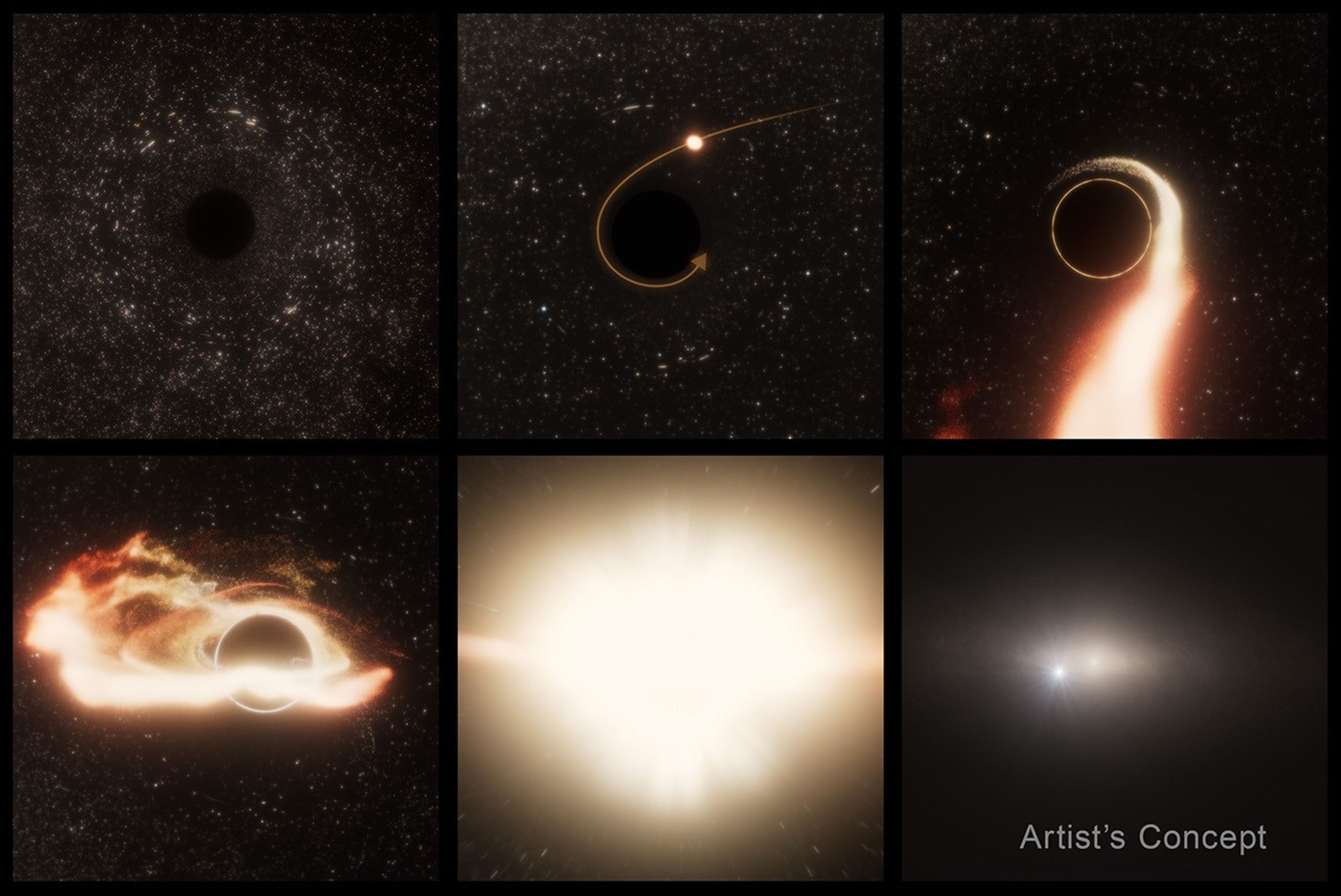
Hubble pinpoints roaming massive black hole

Six-panel illustration marked "Artist's Concept." The upper left panel shows the silhouette of supermassive black hole that is adrift inside a galaxy. The middle upper panel shows a yellow star drifting near the black hole. The three following panels show the star being shredded in bright white concentric streamers followed by a white explosion. the bottom right panel is an external view of the galaxy showing a bright white star-like object that is the site if the explosion as viewed in X-rays and visible light.
This six-panel illustration of a tidal disruption event around a supermassive black hole shows the following: 1) A supermassive black hole is adrift inside a galaxy, its presence only detectable by gravitational lensing; 2) A wayward star gets swept up in the black hole’s intense gravitational pull; 3) The star is stretched or “spaghettified” by gravitational tidal effects; 4) The star’s remnants form a disk around the black hole; 5) There is a period of black hole accretion, pouring out radiation across the electromagnetic spectrum, from X-rays to radio wavelengths; and 6) The host galaxy, seen from afar, contains a bright flash of energy that is offset from the galaxy’s nucleus, where an even more massive black hole dwells.
Artwork: NASA, ESA, STScI, Ralf Crawford (STScI)

Like a scene...

Read More

Mysteriously bright flash is a black hole jet pointing straight toward Earth, astronomers say

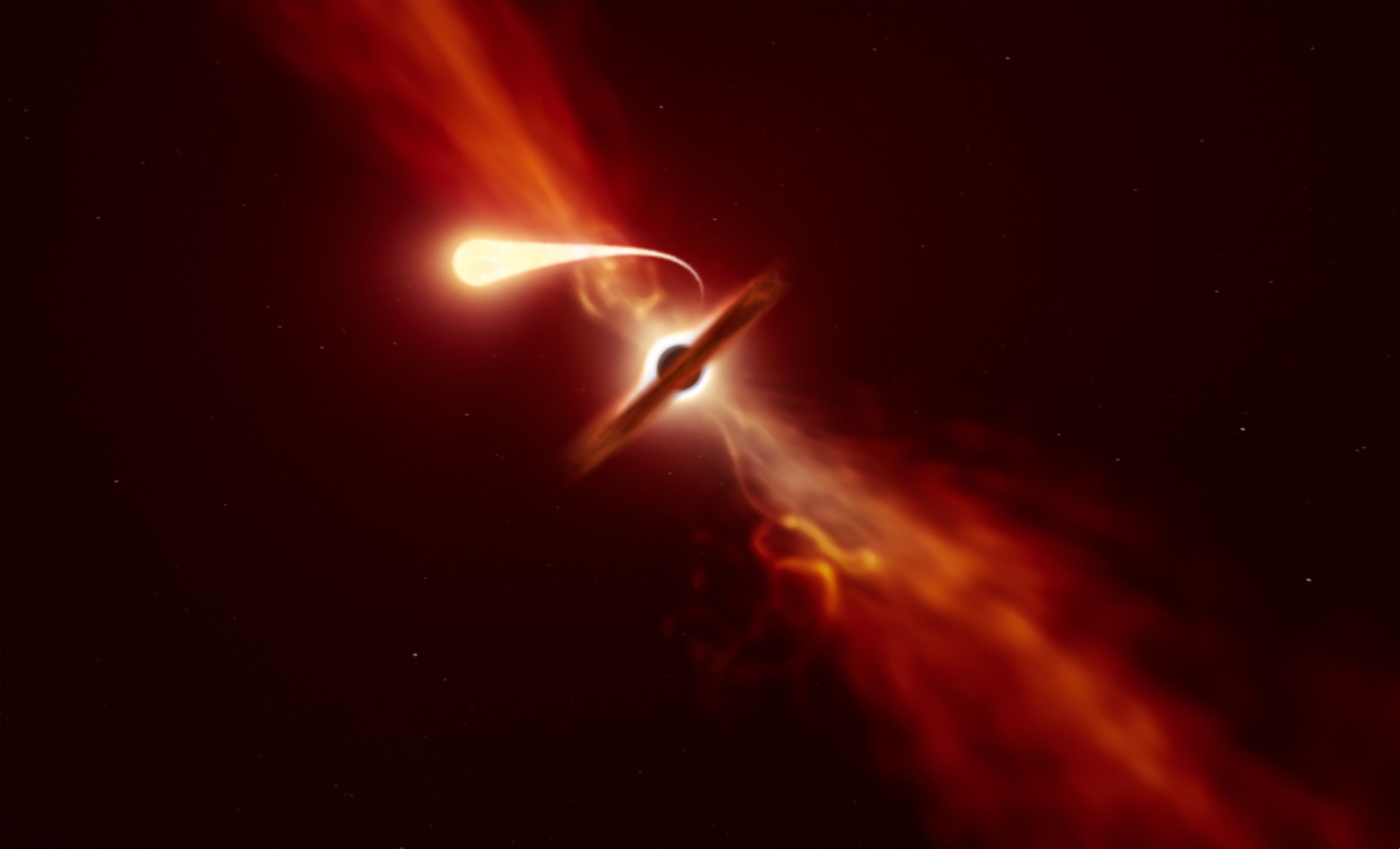
Artist’s impression of star being tidally disrupted by a supermassive black hole
Artist’s impression of star being tidally disrupted by a supermassive black hole Credit: ESO/M. Kornmesser

Astronomers have determined the source of an incredibly bright X-ray, optical and radio signal appearing from halfway across the Universe.

The signal, named AT 2022cmc, was discovered earlier this year by the Zwicky Transient Facility in California. Findings published today in Nature Astronomy, suggest that it is likely from a jet of matter, streaking out from a supermassive black hole at close to the speed of light.

The team, including researchers from MIT and the University of Birmingham, believe the jet is the product of a black hole that suddenly began devouring a nearby star, releasing a huge amount of energy in the process...

Read More

Astronomers see Distant Eruption as Black Hole Destroys Star

Artist's conception of Tidal Disruption Event (TDE) in Arp 299. Powerful gravity of supermassive black hole shreds passing star, pulling material into disk rotating around the black hole, and launching jet of particles outward. Artist's conception in pullout -- background is Hubble Space Telescope image of Arp 299, a pair of colliding galaxies. Credit: Sophia Dagnello, NRAO/AUI/NSF; NASA, STScI

Artist’s conception of Tidal Disruption Event (TDE) in Arp 299. Powerful gravity of supermassive black hole shreds passing star, pulling material into disk rotating around the black hole, and launching jet of particles outward. Artist’s conception in pullout — background is Hubble Space Telescope image of Arp 299, a pair of colliding galaxies. Credit: Sophia Dagnello, NRAO/AUI/NSF; NASA, STScI

Star is shredded – Radio telescopes show aftermath. For the first time, astronomers have directly imaged the formation and expansion of a fast-moving jet of material ejected when the powerful gravity of a supermassive black hole ripped apart a star that wandered too close to the cosmic monster.

The scientists tracked the event with radio and infrared telescopes, including the National Science Foundat...

Read More
