Trappist-1e tagged posts

Webb spots first hints of atmosphere on a potentially habitable world

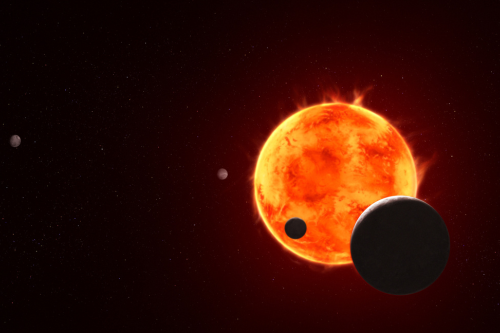
The Earth-size exoplanet TRAPPIST-1 e, depicted at the lower right, is silhouetted as it passes in front of its flaring host star in this artist’s concept of the TRAPPIST-1 system.
Image credit: NASA, ESA, CSA, J. Olmsted (STScI)

Hints of an atmosphere on TRAPPIST-1e raise hopes it could be a watery, potentially habitable world. Astronomers using the James Webb Space Telescope are unraveling the mysteries of TRAPPIST-1e, an Earth-sized exoplanet 40 light years away that could harbor liquid water. Early data suggests hints of an atmosphere, but much remains uncertain. Researchers have already ruled out a hydrogen-rich primordial atmosphere, pointing instead to the possibility of a secondary atmosphere that could sustain oceans or ice.

University of Bristol astrophysicists are helpin...

Read More
TRAPPIST-1e observations narrow down possibilities for atmosphere and surface water on elusive exoplanet

Transmission spectroscopy of the habitable zone planet TRAPPIST-1 e
Scientists call this event a transit, when valuable data can be gathered as the exoplanet passes between the star and the telescope and starlight illuminates the atmosphere, if one is present. NASA’s James Webb Space Telescope has made initial observations of planets b, c, d, and e during their transits, with additional observations of planet e underway. While the star’s frequent flares make it difficult to detect an atmosphere, each transit builds up more and more information for scientists to get a more complete picture of these distant worlds. Credit: NASA, ESA, CSA, J. Olmsted (STScI)

University of Bristol astrophysicists are helping shed new light on an Earth-sized exoplanet 40 light years away where liquid water in the form of a global ocean or icy expanse might exist on its surf...

Read More

Possible Atmospheric Destruction of a potentially Habitable Exoplanet

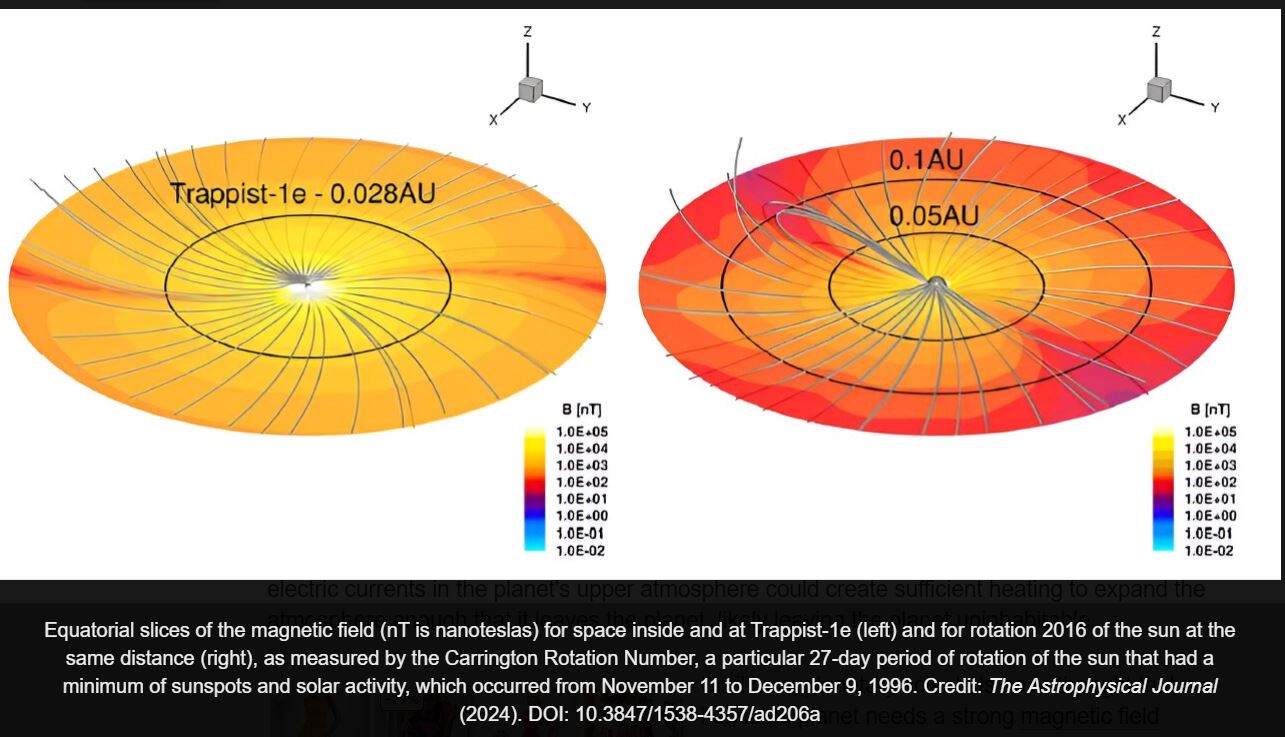
Astrophysicists studying a popular exoplanet in its star’s habitable zone have found that electric currents in the planet’s upper atmosphere could create sufficient heating to expand the atmosphere enough that it leaves the planet, likely leaving the planet uninhabitable.

Until now, planetary scientists have thought that a habitable planet needs a strong magnetic field surrounding it to act as a shield, directing ionized particles, X-rays and ultraviolet radiation in the stellar wind around and away from its atmosphere.
That’s what happens on Earth, preventing dangerous radiation from reaching life on the surface, and what does not occur on Mars, which now lacks a global magnetic field, meaning any initial inhabitants of the red planet will probably need to live in underground caves...

Read More