
V960 Mon tagged posts

Astronomers capture giant planet forming 440 light-years from Earth

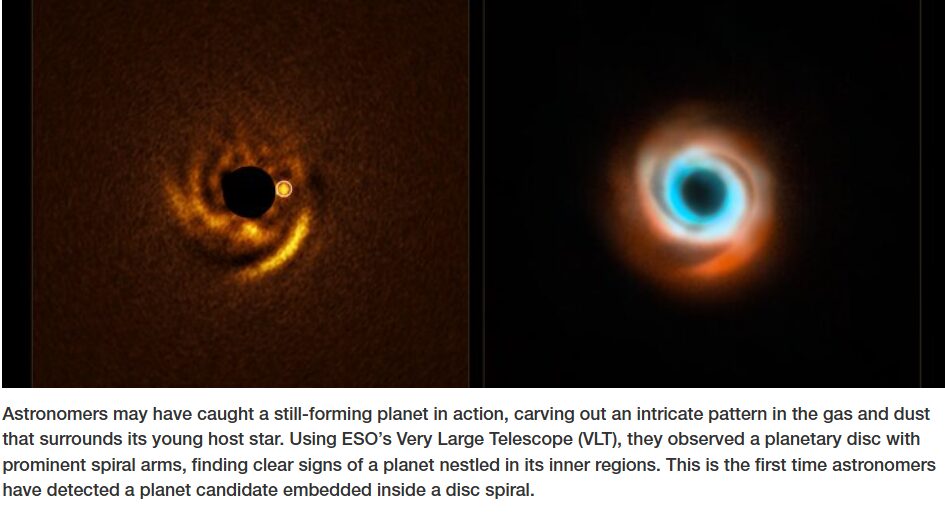
Astronomers may have caught a still-forming planet in action, carving out an intricate pattern in the gas and dust that surrounds its young host star. Using ESO’s Very Large Telescope (VLT), they observed a planetary disc with prominent spiral arms, finding clear signs of a planet nestled in its inner regions. This is the first time astronomers have detected a planet candidate embedded inside a disc spiral.

“We will never witness the formation of Earth, but here, around a young star 440 light-years away, we may be watching a planet come into existence in real time,” says Francesco Maio, a doctoral researcher at the University of Florence, Italy, and lead author of this study, published on July 21 in Astronomy & Astrophysics.

The potential planet-in-the-making was detected around...

Read More

New Image Reveals Secrets of Planet Birth

The background of this image is dark, but in its centre lurks a swirling ghostly figure, which extends towards the edge of the picture. At the very centre there is a small bright region and erupting out of it there is a poorly defined, fuzzy edged cloud and blobs of material in yellow and blue, respectively. The yellow cloud extends far out in the image, making an elongated spiral shape that gets dimmer and less defined as it reaches the top and bottom of the frame. Meanwhile, the blue blobs only extend downwards from the centre and to a fraction of the distance of the yellow spiral cloud. The blobs twist away from the central bright region, forming a tight U-shape lying on its right side.
A spectacular new image released today by the European Southern Observatory gives us clues about how planets as massive as Jupiter could form. Using ESO’s Very Large Telescope (VLT) and the Atacama Large Millimeter/submillimeter Array (ALMA), researchers have detected large dusty clumps, close to a young star, that could collapse to create giant planets.

Astronomers have gained new clues about how planets as massive as Jupiter could form. Researchers have detected large dusty clumps, close to a young star, that could collapse to create giant planets.

A spectacular new image released today by the European Southern Observatory gives us clues about how planets as massive as Jupiter could form...

Read More
