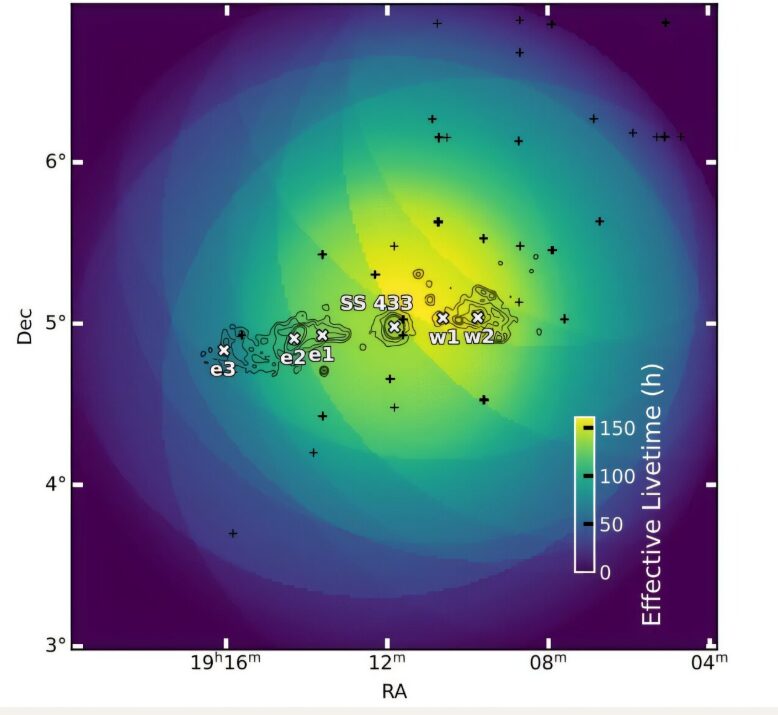
SS 433 region acceptance corrected livetime map: Computed by dividing the exposure map by the VERITAS on axis effective area evaluated at an energy of 1 TeV. The map is overlaid by black X-ray contours. The VERITAS observation pointings are indicated by black markers and SS 433, the eastern and western jet emission regions are indicated by white crosses. Credit: arXiv (2025). DOI: 10.48550/arxiv.2509.21063
Using the Very Energetic Radiation Imaging Telescope Array System (VERITAS), German astronomers have observed a unique microquasar known as SS 433. Results of the observational campaign, published Sept. 25 on the arXiv pre-print server, could help us better understand the nature and behavior of this peculiar object.
Quasars, or quasi-stellar objects (QSOs), are active galactic n...
Vast, quasi-circular features on Venus’s surface may reveal that the planet has ongoing tectonics, according to new research based on data gathered more than 30 years ago by NASA’s Magellan mission.
On Earth, the planet’s surface is continually renewed by the constant shifting and recycling of massive sections of crust, called tectonic plates, that float atop a viscous interior. Venus doesn’t have tectonic plates, but its surface is still being deformed by molten material from below.
Seeking to better understand the underlying processes driving these deformations, the researchers studied a type of feature called a corona.
Ranging in size from dozens to hundreds of miles across, a corona is most often thought to be the location where a plume of hot, buoyant material from the p...
This artist’s conception shows a blazar – the core of an active galaxy powered by a supermassive black hole. Scientists using the VERITAS array have detected gamma rays from the blazar TXS 0506+056, which is also thought to be a source of neutrinos. Credit: M. Weiss/CfA
The VERITAS array has confirmed the detection of gamma rays from the vicinity of a supermassive black hole. While these detections are relatively common for VERITAS, this black hole is potentially the first known astrophysical source of high-energy cosmic neutrinos, a type of ghostly subatomic particle.
On September 22, 2017 the IceCube Neutrino Observatory, a cubic-kilometer neutrino telescope located at the South Pole, detected a high-energy neutrino of potential astrophysical origin...
This artist’s conception shows a blazar — the core of an active galaxy powered by a supermassive black hole. The VERITAS array has detected gamma rays from a blazar known as PKS 1441+25. Researchers found that the source of the gamma rays was within the relativistic jet but surprisingly far from the galaxy’s black hole. The emitting region is at least a tenth of a light-year away, and most likely is 5 light-years away. Credit: M. Weiss/CfA
In April 2015, after traveling for about half the age of the universe, a flood of powerful gamma rays from a distant galaxy slammed into Earth’s atmosphere. That torrent generated a cascade of light – a shower that fell onto the waiting mirrors of the Very Energetic Radiation Imaging Telescope Array System (VERITAS) in Arizona...







Recent Comments