
visceral fat tagged posts

Prediabetes remission possible without dropping pounds, new study finds

<span   " href="https://www.shutterstock.com/image-photo/beautiful-overweight-woman-running-outdoors-fitness-1549708925" rel="nofollow noopener" target="_blank" data-ylk="slk:New Africa/Shutterstock.com;elm:context_link;itc:0;sec:content-canvas">New Africa/Shutterstock.com</a></span>
New Africa/Shutterstock.com

There’s a long-held belief in diabetes prevention that weight loss is the main way to lower disease risk. Our new study challenges this.

For decades, people diagnosed with prediabetes—a condition affecting up to one in three adults depending on age—have been told the same thing by their doctors: eat healthily and lose weight to avoid developing diabetes.

This approach hasn’t been working for all. Despite unchanged medical recommendations for more than 20 years, diabetes prevalence continues rising globally. Most people with prediabetes find weight-loss goals hard to reach, leaving them discouraged and still at high risk of diabetes.

Our latest research, published in Nature Medicine, reveals a different approach entirely...

Read More
A protective immune system cell disappears from a key form of fat, but only in those who are obese

A protective immune system cell disappears from a key form of fat, but only in those who are obese
Loss of Srebf2 alters VAT Treg subset composition. Credit: Science Immunology (2025). DOI: 10.1126/sciimmunol.adl4909

The mammalian immune system is an evolutionary wonder. It’s capable of recognizing and destroying cancer cells, and it can deploy armies of antibodies against viruses, bacteria, parasites and fungi.

Among the lesser-spotlighted roles of the immune system is how a particular T cell helps maintain homeostasis—fostering a balanced and stable metabolic environment—in fat cells. It’s a role that has captured the investigatory eye of an elite team of immunologists.

Having a stronger understanding of the dynamic metabolic activities and signaling pathways in fat tissue can aid new strategies to treat obesity, a major global health concern...

Read More

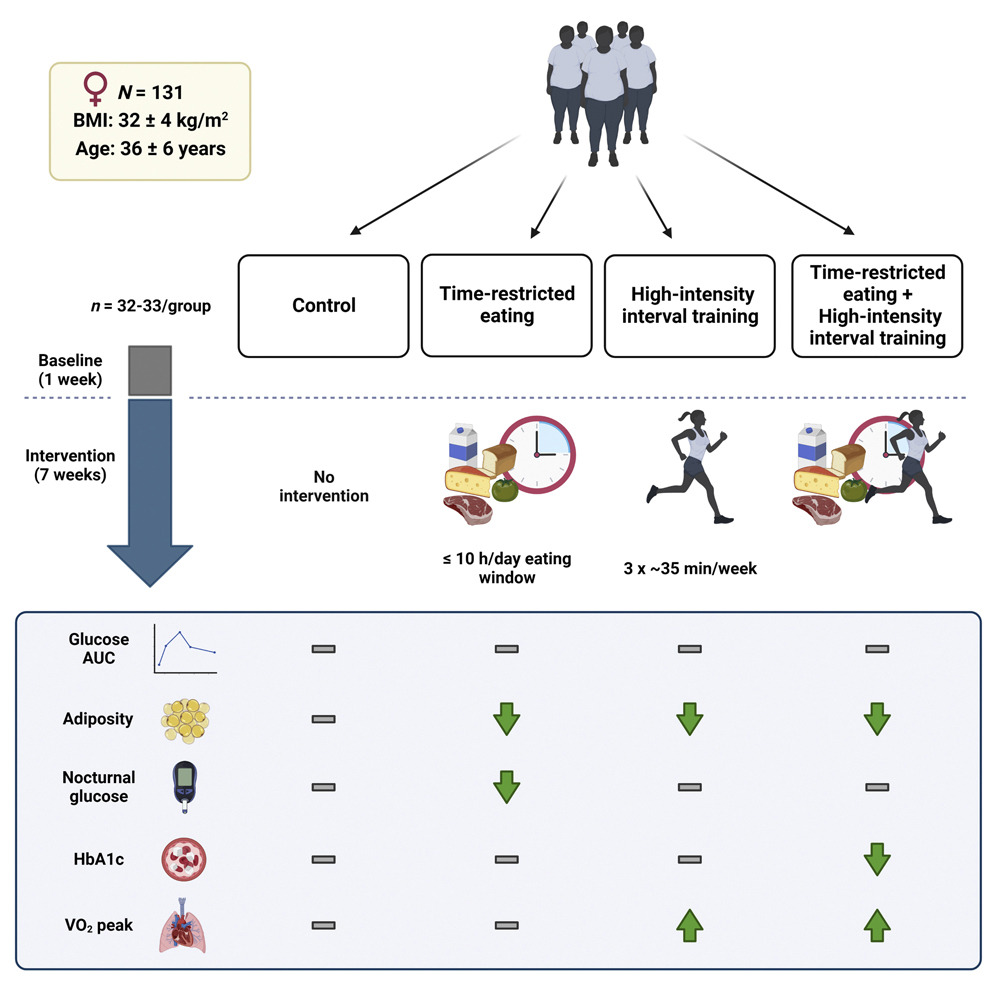
Combining Time-Restricted Eating and HIIT Improves Health Measures in Women with Obesity

Both time-restricted eating (TRE) and high-intensity interval training (HIIT) have been shown to improve cardiometabolic health in people who are overweight and at risk of serious disease. Now a randomized, controlled trial has tested whether combining these two approaches is more effective than either of them on their own. The results, publishing in the journal Cell Metabolism on October 4, show that the combination improved the average long-term glycemic control compared to a no-intervention control group and induced 2-fold greater reductions in fat mass and visceral fat area compared with each intervention in isolation.

“Isolated TRE and HIIT have received increasing attention for being effective and feasible strategies for at-risk populations,” says senior author Trine Moholdt,...

Read More

Why Belly Fat is Dangerous for the Heart

Know your risks for metabolic syndrome. Credit: Image courtesy of American College of Cardiology

Know your risks for metabolic syndrome. Credit: Image courtesy of American College of Cardiology

Increasing stomach fat – especially the “hidden fat” in your abdomen – is associated with newly identified and worsening heart disease risk factors, according to a study published in the Journal of the American College of Cardiology. These adverse changes in cardiovascular risk were evident over a relatively short period of time and persisted even after accounting for changes in body mass index (BMI) and waist circumference, two commonly used methods to estimate whether someone is a healthy weight or not.

Previous studies have shown that people who carry excess abdominal fat around their midsection -“spare tire”- tend to face higher risks of heart disease compared to people who have fat elsewhe...

Read More
