
weakly interacting massive particles (WIMPs) tagged posts

JWST may have found the Universe’s first stars powered by dark matter

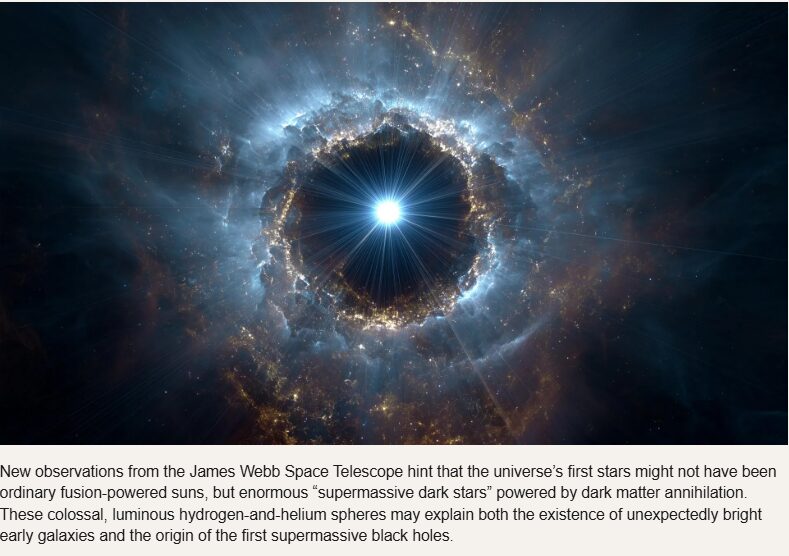
New observations from the James Webb Space Telescope hint that the universe’s first stars might not have been ordinary fusion-powered suns, but enormous “supermassive dark stars” powered by dark matter annihilation. These colossal, luminous hydrogen-and-helium spheres may explain both the existence of unexpectedly bright early galaxies and the origin of the first supermassive black holes.

In the early universe, a few hundred million years after the Big Bang, the first stars emerged from vast, untouched clouds of hydrogen and helium. Recent observations from the James Webb Space Telescope (JWST) suggest that some of these early stars may have been unlike the familiar (nuclear fusion-powered) stars that astronomers have studied for centuries...

Read More
Dark matter could make planets spin faster

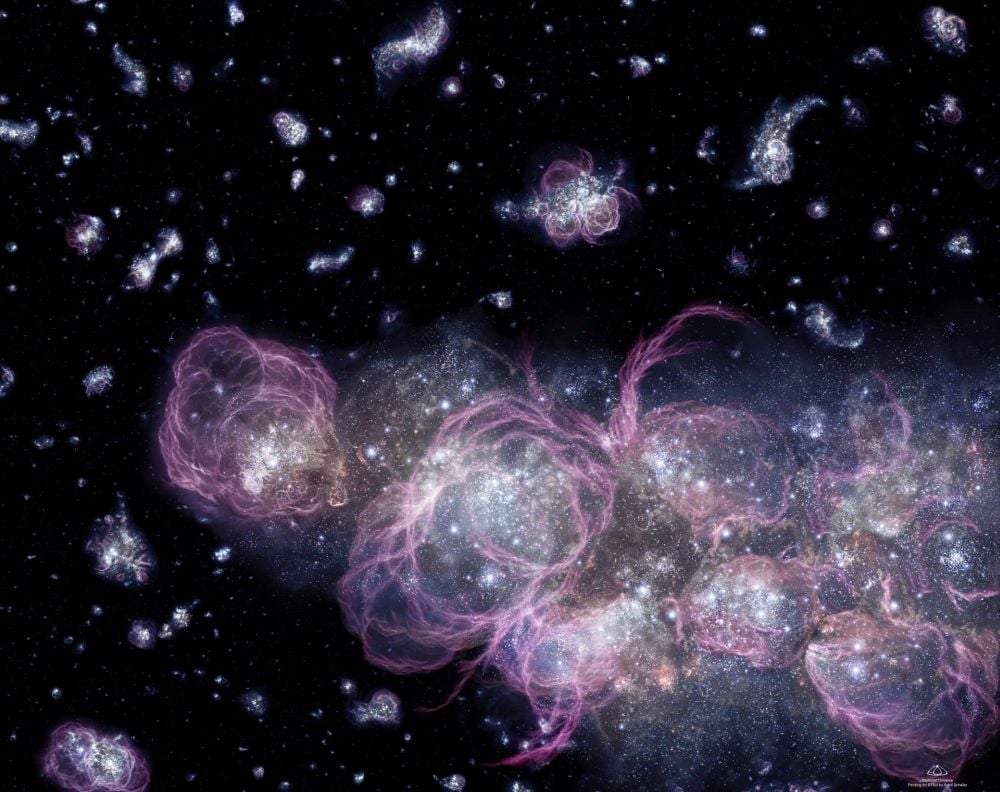
artist_s_impression_of_how_the_very_early_universe_might_have_looked_pillars.jpg

Dark matter is a confounding concept that teeters on the leading edges of cosmology and physics. We don’t know what it is or how exactly it fits into our understanding of the universe. We only know that its unseen mass is a critical part of the cosmos.

Astronomers know dark matter exists. They can tell by the way galaxies rotate, by exploiting gravitational lensing, and by analyzing fluctuations in the Cosmic Microwave Background. But new research suggests that there might be another way to detect its presence.

The research is “Dark Matter (S)pins the Planet,” and it’s available on the arXiv preprint server. Haihao Shi, from the Xinjiang Astronomical Observatory at the Chinese Academy of Sciences, is the lead author. The co-authors are all from Chinese research institutions.

Read More
