
WIMPS tagged posts

After nearly 100 years, scientists may have detected dark matter

After nearly 100 years, scientists may have detected dark matter
Gamma-ray intensity map excluding components other than the halo, spanning approximately 100 degrees in the direction of the Galactic center. The horizontal gray bar in the central region corresponds to the Galactic plane area, which was excluded from the analysis to avoid strong astrophysical radiation. Credit: Tomonori Totani, The University of Tokyo

In the early 1930s, Swiss astronomer Fritz Zwicky observed galaxies in space moving faster than their mass should allow, prompting him to infer the presence of some invisible scaffolding—dark matter—holding the galaxies together. Nearly 100 years later, NASA’s Fermi Gamma-ray Space Telescope may have provided direct evidence of dark mattner, allowing the invisible matter to be “seen” for the very first time.

The elusive nature of ...

Read More
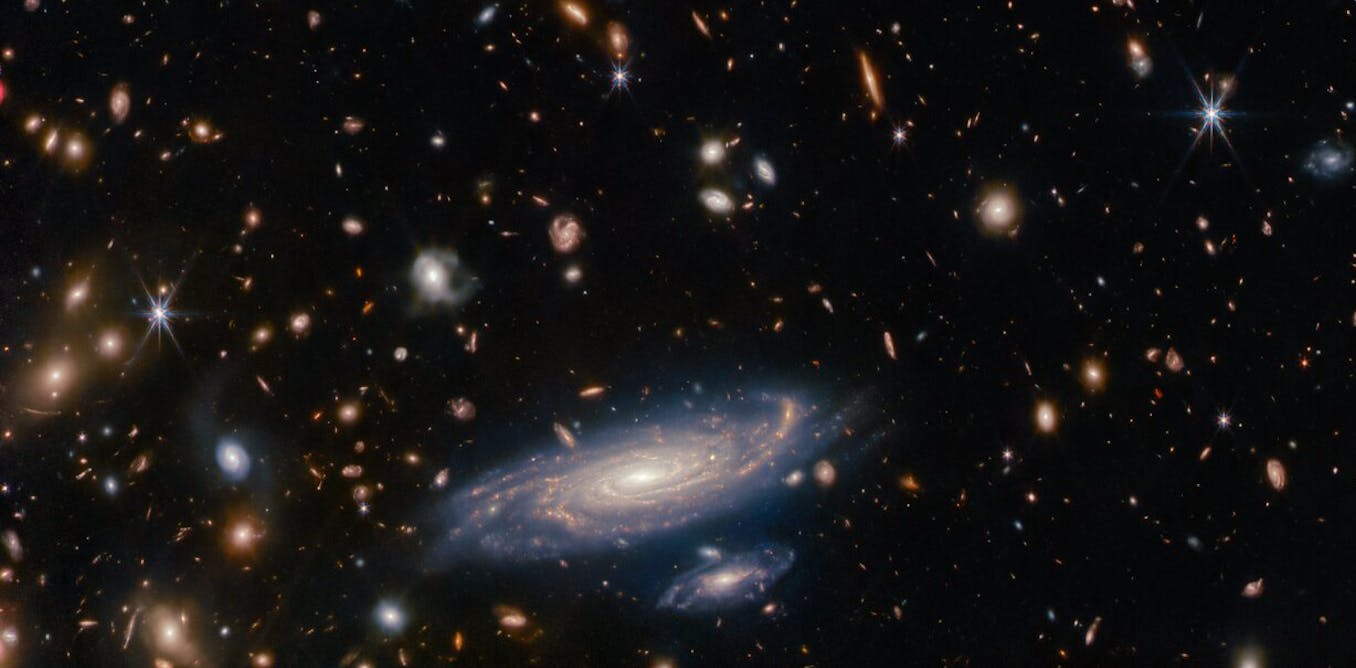
‘Dark Stars’: Dark Matter may Form Exploding Stars, and Observing the Damage could help Reveal what it’s Made of

We wouldn’t be able to see them directly, but they could be out there. ESA/Webb, NASA & CSA, A. Martel

Dark matter is a ghostly substance that astronomers have failed to detect for decades, yet which we know has an enormous influence on normal matter in the universe, such as stars and galaxies. Through the massive gravitational pull it exerts on galaxies, it spins them up, gives them an extra push along their orbits, or even rips them apart.

Like a cosmic carnival mirror, it also bends the light from distant objects to create distorted or multiple images, a process which is called gravitational lensing.

And recent research suggests it may create even more drama than this, by producing stars that explode.

For all the havoc it plays with galaxies, not much is known about whet...

Read More

MACHOs are dead, WIMPs are a no-show – say hello to SIMPs

Conventional WIMP theories predict that dark matter particles rarely interact with one another, and only weakly with normal matter. Hitoshi Murayama of UC Berkeley and Yonit Hochberg of Hebrew University predict that dark matter SIMPs, comprised of a quark and an antiquark, would collide and interact strongly with one another, producing noticeable effects when the dark matter in galaxies collide. Credit: Kavli IPMU graphic

Conventional WIMP theories predict that dark matter particles rarely interact with one another, and only weakly with normal matter. Hitoshi Murayama of UC Berkeley and Yonit Hochberg of Hebrew University predict that dark matter SIMPs, comprised of a quark and an antiquark, would collide and interact strongly with one another, producing noticeable effects when the dark matter in galaxies collide. Credit: Kavli IPMU graphic

Colliding galaxies may be evidence in support of new candidate for universe’s elusive dark matter. The nature of dark matter remains elusive, with numerous experimental searches for WIMPs coming up empty-handed and MACHOs all but abandoned...

Read More

World’s Smallest Neutrino Detector observes elusive Interactions of particles

Researchers Bjorn Scholz (left) and Grayson Rich (right) with the world's smallest neutrino detector as it's being installed along 'neutrino alley' at the Spallation Neutron Source at Oak Ridge National Laboratory in Tennessee. Credit: Juan Collar/University of Chicago

Researchers Bjorn Scholz (left) and Grayson Rich (right) with the world’s smallest neutrino detector as it’s being installed along ‘neutrino alley’ at the Spallation Neutron Source at Oak Ridge National Laboratory in Tennessee. Credit: Juan Collar/University of Chicago

Physicists play leading role in confirming theory predicted 4 decades ago. In 1974, a Fermilab physicist predicted a new way for ghostly particles called neutrinos to interact with matter. More than four decades later, a UChicago-led team of physicists built the world’s smallest neutrino detector to observe the elusive interaction for the first time. Neutrinos are a challenge to study because their interactions with matter are so rare...

Read More
