
X-ray emissions tagged posts

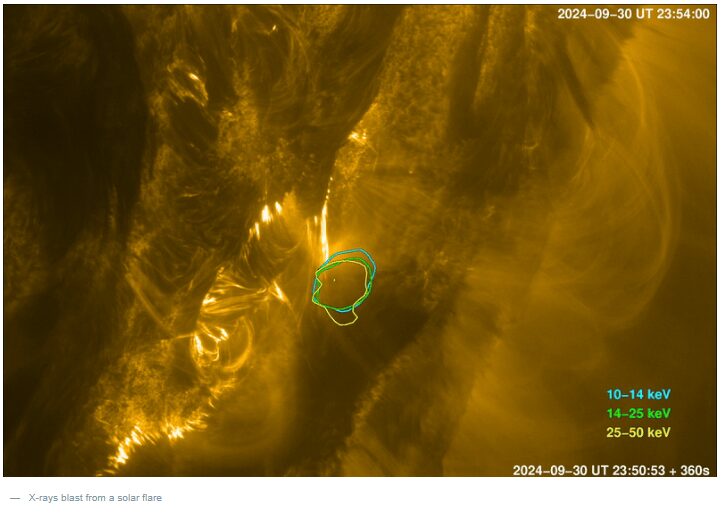
Spacecraft captures the “magnetic avalanche” that triggers giant solar explosions

New observations reveal how solar flares really ignite—and why they can be so powerful. Solar Orbiter has captured the clearest evidence yet that a solar flare grows through a cascading “magnetic avalanche.” Small, weak magnetic disturbances rapidly multiplied, triggering stronger and stronger explosions that accelerated particles to extreme speeds. The process produced streams of glowing plasma blobs that rained through the Sun’s atmosphere long after the flare itself.

Much like a snow avalanche that starts with a small shift before cascading downhill, new observations show that solar flares begin with subtle magnetic disturbances that rapidly intensify...

Read More
X-ray Emissions from Black Hole Jets Vary Unexpectedly, Challenging Leading Model of Particle Acceleration

black hole
Credit: Pixabay/CC0 Public Domain

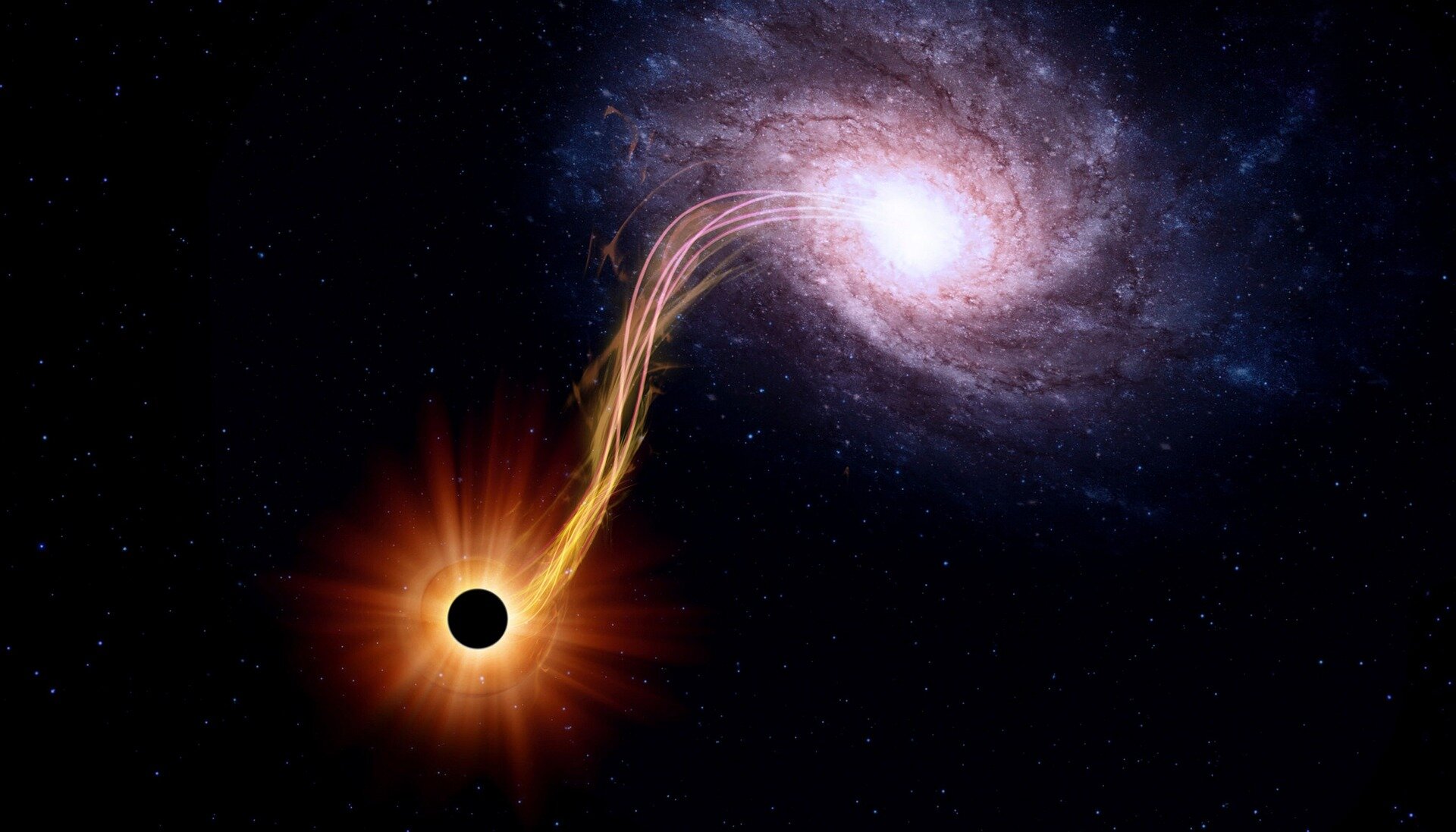
Researchers discovered only relatively recently that black hole jets emit X-rays, and how the jets accelerate particles to this high-energy state is still a mystery. Surprising new findings in Nature Astronomy appear to rule out one leading theory, opening the door to reimagining how particle acceleration works in the jets—and possibly also elsewhere in the universe.

One leading model of how jets generate X-rays expects the jets’ X-ray emissions to remain stable over long time scales (millions of years). However, the new paper found that the X-ray emissions of a statistically significant number of jets varied over just a few years.

“One of the reasons we’re excited about the variability is that there are two main models for how X-rays are produ...

Read More

This is what it looks like when a Black Hole Snacks on a Star

Illustration of a black hole shredding a star in a tidal disruption event
This illustration shows a glowing stream of material from a star, torn to shreds as it was being devoured by a supermassive black hole. The feeding black hole is surrounded by a ring of dust, not unlike the plate of a toddler is surrounded by crumbs after a meal.NASA/JPL-Caltech

While black holes and toddlers don’t seem to have much in common, they are remarkably similar in one aspect: Both are messy eaters, generating ample evidence that a meal has taken place.

But whereas one might leave behind droppings of pasta or splatters of yogurt, the other creates an aftermath of mind-boggling proportions. When a black hole gobbles up a star, it produces what astronomers call a “tidal disruption event...

Read More
