



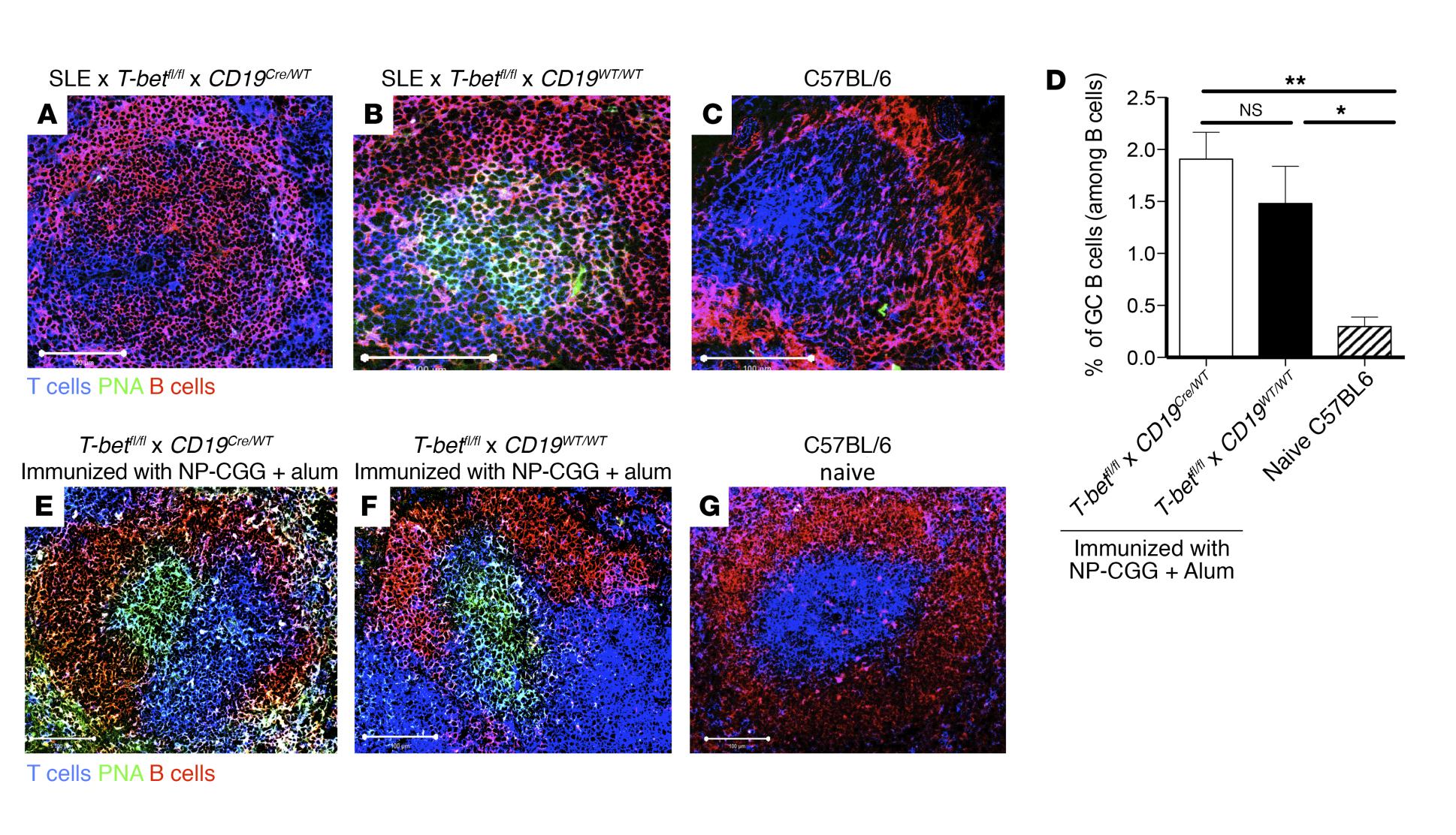
T-bet expression in B cells is required for the formation of spontaneous GCs, but is dispensable for the formation GCs following deliberate immunization. (A–C) Representative immunofluorescent staining of 5 spleen sections obtained from (A) SLE × T-betfl/fl × CD19Cre/WT, (B) SLE × T-betfl/fl × CD19WT/WT, or (C) C57BL/6 mice. (D) Percentage of GC B cells identified by FACS as B220+CD19+CD4–CD8–GL7+CD95+ and (E–G) representative immunofluorescent staining of spleens sections obtained from (E) T-betfl/fl × CD19Cre/WT, (F) T-betfl/fl × CD19WT/WT mice immunized with NP-CGG and alum (day 11) (n = 4 mice per group), or (G) naive C57BL/6 mice. n = 4 mice per group, representative of 3 independent experiments. Scale bars: 100 μm. *P < 0.05, **P < 0.01 by 1-way ANOVA followed by Newman-Keuls analysis. NS, not significant; PNA, peanut agglutinin.
Newly identified cells help explain why women suffer autoimmune disease more often than men, and suggest a therapeutic target to prevent autoimmune disease in humans. “Our findings confirm that Age-associated B Cells (ABCs) drive autoimmune disease,” said Kira Rubtsova, PhD, an instructor in biomedical science at National Jewish Health. “We demonstrated that the transcription factor T-bet inside B cells causes ABCs to develop. When we deleted T-bet inside B cells, mice prone to develop autoimmune disease remained healthy. We believe the same process occurs in humans with autoimmune disease, more often in elderly women.”
Several autoimmune diseases, including lupus, rheumatoid arthritis and multiple sclerosis strike women 2 to 10 times as often as men. Overall, about 80% of autoimmune patients are women. B cells are important players in autoimmune disease. Transcription factors bind to DNA inside cells and drive the expression of one or several genes. Researchers believe that T-bet appears inside cells when a combination of receptors on B-cell surfaces – TLR7, Interferon-gamma and the Bcell receptor – are stimulated.
Through breeding and genetic techniques the research team eliminated the ability of autoimmune-prone mice to express T-bet inside their B cells. As a result, ABCs did not appear and the mice remained healthy. Kidney damage appeared in 80% of mice with T-bet in the B cells and in only 20% of T-bet-deficient mice. 75% of mice with T-bet in their B cells died by 12 months, while 90% of T-bet-deficient mice survived 12 months.
“Our findings for the first time show that ABCs are not only associated with autoimmune disease, but actually drive it,” said Dr. Rubtsova. ABCs have attracted increasing interests since their discovery in 2011. Dr. Rubtsova and her colleagues at National Jewish Health have expanded their study of ABCs beyond autoimmune disease and are looking at their involvement in sarcoidosis, hypersensitivity pneumonitis and chronic beryllium disease. http://www.nationaljewish.org/about/mediacenter/pressreleases/2017-news/trigger-for-autoimmune-disease-identified
https://www.jci.org/articles/view/91250


Recent Comments